Home
Class 12
CHEMISTRY
How does the rate of an enzyme-catalyzed...

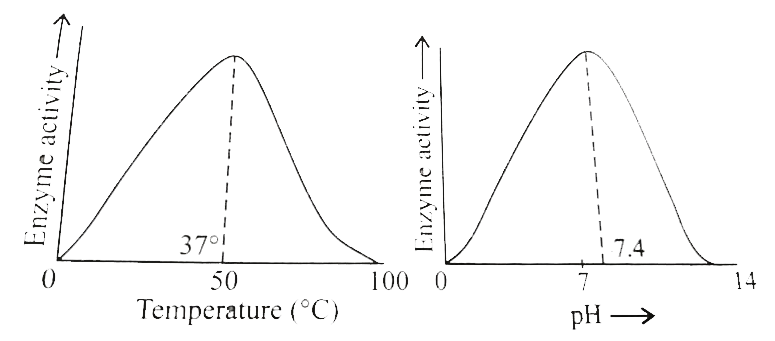
How does the rate of an enzyme-catalyzed reactions vary with `(a)` temperature and `(b)` `pH?` Represent diagrammatically.

Text Solution

Verified by Experts

As the temperature or `pH` is increased, the rate rise till it is maximum at `37^(@)C` (physiological temperature) or `pH=7.4` and then falls off (as shows in the figure).

Promotional Banner

Topper's Solved these Questions

  • SURFACE CHEMISTRY

    CENGAGE CHEMISTRY|Exercise Solved Examples|20 Videos
  • SURFACE CHEMISTRY

    CENGAGE CHEMISTRY|Exercise Ex 5.1|11 Videos
  • SOLUTIONS

    CENGAGE CHEMISTRY|Exercise Ex 2.3 (Objective)|9 Videos
  • SYNTHETIC AND NATURAL POLYMERS

    CENGAGE CHEMISTRY|Exercise Exercises Assertion Reasoning|10 Videos

Similar Questions

Explore conceptually related problems

First step of an enzyme - catalyzed reaction is

How does an enzyme catalyze a reaction ?

How does the heat increase rate of enzyme action?

At what PH range the rate of enzyme catalyzed reaction is maximum ?

How does pH affects the rate of enzyme activity?

How is the rate of enzyme-catalysed reactions affected by every 10^(@)C rise in temperature?

In a chemical reaction, enzymes catalyze the reaction by

How does the electrical conductivity of super- conductors vary with temperature ?

Which enzyme catalyzes the link reaction ?
