A
B
C
D
Text Solution
Verified by Experts
The correct Answer is:



Topper's Solved these Questions
ISOMERISM
CENGAGE CHEMISTRY|Exercise Assertion-Reasoning Type (Exercise)|5 VideosISOMERISM
CENGAGE CHEMISTRY|Exercise Fill in the blanks (Exercise)|3 VideosISOMERISM
CENGAGE CHEMISTRY|Exercise Single correct answer type|13 VideosIONIC EQUILIBRIUM
CENGAGE CHEMISTRY|Exercise Archives Subjective|28 VideosNCERT BASED EXERCISE
CENGAGE CHEMISTRY|Exercise Chemical Equilibrium|72 Videos
Similar Questions
Explore conceptually related problems
CENGAGE CHEMISTRY-ISOMERISM-Single correct answer type (Exercise)
- Which of the following hydrocarbons has the lowest dipole moment?
Text Solution
|
- The geometrical isomerism is shown by:
Text Solution
|
- The number of geometrical isomers in CH(3)CH=N-OH is
Text Solution
|
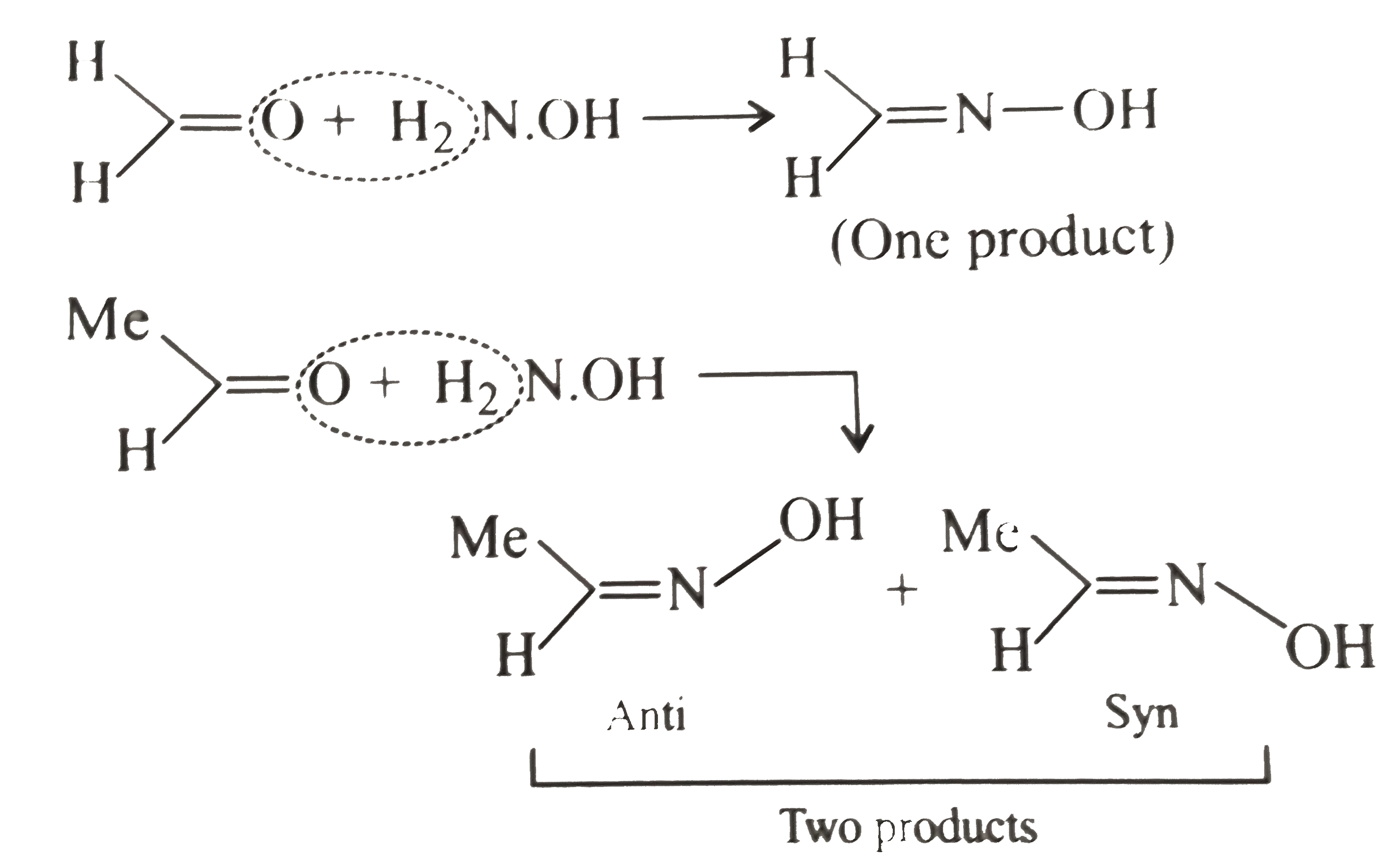
- The smallest aldehyde and its next homologue are treated with NH(2)OH ...
Text Solution
|
- What are the numerical values of N and M?
Text Solution
|
- The compound in which the distance between the two adjacent carbon ato...
Text Solution
|
- The compound which is not isomeric with diethyl ether is :
Text Solution
|
- Among the following, the compound that can be most readily sulphonated...
Text Solution
|
- Which of the following compounds will exhibit cis-trans (geometrical )...
Text Solution
|
- An isomer of ethanol is:
Text Solution
|
- Which of the following will have the least hindered rotation about car...
Text Solution
|
- The number of isomers of C(6)H(14) is:
Text Solution
|
- The enolic form of acetone contains:
Text Solution
|
- The isomers that can be interconverted through rotation around a singl...
Text Solution
|
- How many optically active stereiosomers are possible of butane 2,3 dio...
Text Solution
|
- The optically active tartaric acid is named as D-(+)- tartaric acid be...
Text Solution
|
- Which of the following compounds will exhibits geometrical isomerism ?
Text Solution
|
- The number of isomers for the compound with molecular formula C(2)BrCl...
Text Solution
|
- Which of the following compounds exhibits stereoisomerism?
Text Solution
|
- In the above compound, C(2) is rotated clockwise 120^(@) about C(2)-C(...
Text Solution
|