Home
Class 12
PHYSICS
Surface tension of a liquid is numerical...

Surface tension of a liquid is numerically equal to

Text Solution

Verified by Experts
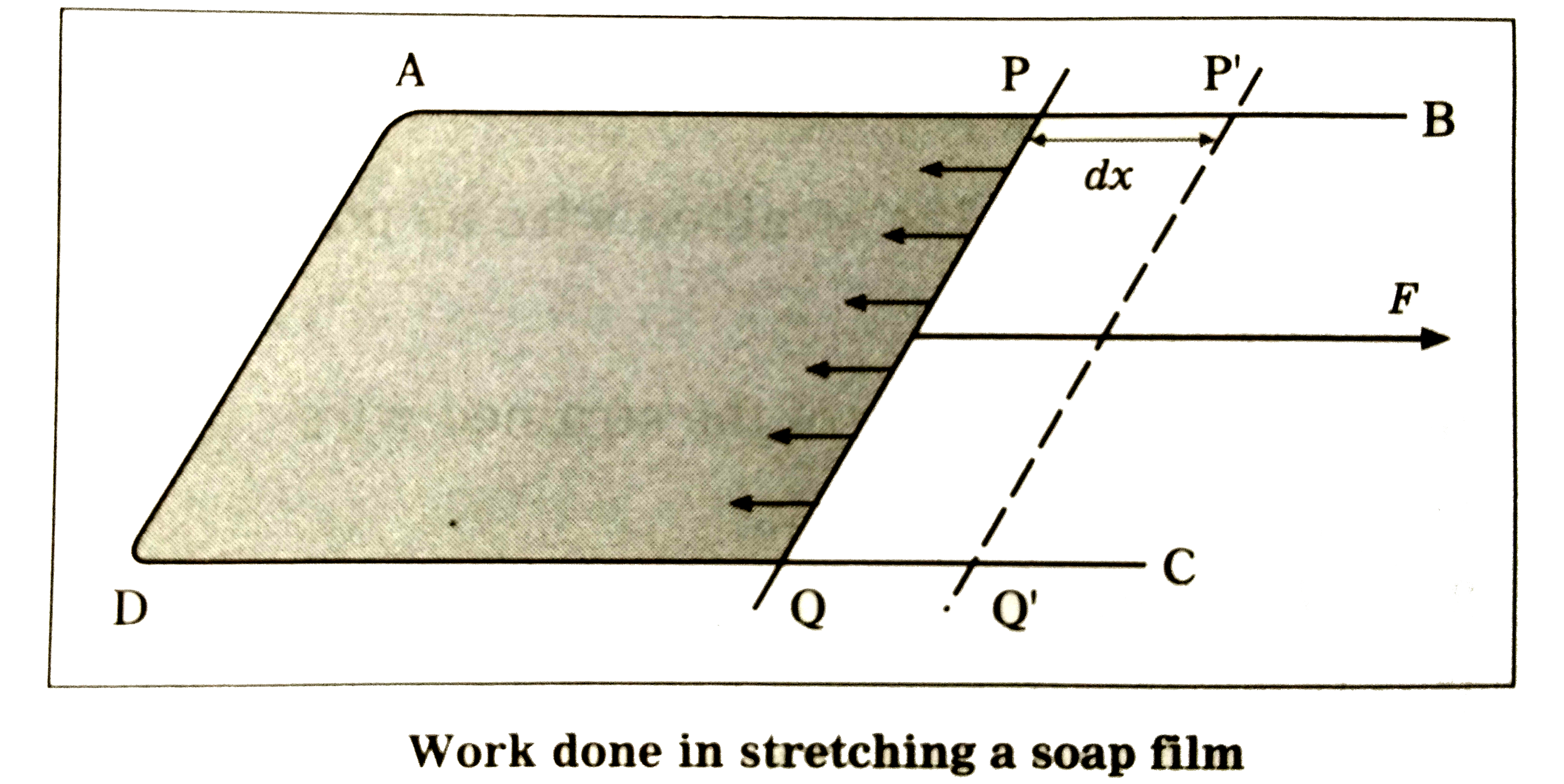
Suppose a soap film is isothermally stretched over the area enclosed by a U-shaped frame ABCD and a movable cros-piece PQ. as shown in the figure. Let T be the surface tension of the soap solution and l, the length of wire PQ in contact with the soap film.
The film has two sufaces. Hence, the net force on the wire PQ is 2T l.Suppose that wire PQ is pulled outward very slowly through a distance dx to the position P'Q' by an extrenal force F=2T l.

The work done by the extrenal force against the force due to the film is
W=applied force `xx`displacement
`:. W=Fdx=2Tl dx`
Due to the displacement dx, the surface area of the film increases by
A=2ldx
Thus, the work done per unit surface area is
`(W)/(A)=(2Tl dx)/(2l dx)=T`
This work is stored in the unit surface area of the liquid in the form of potential energy and is called the surface. Thus, the surface energy per unit area of a liquid is equal to its surface tension.
Promotional Banner

Topper's Solved these Questions

  • DERIVATIONS-I

    NAVNEET PUBLICATION - MAHARASHTRA BOARD|Exercise Wave Motion|2 Videos
  • DERIVATIONS-I

    NAVNEET PUBLICATION - MAHARASHTRA BOARD|Exercise Stationary Waves|5 Videos
  • DERIVATIONS-I

    NAVNEET PUBLICATION - MAHARASHTRA BOARD|Exercise Elasticity|2 Videos
  • DEFINITIONS

    NAVNEET PUBLICATION - MAHARASHTRA BOARD|Exercise COMMUNICATION SYSTEMS|3 Videos
  • DERIVATIONS-II

    NAVNEET PUBLICATION - MAHARASHTRA BOARD|Exercise Assignments|9 Videos

Similar Questions

Explore conceptually related problems

Surface tension in a liquid is due to :

Define surface energy. Prove that it is numerically equal to the surface tension.

Surface tension of a liquid depends upon .

Surface tension of a liquid is a molecular phenomenon of liquids involving the force of cohesion among the liquid molecules. It is a scalar quantity and numerically equal to the surface energy. Numerically, it is proved that the potential enenergy of a liquid is maximum on the surface. Sparingly soluble salts and surface active substances decrease the surface tension of the liquid, however, the fairly soluble solute increase is independent of surface area but if depends on the intermolecular force and the temperature. Surface tension of a liquid is zero at:

Surface tension of a liquid is a molecular phenomenon of liquids involving the force of cohesion among the liquid molecules. It is a scalar quantity and numerically equal to the surface energy. Numerically, it is proved that the potential enenergy of a liquid is maximum on the surface. Sparingly soluble salts and surface active substances decrease the surface tension of the liquid, however, the fairly soluble solute increase is independent of surface area but if depends on the intermolecular force and the temperature. Surface tension of a liquid does not depend on :

Surface tension of a liquid is a molecular phenomenon of liquids involving the force of cohension along the liquid molecules. It is scalar quantity and is numberically equal to the surface energy. Numerically, it is proved that the potential soluble salts and surfce active substance. Sparingly soluble salts and surface acitve substances decrease the surface tension of the liquid. However, the fairly soluble solutes increase the surface tension of the liquid. Surface tension of a liquid is independent of surface area but it depends on the intemolecular forces and the temperature. Which among the following is not the unit of surface tension ?

Surface tension of a liquid is a molecular phenomenon of liquids involving the force of cohesion among the liquid molecules. It is a scalar quantity and numerically equal to the surface energy. Numerically, it is proved that the potential enenergy of a liquid is maximum on the surface. Sparingly soluble salts and surface active substances decrease the surface tension of the liquid, however, the fairly soluble solute increase is independent of surface area but if depends on the intermolecular force and the temperature. Which of the following has the highest surface tension ?

