Home
Class 11
PHYSICS
Find the resultant of the three vectors ...

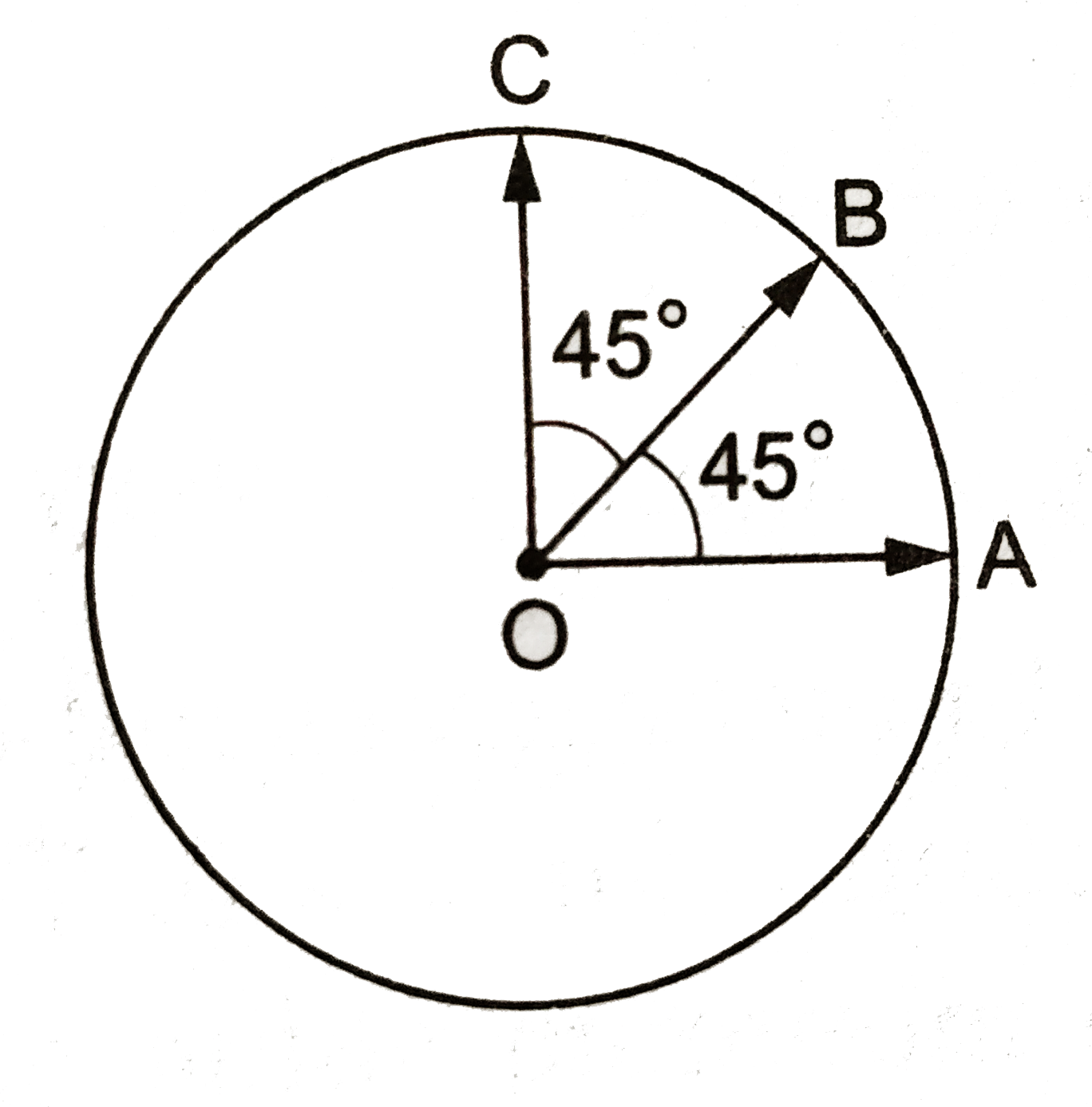
Find the resultant of the three vectors `vec(OA), vec(OB)` and `vec(OC)` shown in figure. Radius of the circle is R.

A

`r`

B

`2r`

C

`r(1+sqrt(2))`

D

`r(sqrt(2))`

Text Solution

Verified by Experts

The correct Answer is:
C

`vec(OC)` and `vec(OA)` are equal in magnitude and inclined to each other at an angle of `90^(@)`, So their resultant is `sqrt(2)r`. It acts mid-way between `vec(OC)` and `vec(OA)`,i.e., along OB.
Now, both `r` and `sqrt(2)r` are along the same line and in the same direction.
Resultant `=r+sqrt(2)r=r(1+sqrt(2))`
Promotional Banner

Topper's Solved these Questions

  • VECTORS

    CENGAGE PHYSICS|Exercise Exercise Multiple Correct|5 Videos
  • VECTORS

    CENGAGE PHYSICS|Exercise Exercise Subjective|28 Videos
  • TRAVELLING WAVES

    CENGAGE PHYSICS|Exercise Integer|9 Videos
  • WORK, POWER & ENERGY

    CENGAGE PHYSICS|Exercise Archives (integer)|4 Videos

Similar Questions

Explore conceptually related problems

The resultant of the three vectors vec(OA), vec(OB) and vec(OC) shown in figure is

Find the resultant of the three vectors vec OA,vec OB and vec OC each of magnitude r as shown in figure?

What is the angle between the vector vec(A) and vec(B) as shown in figure ?

The resultant of vectors vec(OA) and vec(OB) is peerpendicular to vec(OA). Find the angle AOB.

The magnitude of vectors vec(OA), vec(OB) and vec (OC) in figure are equal. Find the direction of vec(OA)+vec(OB)-vec(OC) . .

The resultant of two velocity vectors vec(A) and vec(B) is perpendicular to vec(A) . Magnitude of Resultant vec(R ) is equal to half magnitude of vec(B) . If the angle between vec(A) and vec(B) is (30 theta)^(@) , then value of theta is ?

The resultant of two vectors vec(A) and vec(B) is perpendicular to the vector vec(A) and its magnitudes is equal to half of the magnitudes of vector vec(B) (figure). The angle between vec(A) and vec(B) is

The magnitudes of vectors vec OA,vec OB and vec OC( in figure( 2-W3) are equal.Find the direction of )/(Ovec A)+vec OB-vec OC.

The sum of the three vectors shown in figure is zero. Find the magnitudes of the vectors vec(OB) and vec(OC) .

ABCD is a quadrilateral and E is the point of intersection of the lines joining the middle points of opposite side. Show that the resultant of vec (OA) , vec(OB) , vec(OC) and vec(OD) = 4 vec(OE) , where O is any point.

CENGAGE PHYSICS-VECTORS-Exercise Single Correct
  1. Mark the correct statement.

    Text Solution

    |

  2. Out of the following forces, the resultant of which cannot be 10N?

    Text Solution

    |

  3. Which of the following pairs of forces cannot be added to give a resul...

    Text Solution

    |

  4. In an equilateral triangle ABC, AL, BM, and CN are medians. Forces alo...

    Text Solution

    |

  5. The sum of two vectors A and B is at right angles to their difference....

    Text Solution

    |

  6. If a parallelogram is formed with two sides represented by vector vec(...

    Text Solution

    |

  7. Given that vec(A)+vec(B)=vec(C ) and that vec(C ) is perpendicular to ...

    Text Solution

    |

  8. Two forces vec(F)(1)=500N due east and vec(F)(2)=250N due north have t...

    Text Solution

    |

  9. Find the resultant of the three vectors vec(OA), vec(OB) and vec(OC) s...

    Text Solution

    |

  10. Two vectors vec(a) and vec(b) are at an angle of 60^(@) with each othe...

    Text Solution

    |

  11. The resultant of two vectors vec(P) and vec(Q) is vec(R ). If the magn...

    Text Solution

    |

  12. A vector vec(A) When added to the vector vec(B)=3hat(i)+4hat(j) yields...

    Text Solution

    |

  13. ABCDEF is a regular hexagon with point O as centre. The value of vec(A...

    Text Solution

    |

  14. In a two diamensional motion of a particle, the particle moves from po...

    Text Solution

    |

  15. The sum of two forces at a point is 16N. if their resultant is normal...

    Text Solution

    |

  16. The angle between two vector A and B is theta. Vector R is the resulta...

    Text Solution

    |

  17. The resultant of three vectors 1,2, and 3 units whose directions are t...

    Text Solution

    |

  18. A unit vector along the incident ray of light is hat(i). The unit vect...

    Text Solution

    |

  19. The components of a vector along the x- and y- directions are (n+1) an...

    Text Solution

    |

  20. Two point masses 1 and 2 move with uniform velocities vec(v)(1) and ve...

    Text Solution

    |

