Home
Class 11
PHYSICS
Two point masses 1 and 2 move with unifo...

Two point masses 1 and 2 move with uniform velocities `vec(v)_(1)` and `vec(v)_(2)`, respectively. Their initial position vectors are `vec(r )_(1)` and `vec(r )_(2)`, respectively. Which of the following should be satisfied for the collision of the point masses?

A

`(vec(r )_(1)-vec(r )_(2))/(|vec(r )_(2)-vec(r )_(1)|)=(vec(v)_(2)-vec(v)_(1))/(|vec(v)_(2)-vec(v)_(1)|)`

B

`(vec(r )_(2)-vec(r )_(1))/(|vec(r )_(2)-vec(r )_(1)|)=(vec(v)_(2)-vec(v)_(1))/(|vec(v)_(2)-vec(v)_(1)|)`

C

`(vec(r)_(2)-vec(r )_(1))/(|vec(r )_(2)+vec(r )_(1)|)=(vec(v)_(2)-vec(v)_(1))/(|vec(v)_(2)+vec(v)_(1)|)`

D

`(vec(r)_(2)-vec(r )_(1))/(|vec(r )_(2)+vec(r )_(1)|)=(vec(v)_(2)-vec(v)_(1))/(|vec(v)_(2)+vec(v)_(1)|)`

Text Solution

Verified by Experts

The correct Answer is:
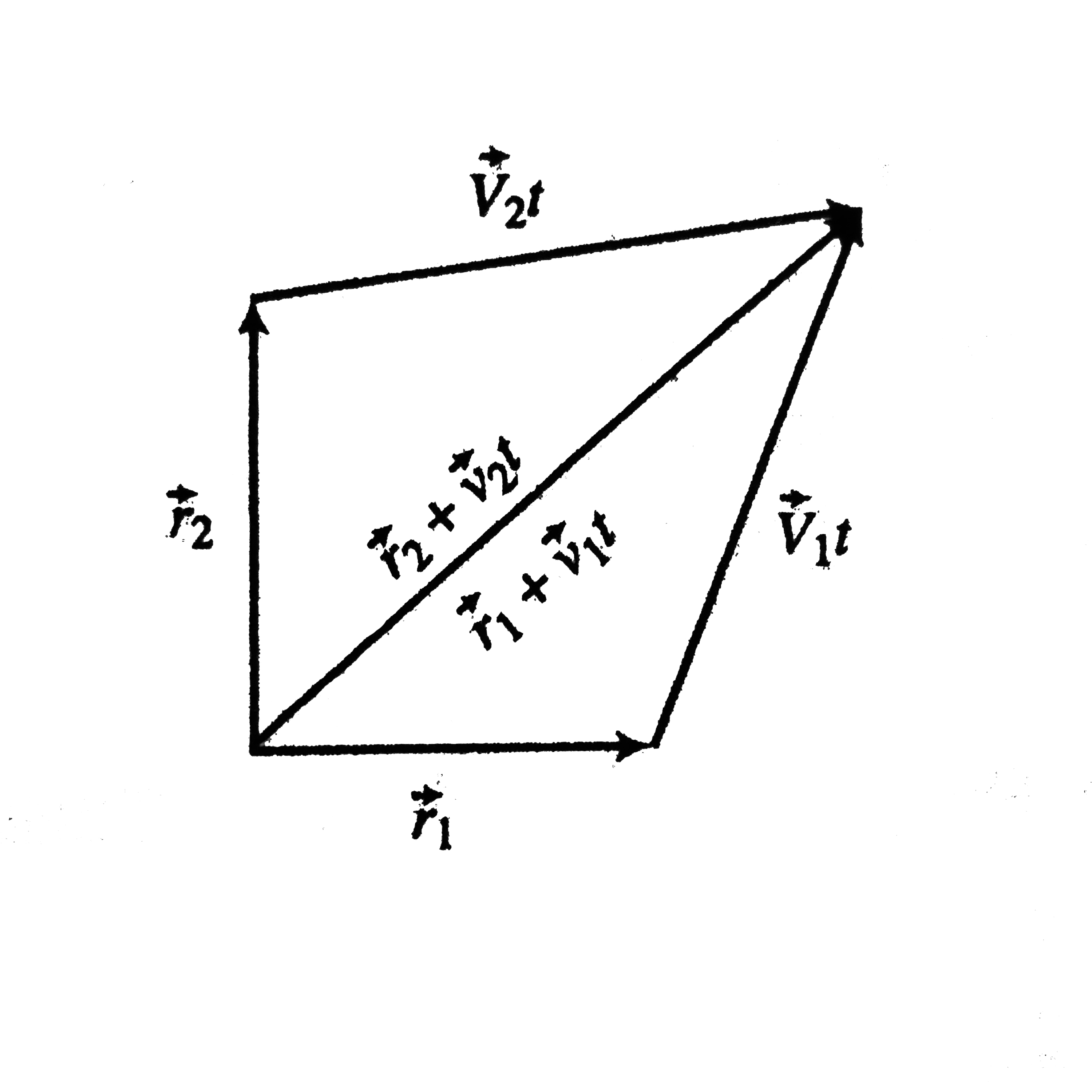
B

For collision,

`vec(r )_(1)+vec(v)_(1)t=vec(r )_(2)+vec(v)_(2)t`
or `vec(r )_(1)-vec(r )_(2)=(vec(v)_(2)-vec(v)_(1))t`
Equating unit vectors, we get
`(vec(r )_(1)-vec(r )_(2))/(|vec(r )_(2)-vec(r )_(1)|)=(vec(v)_(2)-vec(v)_(1))/(|vec(v)_(2)-vec(v)_(1)|)`
Promotional Banner

Topper's Solved these Questions

  • VECTORS

    CENGAGE PHYSICS|Exercise Exercise Multiple Correct|5 Videos
  • VECTORS

    CENGAGE PHYSICS|Exercise Exercise Subjective|28 Videos
  • TRAVELLING WAVES

    CENGAGE PHYSICS|Exercise Integer|9 Videos
  • WORK, POWER & ENERGY

    CENGAGE PHYSICS|Exercise Archives (integer)|4 Videos

Similar Questions

Explore conceptually related problems

Two particles A and B, move with constant velocities vec(v_(1))" and "vec(v_(2)) . At the initial moment their position vectors are vec(r_(1))" and "vec(r_(2)) respectively. The condition for particle A and B for their collision is

If two bodies are in motion with velocity vec(v)_(1) and vec(v)_(2) :

Two particles of masses m_(1) and m_(2) in projectile motion have velocities vec(v)_(1) and vec(v)_(2) , respectively , at time t = 0 . They collide at time t_(0) . Their velocities become vec(v')_(1) and vec(v')_(2) at time 2 t_(0) while still moving in air. The value of |(m_(1) vec(v')_(1) + m_(2) vec(v')_(2)) - (m_(1) vec(v)_(1) + m_(2) vec(v)_(2))|

Two particles 1 and 2 move with velocities vec v_1 and vec v_2 making the angles theta_1 and theta_2 with the line joining them, respectively. Find angular velocity of relative to 1 . .

Let vec(a) and vec(b) be the position vectors of A and B respectively. If C is the point 3 vec(a)-2vec(b) , then which one of the following is correct?

Let vec(a) and vec(b) be the position vectors of A and B respectively. If C is the point 3 vec(a) - 2vec(b) , then which one of the following is correct?

A and B are two points with position vectors 2vec(a)-3vec(b) and 6vec(b)-vec(a) respectively. Write the position vector of a point, which divides the line segment AB internally in the ratio 1 : 2.

L and M are two points with position vectors 2vec(a)-vec(b)andvec(a)+2vec(b) , respectively. The position vector of the pont N which divides the line segment LM in the ratio 2:1 externally is

Two particles moving initially in the same direction undergo a one- dimensional , elastic collision . Their relative velocities before and after the collision are vec(v_(1)) and vec(v_(2)) . Which of the following is not correct?

CENGAGE PHYSICS-VECTORS-Exercise Single Correct
  1. Mark the correct statement.

    Text Solution

    |

  2. Out of the following forces, the resultant of which cannot be 10N?

    Text Solution

    |

  3. Which of the following pairs of forces cannot be added to give a resul...

    Text Solution

    |

  4. In an equilateral triangle ABC, AL, BM, and CN are medians. Forces alo...

    Text Solution

    |

  5. The sum of two vectors A and B is at right angles to their difference....

    Text Solution

    |

  6. If a parallelogram is formed with two sides represented by vector vec(...

    Text Solution

    |

  7. Given that vec(A)+vec(B)=vec(C ) and that vec(C ) is perpendicular to ...

    Text Solution

    |

  8. Two forces vec(F)(1)=500N due east and vec(F)(2)=250N due north have t...

    Text Solution

    |

  9. Find the resultant of the three vectors vec(OA), vec(OB) and vec(OC) s...

    Text Solution

    |

  10. Two vectors vec(a) and vec(b) are at an angle of 60^(@) with each othe...

    Text Solution

    |

  11. The resultant of two vectors vec(P) and vec(Q) is vec(R ). If the magn...

    Text Solution

    |

  12. A vector vec(A) When added to the vector vec(B)=3hat(i)+4hat(j) yields...

    Text Solution

    |

  13. ABCDEF is a regular hexagon with point O as centre. The value of vec(A...

    Text Solution

    |

  14. In a two diamensional motion of a particle, the particle moves from po...

    Text Solution

    |

  15. The sum of two forces at a point is 16N. if their resultant is normal...

    Text Solution

    |

  16. The angle between two vector A and B is theta. Vector R is the resulta...

    Text Solution

    |

  17. The resultant of three vectors 1,2, and 3 units whose directions are t...

    Text Solution

    |

  18. A unit vector along the incident ray of light is hat(i). The unit vect...

    Text Solution

    |

  19. The components of a vector along the x- and y- directions are (n+1) an...

    Text Solution

    |

  20. Two point masses 1 and 2 move with uniform velocities vec(v)(1) and ve...

    Text Solution

    |

