Home
Class 11
PHYSICS
(a) Show that the velocity acquired by a...

(a) Show that the velocity acquired by a particle in sliding down an inclined plane is the same as that acquired by a particle falling freely from frst though a distance equal to the height of the inclined plane. (b) Find the time taken in sliding a particle down the whole length of the incline.

Text Solution

Verified by Experts
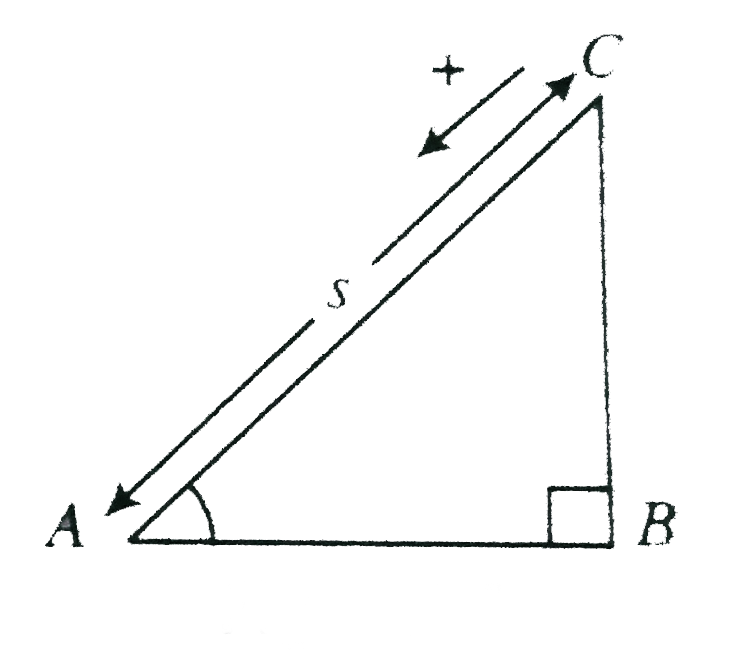
Let a particle sliding from `c` to `A` along the inclined plance`CA` acquire a final velocity `v_(1)`, comering a distance `s` .
If `theta` is the angle of inlination, then
`sin theta =(h)/(s)`
.
Now for the sliding particle, `s=s,u=0,a=g sin theta, v=v_(1)`.
[Taking the direction `C` to `A` as positive]
Using, `v^(2)u^(2)+2as`
`rArr v_(1)^(2) =2(g sin rheta)s =2g[(h)/(s)]s=2 gh`
`becuase v_(1) =sqrt2gh`
Again, let aparticle fall from rest along a distance `h` and acquire a velocity `v_(2)`, then from `v^(2)=u^(2)+2as`,
`v_(2)^(2)=0+2 gh rArr v_(2)=sqrt 2gh` (ii)`
From (i) and (ii), we get the same result.
b. Time take in sliding a particle down the entire length of the incline:
For the motion of particle from C to A `u=0`,
`s=s, a=g sin theta, t=`?.
Using `s=ut+(1)/(2) a t^(2)`, we get `s=(1)/(2)(g sin theta) t^(2)`
`rArr (t^(2)=(2s)/(g sin theta)=(2h)/(g sin^(2) theta)` [becuase sin theta=(h)/(s)]
`becuase t= sqrt(2h)/(g) cos theta`
Thus, the time take varies directly ad the cosecant of the angle of incliation. Now, since cosecant is a dectrasing function in the first quadrant with an increase in `theta` time `t` would decrease.
Promotional Banner

Topper's Solved these Questions

  • KINEMATICS-1

    CENGAGE PHYSICS|Exercise Solved Examples|9 Videos
  • KINEMATICS-1

    CENGAGE PHYSICS|Exercise Exercise 4.1|17 Videos
  • GRAVITATION

    CENGAGE PHYSICS|Exercise INTEGER_TYPE|1 Videos
  • KINEMATICS-2

    CENGAGE PHYSICS|Exercise Exercise Integer|9 Videos

Similar Questions

Explore conceptually related problems

The time taken by a particle to slide down a smooth inclined plane is double the time it would take in falling down through a height equal to the vertical height of the plane. The inclination of the plane with horizontal is :

An object start sliding on a frictionless inclined plane and from same height another object start falling freely

A particle slides down a smooth in clined plane of elevation theta fixed in an elevastor going up with an acceleration a_0 . The base of the incline has a length L.Find the time taken by the particle to reach the bottom.

A block slides down a smooth inclined plane when released from the top, while another falls freely from the same point :

A particle slides down a smooth inclined plane of elevation , fixed in an elevator going up with an acceleration a0 (figure). The base of the incline has a length L. Find the time taken by the particle to reach to the bottom -

A particle slides down a smooth inclined plane of elevation theta fixed in a elevator going up with an acceleration a_(0) . The base of the inline has a length L.

A body sliding down on a smooth inclined plane slides down 1//4th distane in 2s. I will slide down the complete plane in

A body is sliding down an inclined plane (mu = (1)/(2)) . If the normal reaction is twice that of the resultant downward force along the incline , the inclination of plane is

A body is sliding down an inclined plane having coefficient of friction 0.5. If the normal reaction is twice that of resultant downward force along the inclined plane, then find the angle between the inclined plane and the horizontal .

A particle is attached with a string of length l which is fixed at point O on an inclined plane what minimum velocity should be given to the particle along the incline so that it may complete a circle on inclined plane ( plane is smooth and initially particle was resting on the inclined plane . )

