Home
Class 11
PHYSICS
Two cars 1 and 2 move with velocities v(...

Two cars `1` and `2` move with velocities `v_(1)` and `v_(2)`, respectively, on a straight road in same direction When the crs are separated by a destance `d` the driver of car `1` applies brakes and the car moves with uniform retardation `a_(1)`, Simultaneously, car `2` starts accelerating with `a_(2)`, If `v_(1) lt v_(2)`, find the minimum initial separation between the cars to avoid collision between then.

Text Solution

Verified by Experts
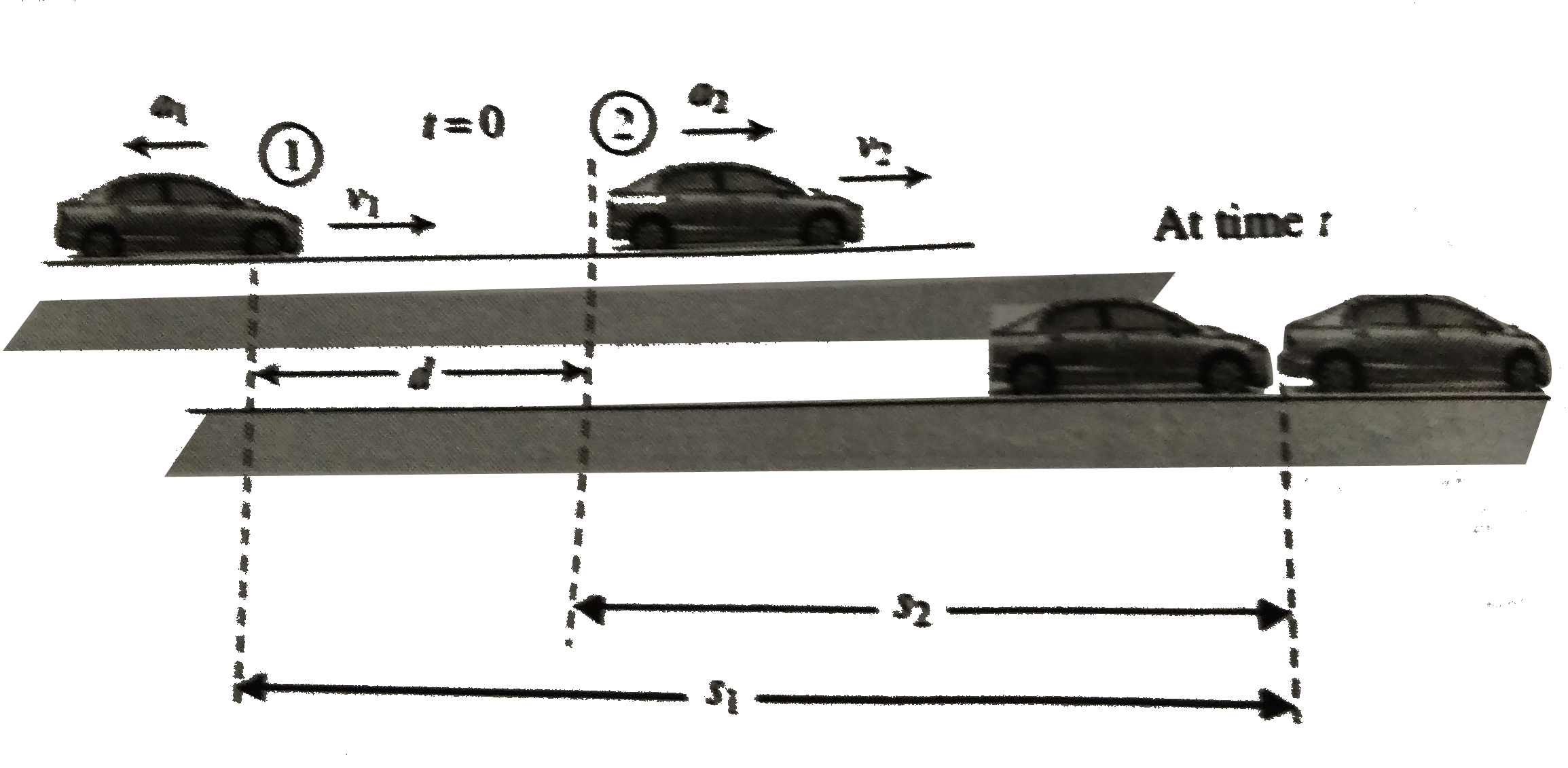
Method 1: Let assume that the cars udergo displacements `s_(1)` and `s_(2)` aftre a time `t` from the instant of beaking.
From , `s_(1)-s_(2)=d` …(i)
where `s_(1)=v_(1)t-(1)/(2) a_(1)t^(2)` (ii)
.
and `s_(2)t+(1)/(2)a_(1)t^(2)` ...(iii)
Using (i), and (ii), we have
`(v_(1)t-(1)/(2) a_(1)t^(2))-(v_(2)t+(1)/(2)+(1)/(2)a_(1)t_(2))=d`
or `(a_(1)+a_(2))t^(2)-2)(v_(1)-v_(2))t+2d=0`
Which is quadratic equation in `t`, solving for `t`
This gives `t=(v_(1)-v_(2)+-sqrt((v_(1)-v_(2))^(2)-2(a_(1)(a1+a_(2)) (d)/(a_(1)+as_(2))`
If cars do not collede, `b^(2)-4ac lt 0`
`((v_(1)-v_(2))^(2))/(2(a_(1)+a_(2))`
Hence, `d_(min)=((v_(1)-v_(2)))^(2)/(2(a_(1)+a_(2))`
Method 2: Relative velocity apparoach
Using `v_(ret)^(2)=u_(ret)^(2)+2a_(rel).s_(rel)` We n obtain the same result.
Substitute: `v_(rel)=v'_(12)=v'_(12)-v'_(2), u_(rel)=v_(1)-v_(2)`,
`a_(rel)=a_(12)=(-a_(1))-a_(1)=-(a_(1)+a_(2))` and `s_(rel)=s_(12) =-d`,
to obtaion `(v'_(1)-v'_(2)=(v_(1)-v_(2))^(2)-2(a(a_(1)+a_(2))d`
Since `v'_(1)ltv'_(2)` to avoid collision, we have
`d=((v_(1)-v_(2)^(2)-(v'_(21)-v'_(2))^(2)/(2(a_(1)+a_(2))`
Maximum distance (d) for collistion is possible when `v'_(1)=v`_(2),
the, `d_(max)=((v_(1)-v_(2)))^(2)`.
Promotional Banner

Topper's Solved these Questions

  • KINEMATICS-1

    CENGAGE PHYSICS|Exercise Solved Examples|9 Videos
  • KINEMATICS-1

    CENGAGE PHYSICS|Exercise Exercise 4.1|17 Videos
  • GRAVITATION

    CENGAGE PHYSICS|Exercise INTEGER_TYPE|1 Videos
  • KINEMATICS-2

    CENGAGE PHYSICS|Exercise Exercise Integer|9 Videos

Similar Questions

Explore conceptually related problems

Two cars of same mass are moving with velocities v_(1) and v_(2) respectively. If they are stopped by supplying same breaking power in time t_(1) and t_(2) respectively then (v_(1))/(v_(2)) is

Two car A and B travelling in the same direction with velocities v_1 and v_2(v_1 gt v_2) . When the car A is at a distance d ahead of the car B , the driver of the car A applied the brake producing a uniform retardation a . There wil be no collision when.

Two cars A and B are moving in same direction with velocities 30 m/s and 20 m/s. When car A is at a distance d behind the car B, the driver of the car A applies brakes producing uniform retardation of 2m//s^(2) . There will be no collision when :-

Two cars, A and B, are traveling in the same direction with velocities v_(a) and v_(b) respectively. When car is at a distance d behind car B, the brakes on A are applied, causing a deceleration at a rate a. Show that to prevent a collision between A and B it is necessary that:

Two cars C_(1) and C_(2) are moving on parallel roads in the same direction with velocity v. The relative of C_(1) w.r.t. C_(2) is :

Two trains are moving with velocities v_1 = 10 ms^-1 and v_2 = 20 ms^-1 on the same track in opposite directions. After the application of brakes if their retarding rates are a_1 = 2 ms^-2 and a_2 = 1 ms^-2 respectively, then the minimum distance of separation between the trains to avoid collision is

A car moving with speed v on a straight road can be stopped with in distance d on applying brakes. If same car is moving with speed 3v and brakes provide half retardation, then car will stop after travelling distance

A bird flies to and fro between two cars wich move with velocities v_(1) and v_(2) , If the speed of the bird is v_(3) and the initial distance ofseparation between then is d , find the total distance covered bythe bird till the cars meet. .

Two cars are moving in same direction with speed of 40kmh^(-1) Find the relative velocity of first car with another.

