Home
Class 11
PHYSICS
At the height of 75 m, a particle A is t...

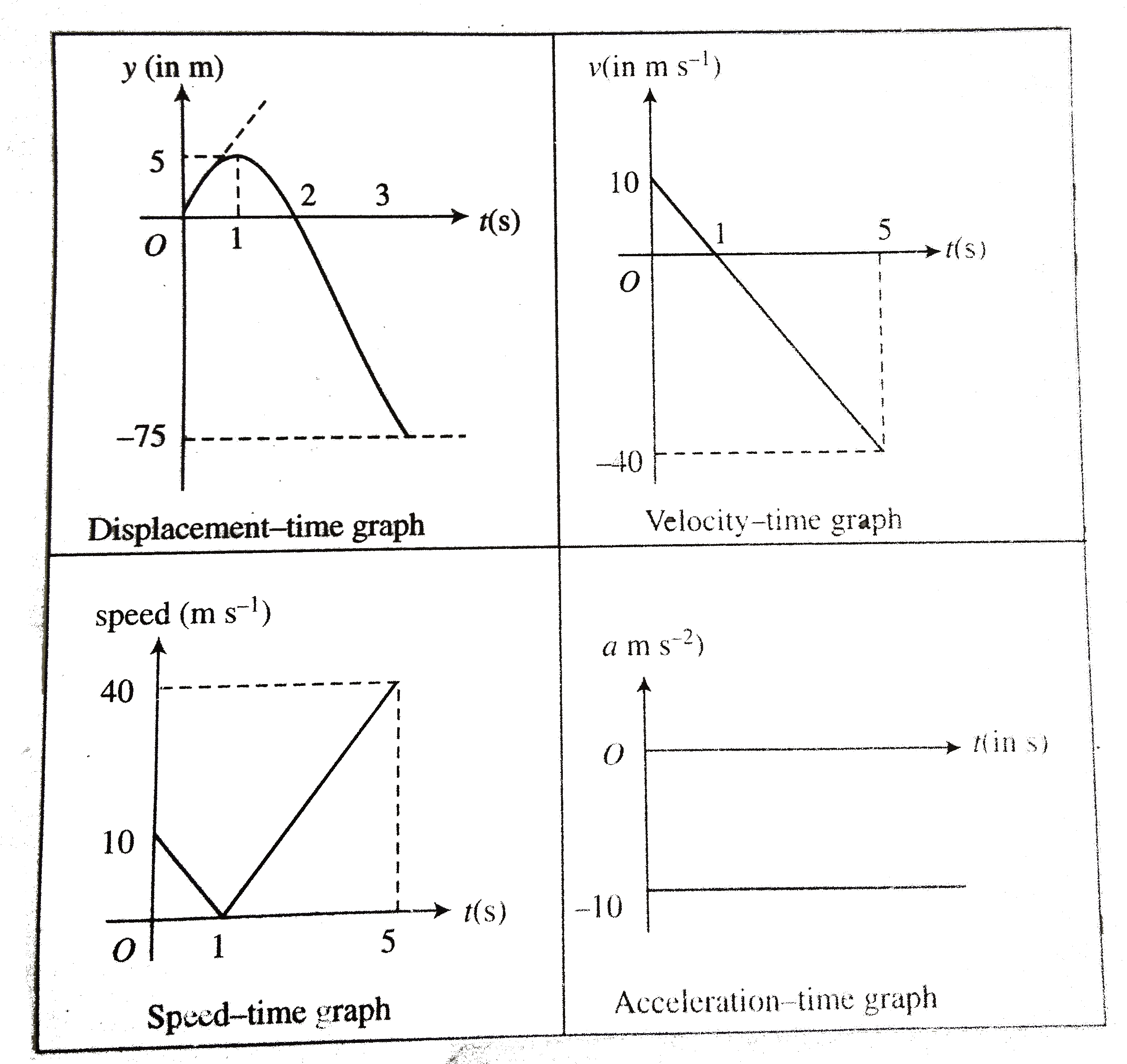
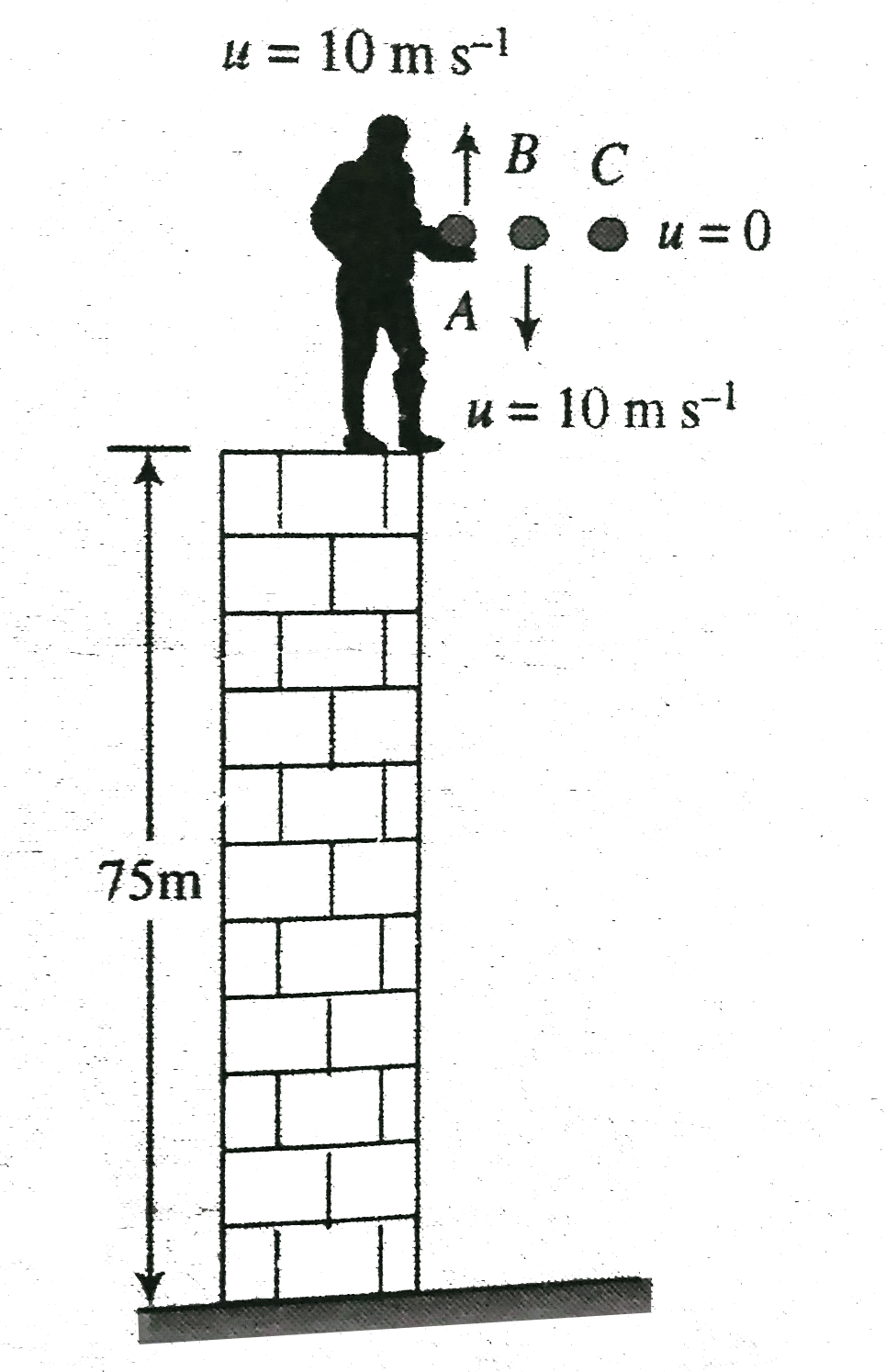
At the height of `75 m`, a particle `A` is thrown up with `V=10 m s^(-1)` and `B` particle is thorwn down with `V=10 m s^(-1)` and `C` particle released with `V=0 m S^(-1)`. Draw graphs of each particle.
.
a. Displacement-time`
b. Speed-time
c. Velocity-time
d. Acceleration-time.

Text Solution

Verified by Experts

Taking oringin at the top of building and upward direction positive.
For particled A `u=+10 s^(-1) a=-10 m s^(-1)`
Using `y=ut+(1)/(2)at^(2)`
`=10t-(1)/(2) xx10xxt^2) =10t-5^(2)` ...(i)
Equation (i) is the equation of parabola open down The parabola passes origin when `y=0`. hence from
`0=10t-5t^(-2) rArr t=0,0 s`
For velocity-time relation, `v=u+at`
`v=10-10t`. (ii)
The relaation is straight line relation with negative slopen and positive intercept.
At maximum hetght, velocity of the particle is zero.
`0=10-10 t rArr t=1 s`
Maximum height from (i), `y_(max)=10xx1-5xx1^(2)=5 s s^(-1)`
It will reach ground wher `y=-100 m`
Using `i` again, `-74=10t-5t^(2) rArr (t-5)(t+3)=0`
When given `t=5 s`, i.e., the particle will hit ground at `t=5 s`.
Velocity at the time of hitting
Using (ii), `v=10-10xx5=40 m s^(-1)`
For speed-time relation, the speed is always positive the mirror-image of velocity-time relation on positive side.
For drawing acceleration-time graph we have taken downward direction as negative and acceleration is constant throughout the motion of the praticle, i.e. `-10 m s^-(2)` Hence, acceleration time graph will be straight line parallel with time axis and below the time axis.
.
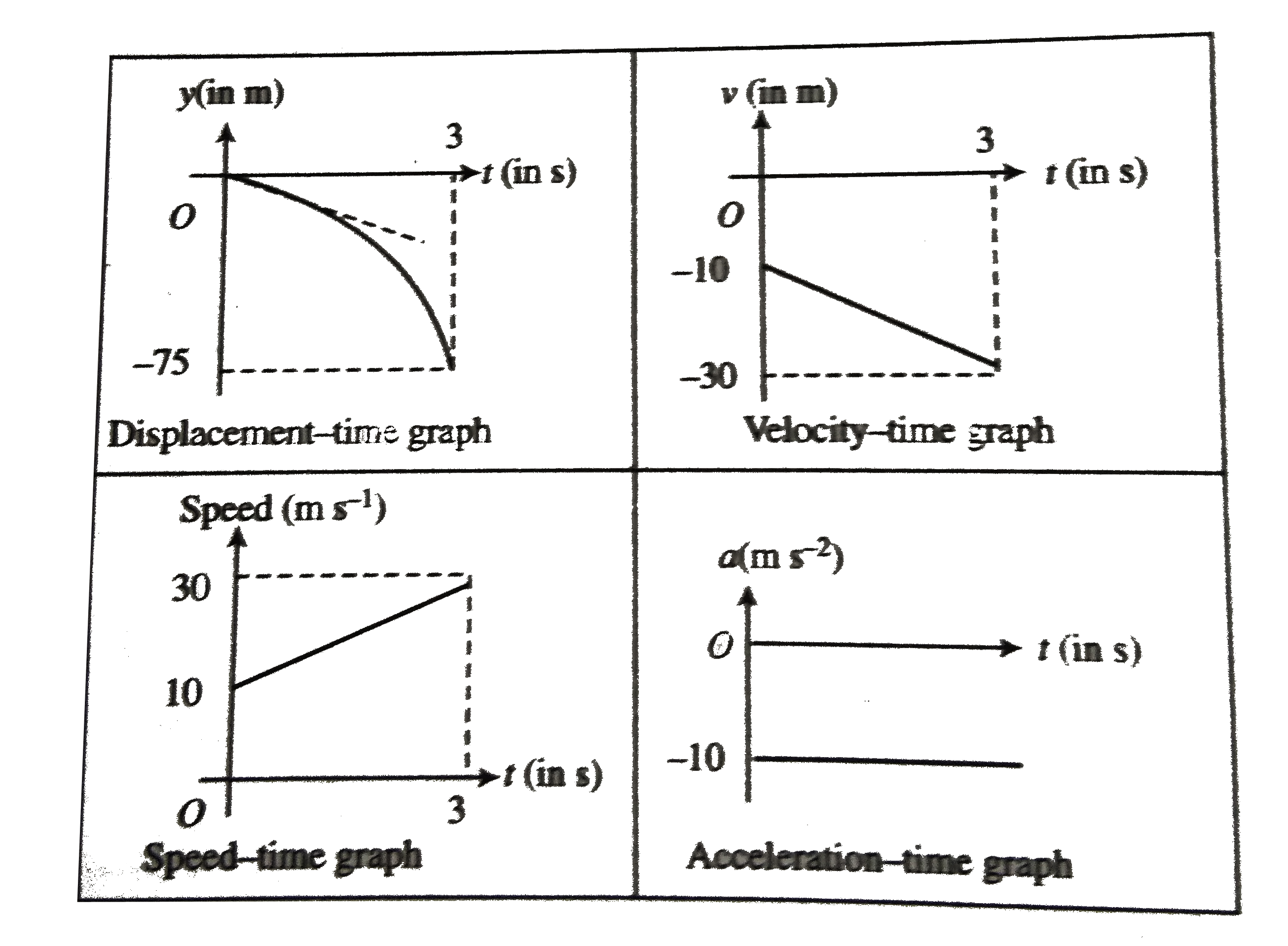
d. For particle B:`u=-10 m s^(-1) a=-20 m s^(-2)`
Displacement-time relation,
`y=-10t-(1)/(2)xxt^(2)=-10t^(2)` ...(iii)`
It is a parabla open down and it passes through origin. The particel will reach ground when `y=-75 m`
From (iii) `=-10t-5t^(2)`
or `t^(2)+2t-15=0 rArr t=3 s`
The velocity of the particle in relation with time
`v=0-10t rArr v=10t` ...(iv)
This is a straight line with negative slope and passing through origin. The particle reaches fround at `t=3 s`, velocity of the particle when it hits ground is
`v=-10xx3=-30 m s^(-1)`
.
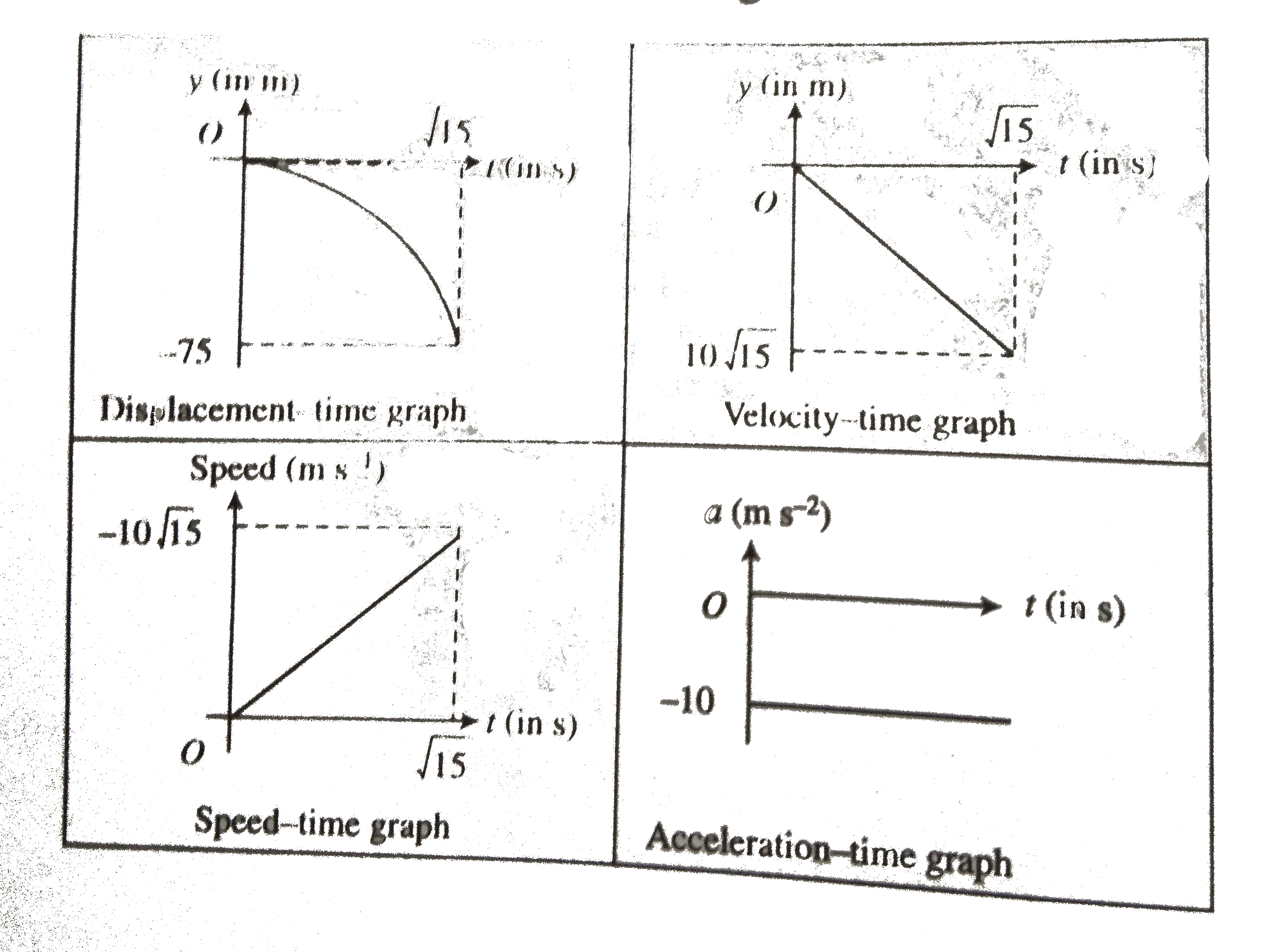
For particle C: `u=0. a=-10 m s^(-2)`
Using `y=ut+(1)/(2)at^(2)`
`=0-(1)/(2)(-10)t^(2)=-5t^(2)`
It is a parabola open down and it passes through origin.
For velocity-time relation `vec v=vec u+vec at`
`v=0-10 t =-10t` ..(vi)
Straight line with negative slope passes through origion.
It will reach round at `y=-75 m`
`-75=-5t^(2) rArr t=sqrt15 s`
Velocity at the time when it reaches ground `v=-10sqrt15 s`.
.
Promotional Banner

Topper's Solved these Questions

  • KINEMATICS-1

    CENGAGE PHYSICS|Exercise Solved Examples|9 Videos
  • KINEMATICS-1

    CENGAGE PHYSICS|Exercise Exercise 4.1|17 Videos
  • GRAVITATION

    CENGAGE PHYSICS|Exercise INTEGER_TYPE|1 Videos
  • KINEMATICS-2

    CENGAGE PHYSICS|Exercise Exercise Integer|9 Videos

Similar Questions

Explore conceptually related problems

At the height of 500m , a particle a is thrown up with v=75 ms^(-1) and particle B is released from rest. Draw, acceleration -time, velocity-time, speed-time and displacement-time graph of each particle.

Velocity of a particle is given as v = (2t^(2) - 3)m//s . The acceleration of particle at t = 3s will be :

A number of particles each of mass 10 g are in motion. 20% of the particles have speed 10 m s^(-1), 50% of particles speed 30 m s^(-1) and 30% have speed 40 m s^(-1) . Calculate the root mean square speed of the particles.

The velocity of particel A is 0.1 m/s and that of particle B is 0.5 m/s. If the mass of particle B is five times that of particle A, then the ratio of de-Broglie wavelength associated with particles A and B is

A particle is moving with velocity v=4t^(3)+3 t^(2)-1 m//s . The displacement of particle in time t=1 s to t=2 s will be

A particle is thrown with a velocity of u m/s. it passes A and B as shown in figure at time t_(1) = 1 " s " and t_(2) = 3 s . The value of u is (g = 10 m/ s^(2) )

A particle is thrown with a velocity of u m/s. It passes A and B as shown in figure at time t_(1) = 1 s and t_(2) = 3 s. The value of u is (g = 10 m//s^(2))

A particle moves vertically with an upwards initial speed v_0 = 10.5 ms^(-1). If its acceleration varies with time as shown in a-t graph in figure, find the velocity of the particles at t = 4s.

The maximum speed of a particle executing S.H.M. is 1 m/s and its maximum acceleration is 1.57 m// sec^(2) . The time period of the particle will be

