Home
Class 11
PHYSICS
The v-s and v^(2)-s graph are given for ...

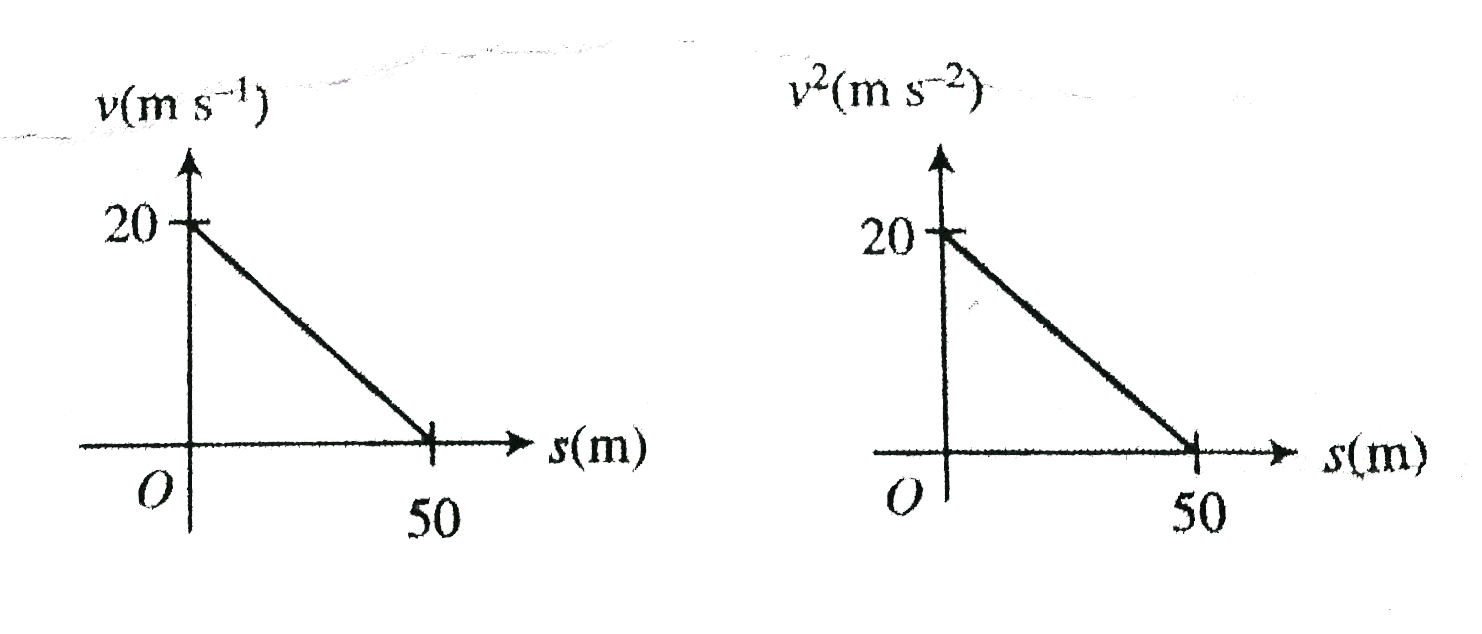
The `v-s` and `v^(2)-s` graph are given for two particles. Find the accelerations of the particles at `s=0`.
.

A

-8, -0.2

B

9, 0.2

C

8, 0.3

D

9, 0.3

Text Solution

Verified by Experts

The correct Answer is:

A

`a_(1)=(vdv)/(ds)`, where `v=20 m s^(-1)` (at s=0)
and `(dv)/(ds)=-(2)/(5)=(a_(1))/(v) =a_(1)/(20)`
Then, `a_(1) =-8 m s^(-2)`
`a_(2)=(1)/(2)(d(v^(2)))/(ds)`, where `(d(v^(2)))/(ds) =-(2)/(5)`
Then, `a_(2)=-0.2 m s^(-2)`.
Promotional Banner

Topper's Solved these Questions

  • KINEMATICS-1

    CENGAGE PHYSICS|Exercise Solved Examples|9 Videos
  • KINEMATICS-1

    CENGAGE PHYSICS|Exercise Exercise 4.1|17 Videos
  • GRAVITATION

    CENGAGE PHYSICS|Exercise INTEGER_TYPE|1 Videos
  • KINEMATICS-2

    CENGAGE PHYSICS|Exercise Exercise Integer|9 Videos

Similar Questions

Explore conceptually related problems

If velocity of a particle is given by v=2t^(2)-2 then find the acceleration of particle at t = 2 s.

If velcotiy of a particle is given by v=2t-1 then find the acceleration of particle at t = 2s.

The velocity-time graph of a moving particle is given below. The acceleration of the particle at t = 5 s will be

A particle moves in a circle of radius 1.0cm with a speed given by v=2t , where v is in cm//s and t in seconds. (a) Find the radial accerleration of the particle at t=1s . (b) Find the tangential accerleration of the particle at t=1s . Find the magnitude of net accerleration of the particle at t=1s .

A particle moves in a circular path such that its speed 1v varies with distance s as v = sqrt(s) , where prop is a positive constant. Find the acceleration of the particle after traversing a distance s .

A graph between the square of the velocity of a particle and the distance s moved by the particle is shown in the figure. The acceleration of the particle is

A particle moves in circle of radius 1.0 cm at a speed given by v=2.0 t where v is in cm/s and t in seconeds. A. find the radia accelerationof the particle at t=1 s. b. Findthe tangential acceleration at t=1s. c.Find the magnitude of the aceleration at t=1s.

A particle moves in a circular path such that its speed v varies with distance s as v=alphasqrt(s) where alpha is a positive constant. If the acceleration of the particle after traversing a distance s is [alpha^2sqrt(x+s^2/R^2)] find x.

A particle is moving with a velocity of v=(3+ 6t +9t^2) m/s . Find out (a) the acceleration of the particle at t=3 s. (b) the displacement of the particle in the interval t=5s to t=8 s.

Referrring to the v^(2)-s diagram of a particle, find the displacement of the particle durticle during the last two seconds. .
