Home
Class 11
PHYSICS
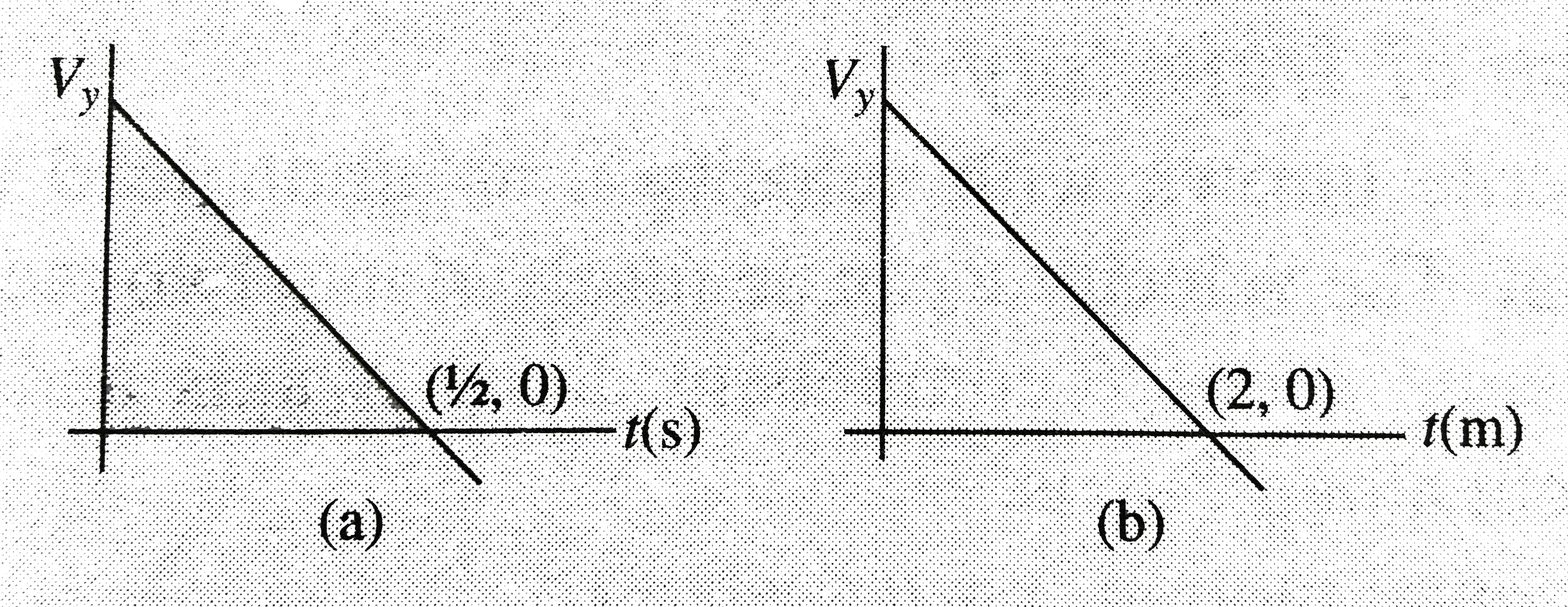
Two graphs of the same projectile motion...

Two graphs of the same projectile motion (in the x - y plane) projected from origin are shown in (Fig. 5 .10). X - axis is along horozontal direction and Y - axis is vertically upwards. Take `g = 10 m s^2`
Find (i) The y component of initial velocity and
(ii) the `X` component of initial velocity.
.

Text Solution

Verified by Experts

From garph (i) : `v_y = 0 at t = (1)/(2) s`, i.,e., time taken to reach maximum height `H` is
`t = (u_y)/(g) = (1)/(2) rArr u_y = 5 m s^-1`
From graph (2) , `v_y = 0 at x = 2 m`, i.,e., when the particle is at maximum height, its displacement along horizontal, `x = 2 m`.
`x = u_x xx t rArr 2 = u_x xx (1)/(2) rArr u_ x = 4 m s^-1`.
Promotional Banner

Topper's Solved these Questions

  • KINEMATICS-2

    CENGAGE PHYSICS|Exercise Solved Examples|7 Videos
  • KINEMATICS-2

    CENGAGE PHYSICS|Exercise Exercise 5.1|15 Videos
  • KINEMATICS-1

    CENGAGE PHYSICS|Exercise Integer|9 Videos
  • KINETIC THEORY OF GASES

    CENGAGE PHYSICS|Exercise Compression|2 Videos

Similar Questions

Explore conceptually related problems

Two graphs of the same projectile motion (in the xy-plane) projected from origin are shown. X-axis is along horizontal direction and y-axis is vertically upwards. Take g = 10 ms^(-2) . , The projection speed is :

Two graphs of the same projectile motion (in the xy-plane) projected from origin are shown. X-axis is along horizontal direction and y-axis is vertically upwards. Take g = 10 ms^(-2) . Projection angle with the horizontal is :

Two graphs of the same projectile motion (in the xy-plane) projected from origin are shown. X-axis is along horizontal direction and y-axis is vertically upwards. Take g = 10 ms^(-2) . , Maximum height attained from the point of projection is

At a height of 0.4 m from the ground, the velocity of projectile in vector from is vec(u)=(6hat(i)+2hat(j)) (the x-axis is horizontal and y-axis is vertically upwards). The angle of projection is : (g = 10 m//s^(2))

Equation of trajectory of a projectile is given by y = -x^(2) + 10x where x and y are in meters and x is along horizontal and y is vericall y upward and particle is projeted from origin. Then : (g = 10) m//s^(2)

A body is projected horizontally from the top of a tower with a velocity of 20m/s .After what time the vertical component of velocity is four times the horizontal component of velocity (g=10m/s^(2))

A particle is projected from the horizontal x-z plane, in vertical x-y plane where x-axis is horizontal and positive y-axis vertically upwards. The graph of y coordinate of the particle v/s time is as shown . The range of the particle is sqrt3 . Then the speed of the projected particle is:

What are component of vecg along x and y axis respectively |vecg|=10m//s^(2) .

A particle is projected from gound At a height of 0.4 m from the ground, the velocity of a projective in vector form is vecv=(6hati+2hatj)m//s (the x-axis is horizontal and y-axis is vertically upwards). The angle of projection is (g=10m//s^(2))

