Home
Class 11
PHYSICS
A man wants to swim in a river from A to...

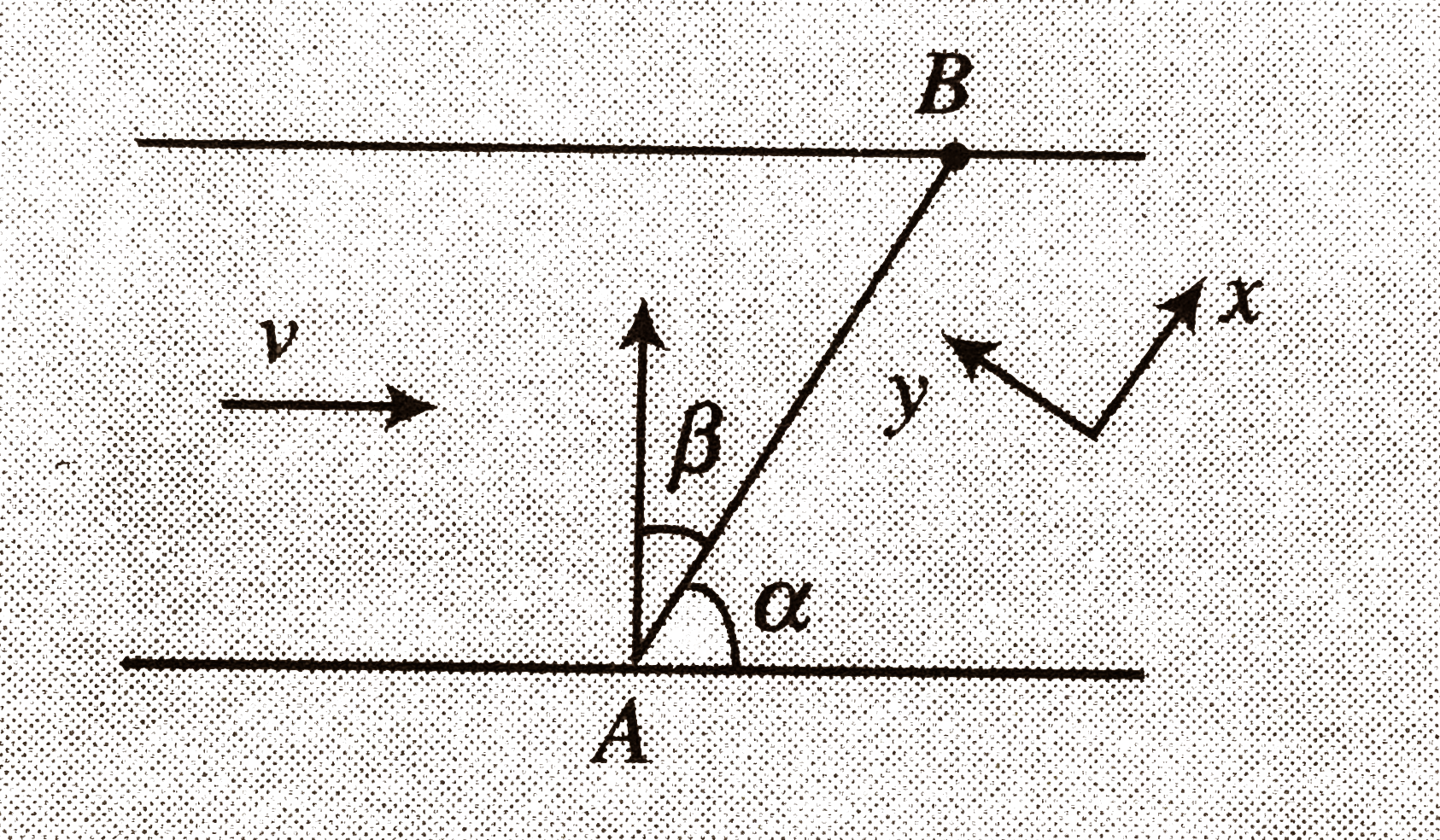
A man wants to swim in a river from `A to B` and back from `B to A` always following line `AB` (Fig. 5.94). The distance between points `A and B` is `S`. The velocity of the river current `v` is constant over the entire width of the river. The line `AB` makes an angle `prop` with the direction of current. The man moves with velocity `u` at angle `beta` to the line `AB`. The man swim to cover distance `AB` and back, find the time taken to complete the journey.
.

Text Solution

Verified by Experts

In this problem, we choose axis along `AB` and normal to is it.
Since the man moves along `AB`, the velocity components of current and man normal to `AB` must cancel out, i.e.,
`u sin beta = v sin prop`
When the man moves from `A` to `B`, his resultant velocity along `AB = (u cos beta + v cos prop)`
Hence, `S = (u cos beta + v cos prop) t_1`
while for motion from `B` to `A S = (u cos beta - v cos prop)t_2`
From the condition of the problem, `t_1 + t_2 = t`
`(S)/(u cos beta + v cos prop) + (S)/( u cos beta - v cos prop) = t`
`s [(u cos beta - v cos prop + u cos beta + v cos prop)/(u^2 cos^2 beta - v^2 cos^2 prop)] = t`
`(S(2 u cos beta))/(u^2 cos^2 beta - v^2 cos^2 prop) = t`.
.
Promotional Banner

Topper's Solved these Questions

  • KINEMATICS-2

    CENGAGE PHYSICS|Exercise Solved Examples|7 Videos
  • KINEMATICS-2

    CENGAGE PHYSICS|Exercise Exercise 5.1|15 Videos
  • KINEMATICS-1

    CENGAGE PHYSICS|Exercise Integer|9 Videos
  • KINETIC THEORY OF GASES

    CENGAGE PHYSICS|Exercise Compression|2 Videos

Similar Questions

Explore conceptually related problems

A launch plies between two points A and B on the opposite banks of a river always following the line AB. The distance S between points and B is 1200 m. The velocity of the river current v= 1.9 m//s is constant over the entire width of the river. The line AB makes an angle alpha= 60^@ with the direction of the current. With what velocity u and at what angle beta to the line AB should the launch move to cover the distance AB and back in a time t= 5 min ? The angle beta remains the same during the passage from A to B and from B to A.

A steamer plies between two stations A and B on opposite banks of a river, always following the path AB . The distance between stations A and B is 1200 m . The velocity of the current is sqrt(17) m s^-1 and is constant over the entire width of the river. The line AB makes an angle 60^@ with the direction of the flow. The steamer takes 5 min to cover the distance AB and back. (a) Find the velocity of steamer with respect to water. (b) In what direction should the steamer move with respect to line AB ?

A man wishes to cross a river flowing with velocity u swims at an angle theta with the river flow.If the man swims with speed v and if the width of the river is d , then the drift travelled by him is

A swimmer wants to cross a river from point A to point B. Line AB makes an angle of 30^(@) with the flow of river. Magnitude of velocity of the swimmer is same as that of the river. The angle theta with the line AB should be _________ ""^(@) , so that the swimmer reaches point B.

A swimmer crosses the river along the line making an angle of 45^(@) with the direction of flow. Velocity of the river is 5 m/s. Swimmer takes 6 seconds to cross the river of width 60 m. The velocity of the swimmer with respect to water will be :

A swimmer starts to swim from point a to cross a river. He wants to reach point B on the opposite side of the river. The line AB makes an angle 60^(@) with the river flow as shown. The velocity of the swimmer in still water is same as that of the water (i) In what direction should he try to direct his velocity ? Calculate angle between his velocity ? Calculate angle between his velocity and river velocity. (ii) Find the ratio of the time taken to cross the river in this situation to the minimum time in which he can cross this river.

A man directly crosses a river in time t_1 and swims down the current a distance equal to the width of the river I time t_2 . If u and v be the speed of the current and the man respectively, show that : t_1 :t_2 = sqrt(v + u) : sqrt(v - u)) .