Home
Class 11
PHYSICS
Two particles are located on a horizonta...

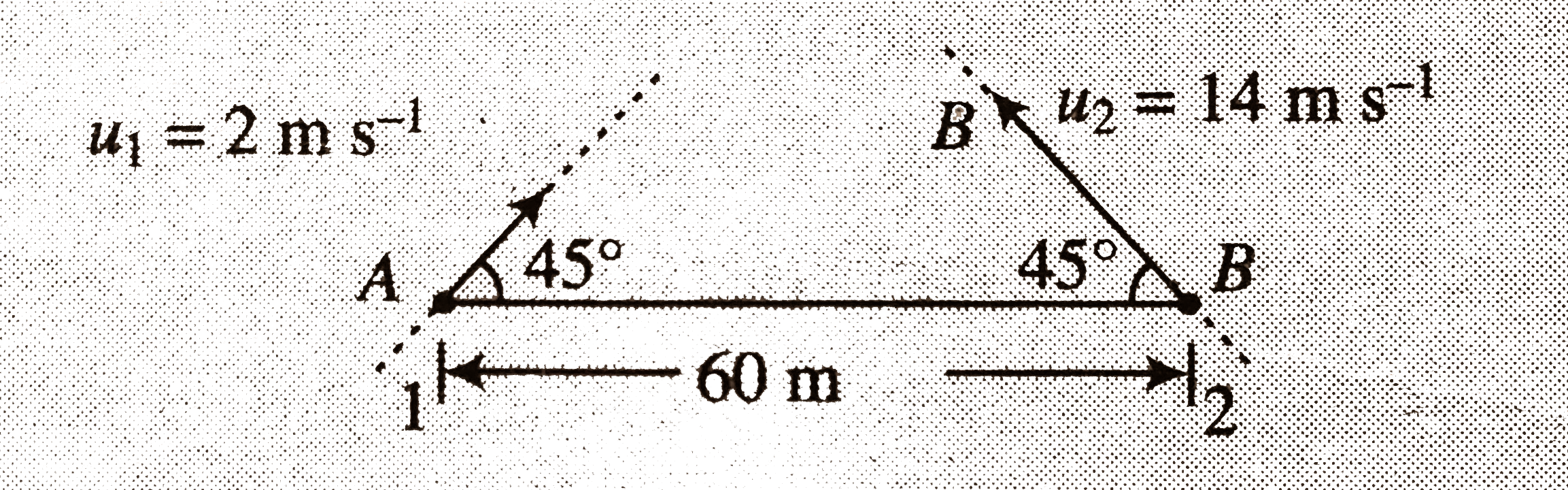
Two particles are located on a horizontal plane at a distance `60 m`. At `t = 0` both the particles are simultaneously projected at angle `45^@` with velocities `2 ms^-1 and 14 m s^-1`, respectively. Find
(a) Minimum separation between them during motion.
(b) At what time is the separation between them minimum ?
.

Text Solution

Verified by Experts

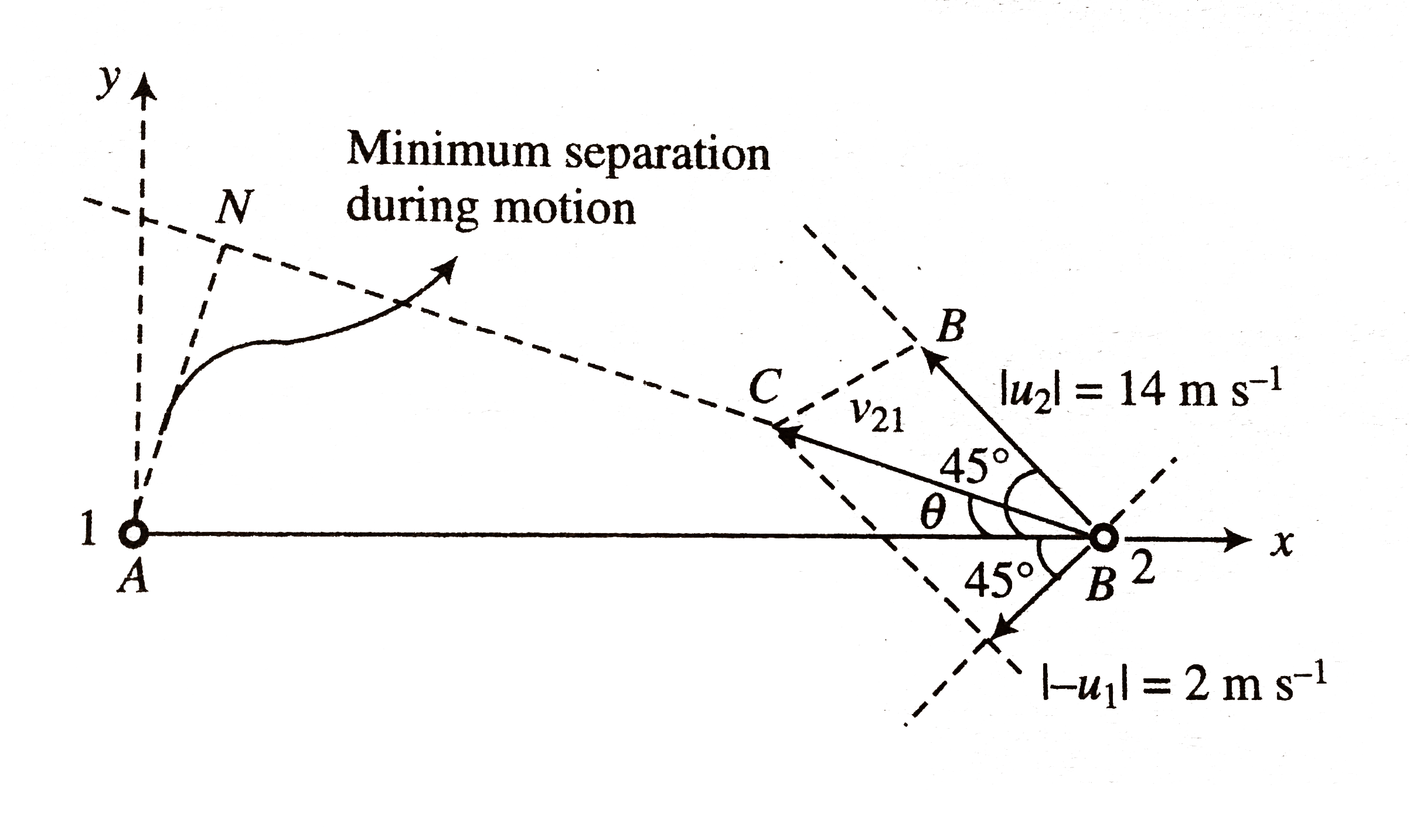
In relative motion, observer consioders himself at rest and observes the motiob of object. Graphically, we can draw the direction of motion of particle `2` w.r.t. particle `1` (Fig. 5.123). Both the particles are moving in gravitation field with same acceleration `g`. Hence, relative acceleration of particle `2` as seen from particle `1` will be zero. It means the relative velocity of the particle `2` w.r.t. particle `1` will be constant and will be equal to initial relative velocity. Graphically, we can draw the situation as shown in (Fig. 5.123).
`AN` is the minimum separation between the particles and `BN` is the relative separation between the particles when the distance between `1 and 2` is shortest. From figure, we can write
`v_(12) cos theta = 14 cos 45^@ + 2 cos 45^@` ...(i)
`v_(12) sin theta = 14 sin 45^@ - 2 sin 45^@` ....(ii)
From (i) and (ii), `v_(12) = 10 sqrt(2) m s^-1`
`cos theta = (4)/(5) and sin theta = (3)/(5), as theta = 37^@`
Hence, minimum separation between the particles
=`AN = AB sin theta = 60 xx (3)/(5) = 36 m`
The time when separation between the particles is minimum,
`t = ( B N)/(|vec v_(12)|) = t = (60 cos 37^@)/(10 sqrt(2)) = (12 sqrt(2))/(5) s`.
.
Promotional Banner

Topper's Solved these Questions

  • KINEMATICS-2

    CENGAGE PHYSICS|Exercise Solved Examples|7 Videos
  • KINEMATICS-2

    CENGAGE PHYSICS|Exercise Exercise 5.1|15 Videos
  • KINEMATICS-1

    CENGAGE PHYSICS|Exercise Integer|9 Videos
  • KINETIC THEORY OF GASES

    CENGAGE PHYSICS|Exercise Compression|2 Videos

Similar Questions

Explore conceptually related problems

Two particles are thrown simultaneously from points A and B with velocities u_1 = 2ms^(-1) and u_2 - 14 ms^(-1) , respectively, as shown in figure. Minimum separation between A and B is

Two particles A and B are thown vertically upward with velocity, vertically upward with velocity, 5 m s^(-1) and 10 m s^(-1) respectively (g=10 m s^(-2)), Find separation between them after 1 s . .

Particles A and B are moving with constant velocities along x and y axis respectively, the graph of separation between them with time is

From a tower of height 40 m , two bodies are simultaneously projected horizontally in opposite direction, with velocities 2 m s^-1 and 8 ms^-1 . respectively. The horizontal distance between two bodies, when their velocity are perpendicular to each other, is.

Two bodies A and B are at position (2, 3)m amd (5, 7)m respectively. These two are moving with constant velocity 3 ms^(-1) along -ve y axis and 4ms^(-1) along +ve x axis respectively. Minimum separation between them during their motion is

Two particles are thrown horizontally in opposite directions from the same point from a height h with velocities 4 ms^(-1) and 3 ms^(-1) . What is the separation between them when their velocities are perpendicular to each other?

A particle is projected from ground with velocity 40sqrt(2)m//s at 45^(@) . At time t=2s

A particle is projected from an inclined plane OP_1 from A with velocity v_1 = 8ms^(-1) at an angle 60^@ with horizontal. An another particle is projected at the same instant from B with velocity v_2 = 16 ms^(-1) and perpendicular to the plane OP_2 as shown in figure. After time 10(sqrt3) s there separation was minimum and found to be 70m. Then find distance AB.

Initially two particles A and B are present at (0,0) and (d,0) respectively They start moving with speed V_(A)=Vhat(i)+Vhat(j) and V_(B)=-Vhat(j) If R is magnitude of relative separation between them and T_(0) be the time when separation between them is minimum, then