Home
Class 11
PHYSICS
Two particles A and B are moving with un...

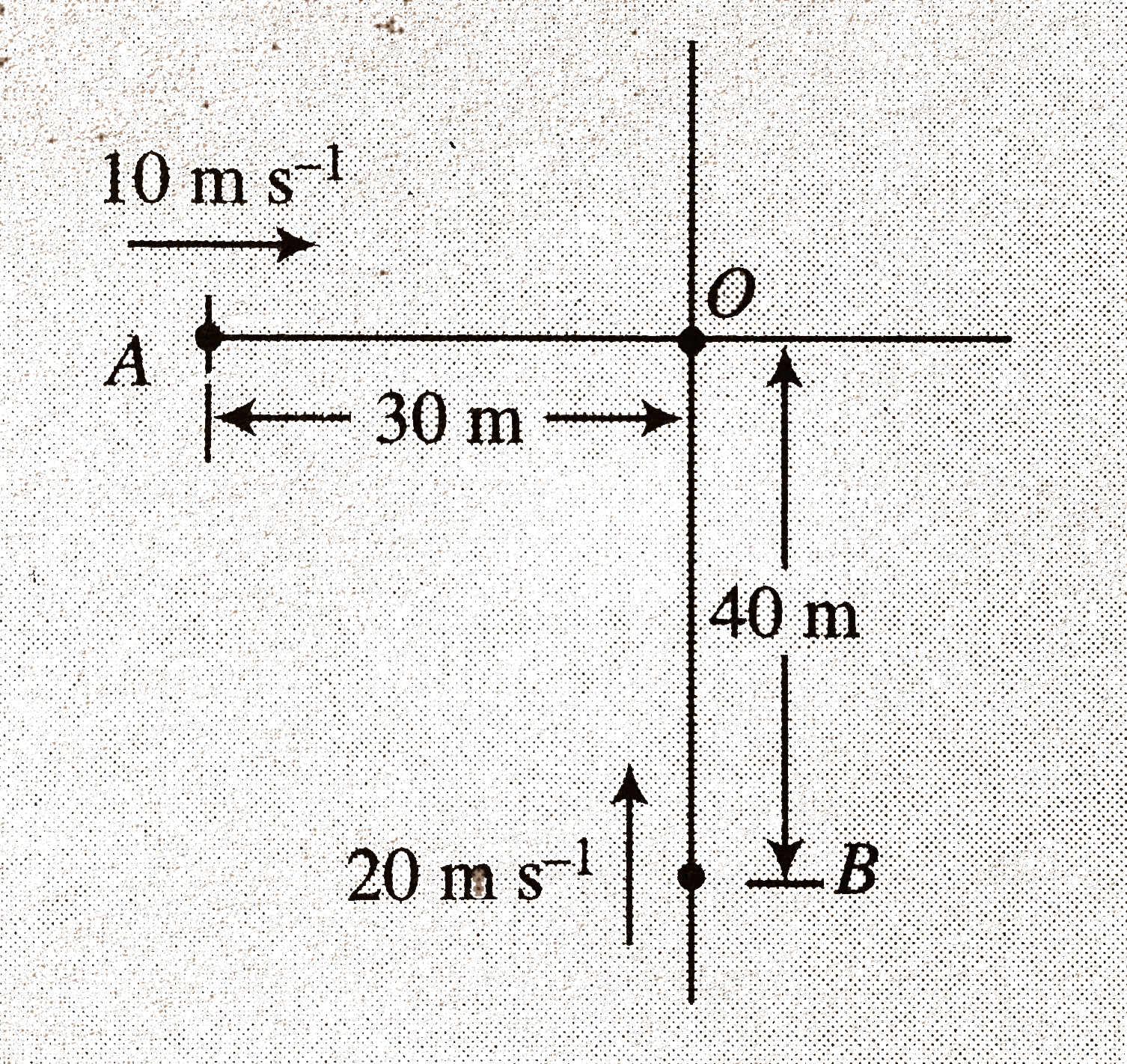
Two particles `A and B` are moving with uniform velocity as shown in (Fig. 5.130) given below at `t = 0`.
(a) Will the two particles collide ?
(b) Find out the shortest distance between two particles.
.

Text Solution

Verified by Experts

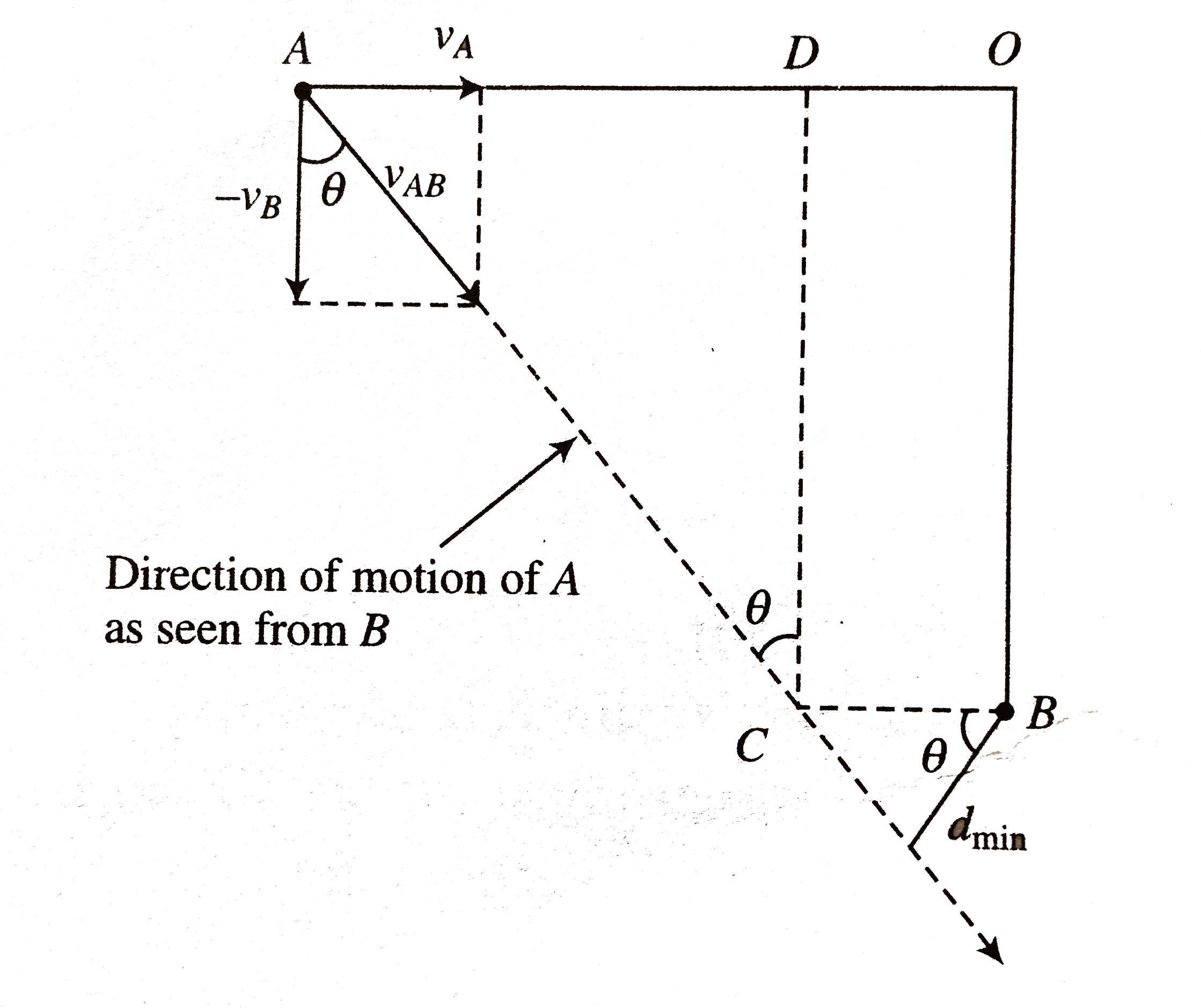
Observing `A` from the frame of `B`
Let us draw `vec v_(A B)`,
`vec v_(A B) = vec v_A - vec v_B = vec v_A + (- vec v_B)`
`tan theta = (10)/(20) = (1)/(2)`
Again `tan theta = (A D)/(C D) = (A D)/(40) = (1)/(2)`
`rArr AD = 20 rArr D O = 10`
`rArr BC = 10`
Hence, the shortest distance between the particles
`d_("short") = BC cos theta = 10 cos theta = (10 xx 2)/(sqrt(5)) = 4 sqrt(5) m`
Since the closest distance is non - zero, therefore, the particles will not collide.
.
Promotional Banner

Topper's Solved these Questions

  • KINEMATICS-2

    CENGAGE PHYSICS|Exercise Solved Examples|7 Videos
  • KINEMATICS-2

    CENGAGE PHYSICS|Exercise Exercise 5.1|15 Videos
  • KINEMATICS-1

    CENGAGE PHYSICS|Exercise Integer|9 Videos
  • KINETIC THEORY OF GASES

    CENGAGE PHYSICS|Exercise Compression|2 Videos

Similar Questions

Explore conceptually related problems

Shortest Distance Between Two Moving Particle

Two particles are moving in different circles in same plane with different angular velocities as shown in figure. At t = 0, initial positions of particles A and B are shown by dots on the respective circles. Initial distance between particles is 1m. Particle A move anticlockwise in the first circle whereas B moves clockwise in the second circle. Angle described (rotated) by A and B in time 't' are theta_(A)=((pi)/2t) and theta_(B)=(pit) respectively. here theta is in radian and t is in second. Radius of each circle is shown in diagram. At time t=2 second, the angular velocity of the particle A with respect to the particle B is

Two particles are moving in different circles in same plane with different angular velocities as shown in figure. At t = 0, initial positions of particles A and B are shown by dots on the respective circles. Initial distance between particles is 1m. Particle A move anticlockwise in the first circle whereas B moves clockwise in the second circle. Angle described (rotated) by A and B in time 't' are theta_(A)=((pi)/2t) and theta_(B)=(pit) respectively. here theta is in radian and t is in second. Radius of each circle is shown in diagram. Find the magnitude of acceleration of A at t=1 sec

Two particles are moving in different circles in same plane with different angular velocities as shown in figure. At t = 0, initial positions of particles A and B are shown by dots on the respective circles. Initial distance between particles is 1m. Particle A move anticlockwise in the first circle whereas B moves clockwise in the second circle. Angle described (rotated) by A and B in time 't' are theta_(A)=((pi)/2t) and theta_(B)=(pit) respectively. here theta is in radian and t is in second. Radius of each circle is shown in diagram. At time t=1 sec. the magnitude of acceleration of A with respect to B is

s-t graph of two particles A and B are shown in fig. Find the ratio of velocity of A to velocity of B.

Two particles start moving simultaneously with constant velocities u_1 and u_2 as shown in (Fig. 5.194). First particle starts from A along AO and second starts from O along OM . Find the shortest distance between them during their motion. .

Two Particle A and B are moving with uniform velocities of 20m/sec and 10m/sec as shown in the shown in the figure. The Magnitude of angular velocity of A with respect to B.when their separation (AB) is 10 meter is

Two objects A and B are moving along the directions as shown in (Fig. 5.77). Find the magnitude and direction of the relative velocity of B w.r.t. A . ,

Particles A and B move with constant and equal speeds in a circle as shown in (Fig. 5.164). Find the angular velocity of the particle A with respect to B , if the angular velocity of particle A w.r.t. O is omega . .

Two particles A and B are initially 40 m apart, A is behind B . Particle A is moving with uniform velocity of 10 m s^(-1) towared B . Particle B starts moving away from A with constant acceleration of 2 m s^(-1) . The minimum distance between the two is .