Home
Class 11
PHYSICS
Find the angular velocity of A with resp...

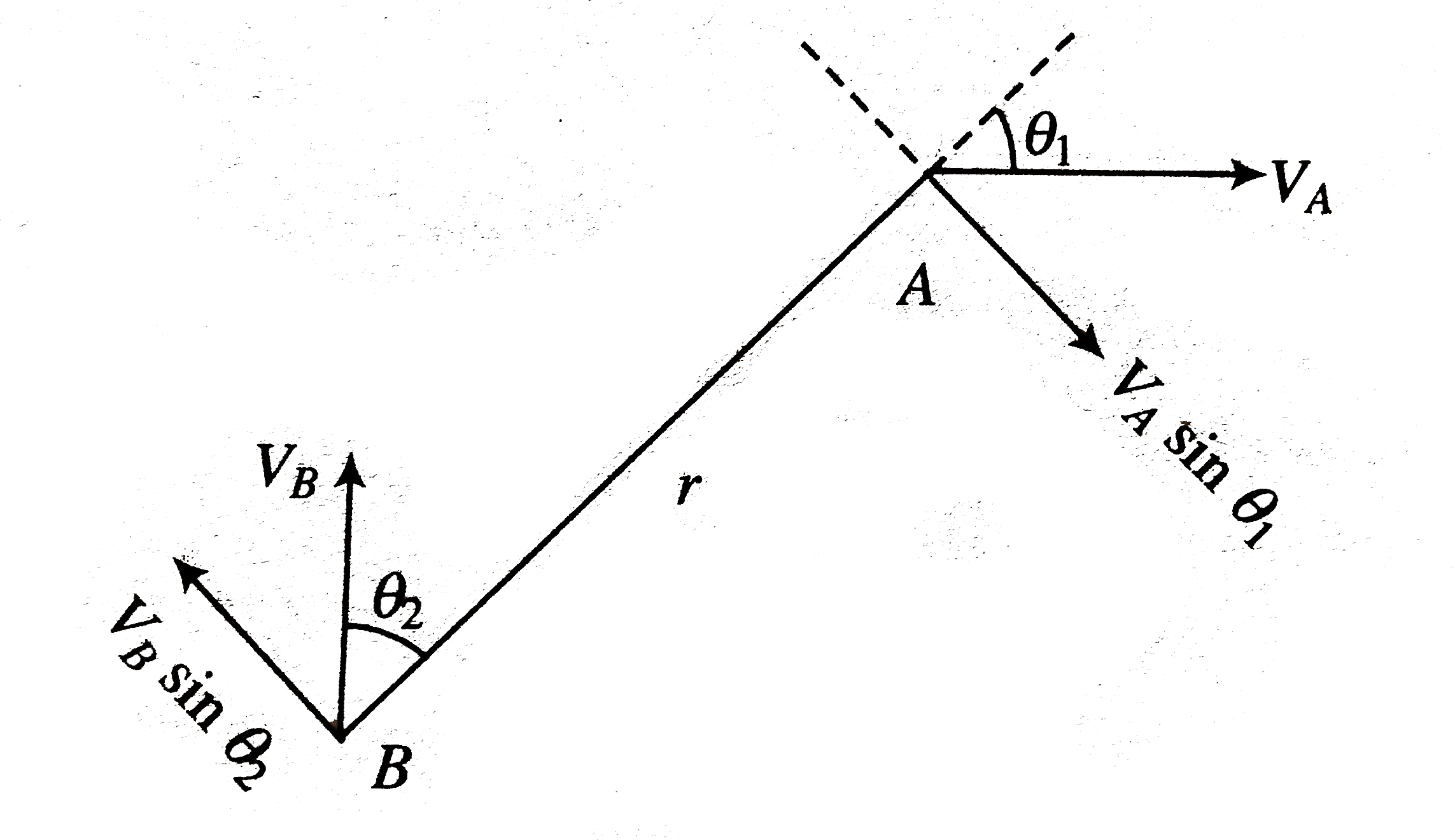
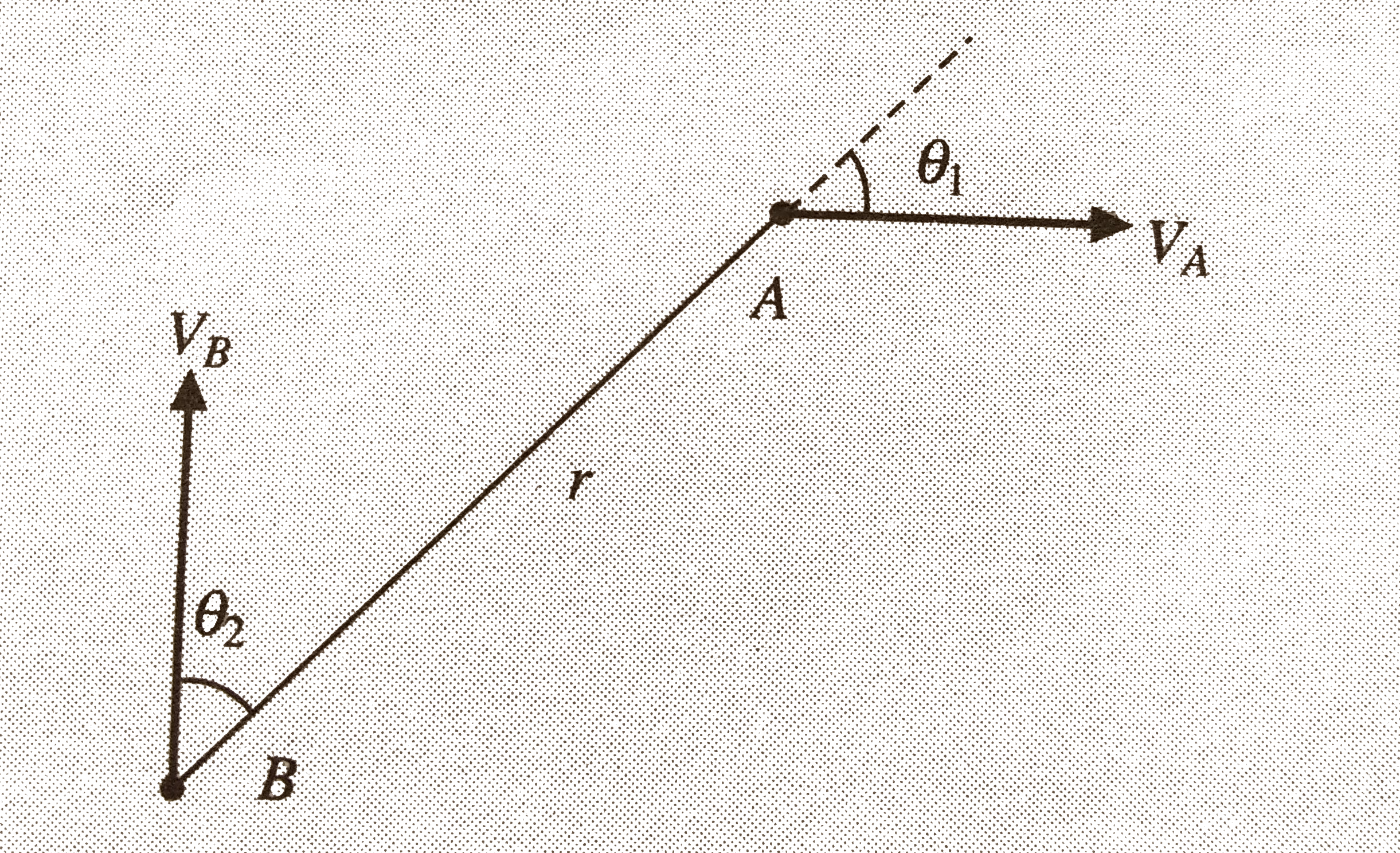
Find the angular velocity of `A` with respect to `B` in (Fig. 5.156).
.

Text Solution

Verified by Experts

Angular velocity of `A` with respect to `B` ,
`omega_(A B) = ((V_(A B))_|_)/(r_(A B))`
`rArr (V_(A B))_|_ = V_A sin theta_1 + V_B sin theta_2`
`rArr r_(A B) = r`
`omega_(A B) = (v_A sin theta_1 + v_B sin theta_2)/( r)`.
.
Promotional Banner

Topper's Solved these Questions

  • KINEMATICS-2

    CENGAGE PHYSICS|Exercise Solved Examples|7 Videos
  • KINEMATICS-2

    CENGAGE PHYSICS|Exercise Exercise 5.1|15 Videos
  • KINEMATICS-1

    CENGAGE PHYSICS|Exercise Integer|9 Videos
  • KINETIC THEORY OF GASES

    CENGAGE PHYSICS|Exercise Compression|2 Videos

Similar Questions

Explore conceptually related problems

Particles A and B move with constant and equal speeds in a circle as shown in (Fig. 5.164). Find the angular velocity of the particle A with respect to B , if the angular velocity of particle A w.r.t. O is omega . .

Find the angular velocity of A with respect to O at the instant shown in (Fig. 5.165). .

A particle is moving with constant speed in a circle as shown in (Fig. 5.163). Find the angular velocity of the particle A with respect to fixed point B and C if angular velocity with respect to O is omega . .

Two Particle A and B are moving with uniform velocities of 20m/sec and 10m/sec as shown in the shown in the figure. The Magnitude of angular velocity of A with respect to B.when their separation (AB) is 10 meter is

Two particle 'A' and 'B' are moving on the same circle with angular omega_(1) and omega_(2) respectively w.r.t. the centre of circle. Find the angular velocity of 'A' w.r.t. 'B' when, (i) their sense of rotations is same, (ii) and their sense of rotation is opposite.

A rod od length l is moving in a vertical plane ( x-y ) when the owest point A of the rod is moved with a velociy v . find the a angular velocity of the rod and b velocity of the end B .

A rod AB length 5 m which remains in vertical plane has its ends A and B constrained to remain contact with a horizontal floor and a vertical wall respectively. Determine the velocity of the end B and angular velocity at the position shown in Fig. , if the point A has a velocity of 3ms^(1) rightward.

A solid body rotates with deceleration about a stationary axis with an angular deceleration betapropsqrt(omega) , where omega is its angular velocity. Find the mean angular velocity of the body averaged over the whole time of rotation if at the initial moment of time its angular velocity was equal to omega_0 .