Home
Class 11
PHYSICS
A large , heavy box is sliding without ...

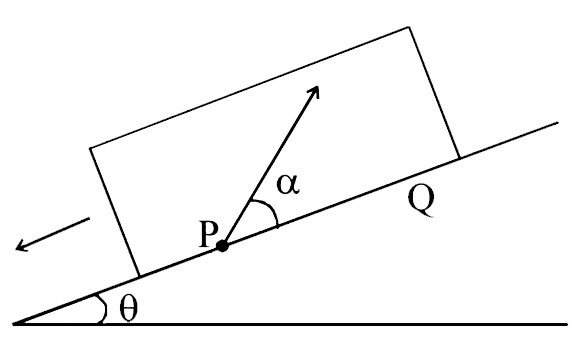
A large , heavy box is sliding without friction down a smooth plane of inclination `theta` . From a point `P` on the bottom of the box , a particle is projected inside the box . The initial speed of the particle with respect to the box is `u` , and the direction of projection makes an angle `alpha` with the bottom as shown in Figure .
(a) Find the distance along the bottom of the box between the point of projection `p` and the point `Q` where the particle lands . ( Assume that the particle does not hit any other surface of the box . Neglect air resistance .)
(b) If the horizontal displacement of the particle as seen by an observer on the ground is zero , find the speed of the box with respect to the ground at the instant when particle was projected .

Text Solution

Verified by Experts
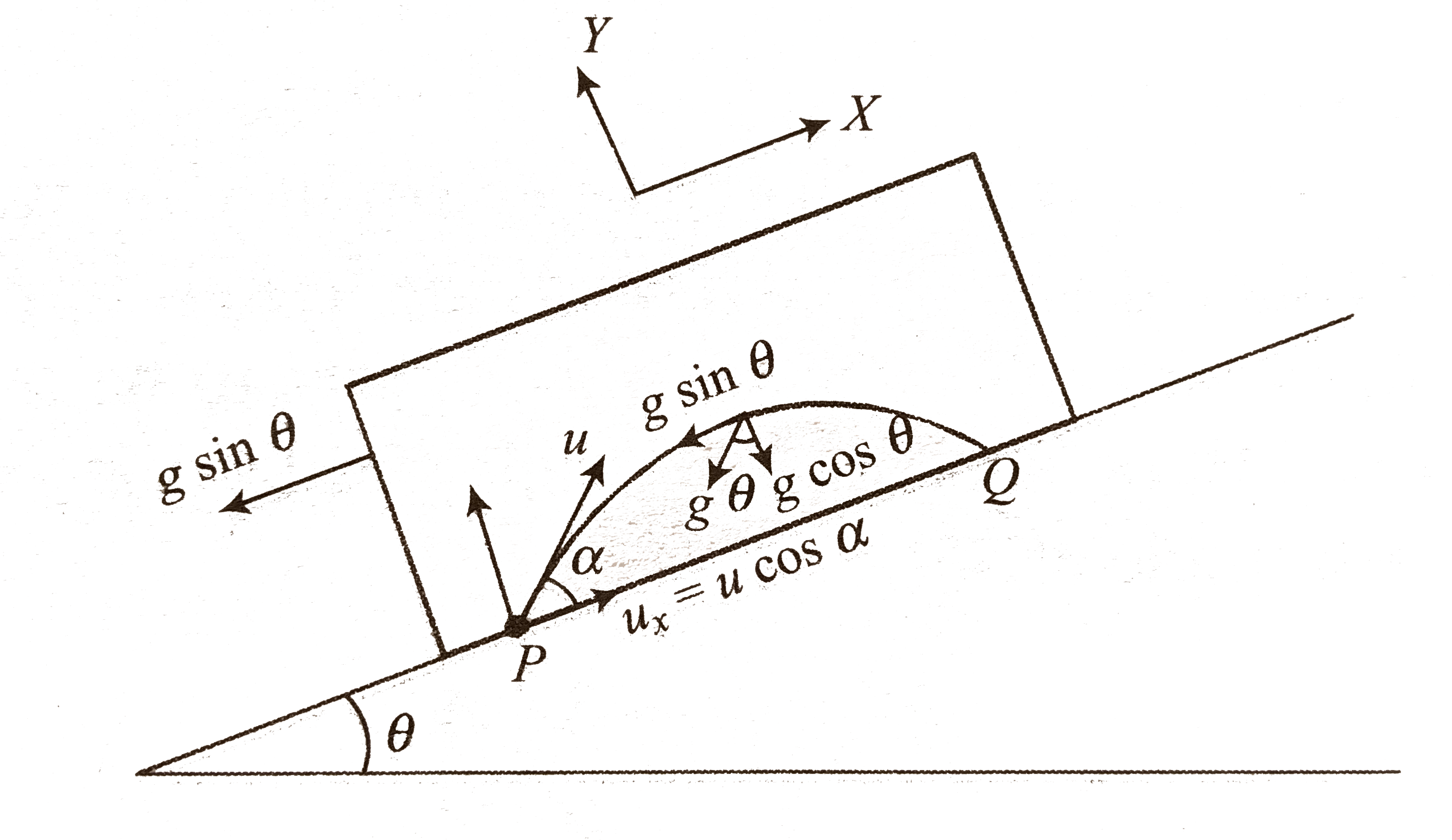
Method 1 : (a) `u` is the relative velocity of the particle with respect to the box. Resolve `u`.
Let `u_x` is the relative velocity of the particle with respect to the box in x - direction. Let `u_y` is the relative velocity with respect to the box in y - direction.
y - direction motion(taking relative terms w.r.t. box)
`u_y = + u sin prop, a_y = - g cos theta, S_y = 0`
`S_y = u_y t + (1)/(2) a_y t^2 rArr 0 = (u sin prop) t - (1)/(2) g cos theta xx t^2`
or `t = (2 u sin prop)/(g cos theta)`
x - direction motion (taking relative terms w.r.t. box) :
`u_x = + u cos prop, a_x = 0`
`S_x = u_x t + (1)/(2) a_x t^2`
`rArr PQ = u cos prop xx (2 u sin prop)/(g cos theta) = (u^2 sin 2 prop)/(g cos theta)`
(b) For the observer (on ground) to see the horizontal displacement to be zero, the distance travelled by the box in time `(2 u sin prop)/(g cos theta)` should be equal to the range `PQ` of the particle. Let the speed of the box at the time of projection of particle be `u_1`. Then for the motion of box with respect to ground (Fig. 5.176).
`PQ = u_1 t + (1)/(2) g sin theta t^2`
Put the values of `PQ and t` and solve to get
`u_1 = (u cos (prop + theta))/(cos theta)`
Method 2 : The above condition can be met if the box covers exactly the same distance as the range of particle.
`((u^1 sin 2 prop)/(g cos theta)) = v ((2 u sin prop)/(g cos theta)) + (1)/(2) g sin theta ((2 u sin prop)/(g cos theta))^2`
or `u cos prop = v + (u sin theta sin prop)/(cos theta)`
or `v = u ((cos prop cos theta - sin prop cos theta)/(cos theta)) = (u cos(prop + theta))/(cos theta)`.
,.
Promotional Banner

Topper's Solved these Questions

  • KINEMATICS-2

    CENGAGE PHYSICS|Exercise Exercise 5.1|15 Videos
  • KINEMATICS-2

    CENGAGE PHYSICS|Exercise Exercise 5.2|25 Videos
  • KINEMATICS-2

    CENGAGE PHYSICS|Exercise Exercise Integer|9 Videos
  • KINEMATICS-1

    CENGAGE PHYSICS|Exercise Integer|9 Videos
  • KINETIC THEORY OF GASES

    CENGAGE PHYSICS|Exercise Compression|2 Videos

Similar Questions

Explore conceptually related problems

A particle is projected with a speed u at an angle theta with the horizontal. What will be the speed of the particle when direction of motion of particle is at an angle alpha with the horizontal?

A box is failing freely. Inside the box, a particle is projected with some velocity v with respect to the box at an angle theta as shown in the figure.

A particle is projected on an inclined plane with a speed u as shown in (Fig. 5.61). Find the range of the particle on the inclined plane. .

A rectangular box is sliding on a smooth inclined plane of inclination theta . At t=0 the box starts to move on the inclined plane. A bolt starts to fall from point A . Find the time after which bolt strikes the bottom surface of the box.

A particle is projected from the ground with an initial speed of v at an angle theta with horizontal. The average velocity of the particle between its point of projection and highest point of trajectroy is :

A paricle is projected up from the bottom of an inlined plane of inclination alpha with velocity v_0 If it returns to the points of projection after an elastic impact with the plane, find the total time of motion of the particle.

A particle is projected from the top of a tower of height H. Initial velocity of projection is u at an angle theta above the horizontal . Particle hits the ground at a distance R from the bottom of tower. What should be the angle of projection theta so that R is maximum ? What is the maximum value of R?

A particle slides down on a smooth incline of inclination 30^(@) , fixed in an elevator going up with an acceleration 2m//s^(2) . The box of incline has width 4m. The time taken by the particle to reach the bottom will be

A particle is projected horizontal with a speed u from the top of plane inclined at an angle theta with the horizontal. How far from the point of projection will the particle strike the plane?