Home
Class 11
PHYSICS
On a frictionless horizontal surface , ...

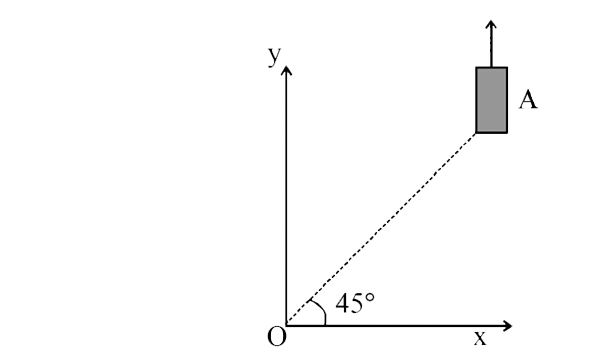
On a frictionless horizontal surface , assumed to be the ` x-y` plane , a small trolley `A` is moving along a straight line parallel to the `y-axis `( see figure) with a constant velocity of `(sqrt(3)-1) m//s ` . At a particular instant , when the line `OA` makes an angle of `45(@)` with the `x - axis ` , a ball is thrown along the surface from the origin `O`. Its velocity makes an angle `phi` with the `x -axis and it hits the trolley .
(a) The motion of the ball is observed from the frame of the trolley . Calculate the angle `theta` made by the velocity vector of the ball with the ` x-axis in this frame .
(b) Find the speed of the ball with respect to the surface , if ` phi = (4 theta )//(4)`.

Text Solution

Verified by Experts
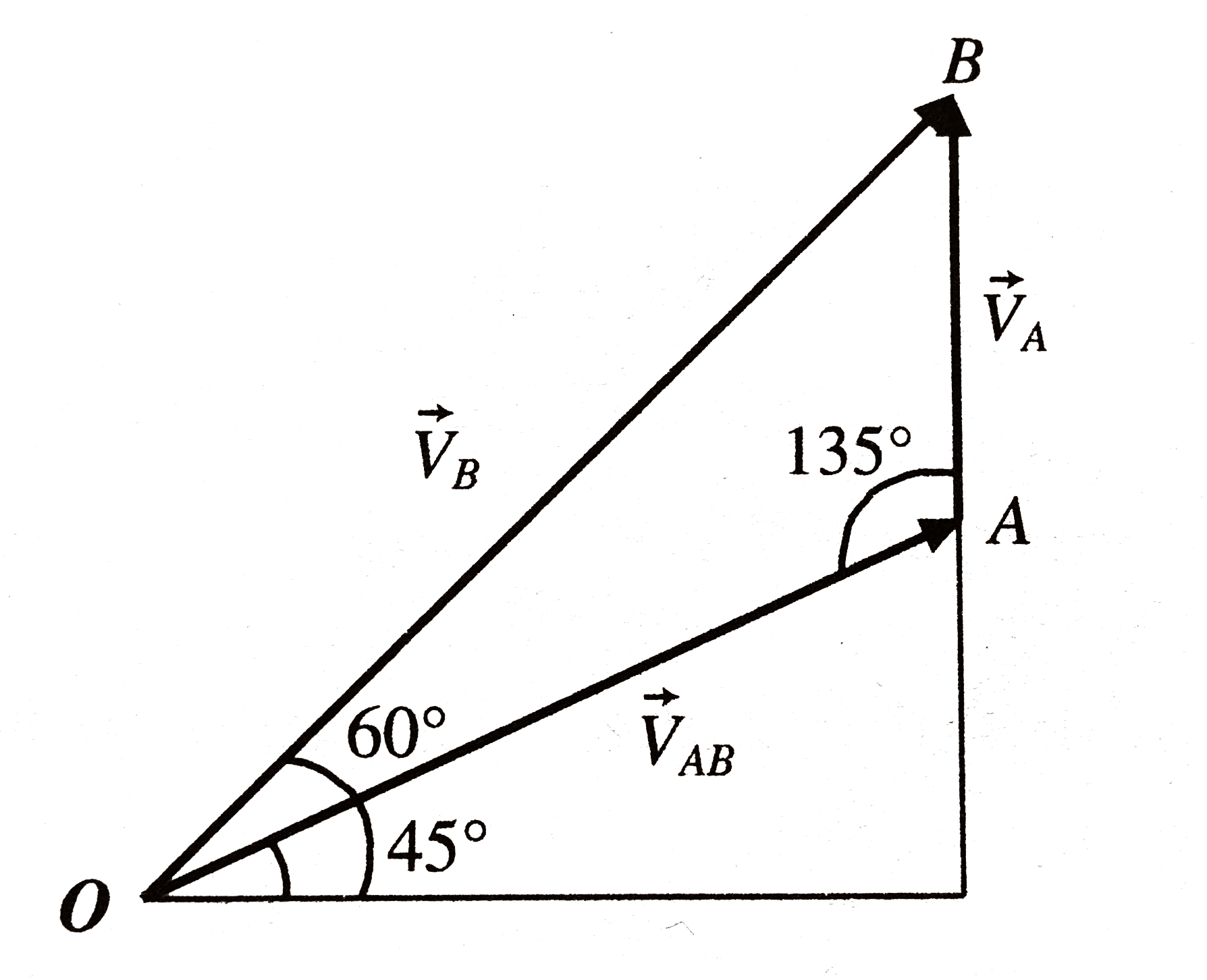
Method 1 : (a) Since the ball hits the trolley, relative to trolley, the velocity of ball should be directed towards the trolley. Hence, in the frame of trolley, the ball will appear to be moving towards `OA`, or in the frame of trolley, ball's velocity will make an angle of `45^@`.
(b) `phi = (4 theta)/(3) = (4 xx 45^@)/(3) = 60^@`
Using sine rule `(V_B)/(sin 135^@) = (V_A)/(sin 15^@)`
`rArr V_B = 2 m s^-1`
Method 2 : (a) Let `A` stands for trolley and `B` for ball.
Relative velocity of `B` will respect to `A (vec v_(B A))` should be along `OA` for the ball to hit the trolley.
Hence, `vec v_(B A)` will make an angle of `45^@` with positive x - axis.
(b) `tan theta = v_(B Ay)/v_(B A x) = tan 45^@ or v_(B A y) = v_(B A x)`...(i)
Further `v_(B Ay) = v_(B y) - v_(A y) or v_(B A x) = v_(B x) - 0` ...(ii)
`v_(B y) - (sqrt(3 - 1))`
`tan theta = v_(B y)/v_(B x) or v_(B y) = v_(B x) tan phi`
From (i),(ii),(iii), and (iv), we get
`v_(B x)= ((sqrt(3 - 1)))/(tan phi - 1) and v_(B y) = ((sqrt(3 - 1)))/(tan theta -1) tan phi`
`phi = (4 theta)/(3) = (4)/(3) (45^@)`
Speed of ball w.r.t. surface,
`v_B = sqrt(v_(B x)^2 + v_(B y)^2) = (sqrt( 3- 1))/(tan phi - 1) sec phi`
Substituting `phi = 60^@`, we get `v_B = 2 ms^-1`.
.
Promotional Banner

Topper's Solved these Questions

  • KINEMATICS-2

    CENGAGE PHYSICS|Exercise Exercise 5.1|15 Videos
  • KINEMATICS-2

    CENGAGE PHYSICS|Exercise Exercise 5.2|25 Videos
  • KINEMATICS-2

    CENGAGE PHYSICS|Exercise Exercise Integer|9 Videos
  • KINEMATICS-1

    CENGAGE PHYSICS|Exercise Integer|9 Videos
  • KINETIC THEORY OF GASES

    CENGAGE PHYSICS|Exercise Compression|2 Videos

Similar Questions

Explore conceptually related problems

A straight line makes an angle of 135^(@) with the X-axis and cuts Y-axis at a distance -5 from the origin. The equation of the line is

Equation of line parallel to X-axis and Y-axis

A particle is moving along a straight line parallel to x-axis with constant velocity. Find angular momentum about the origin in vector form :

A small cart A starts moving on a horizontal surface, assumed to be x-y plane along a straight line parallel to x-axis (see figure) with a constant acceleration of 4 m//s^(2) . Initially it is located on the positive y-axis at a distance 9 m from origin. At the instant the cart starts moving, a ball is rolled along the surface from the origin in a direction making an angle 45° with the x-axis. The ball moves without friction at a constant velocity and hits the cart. (a) Describe the path of the ball in a reference frame attached to the cart. (b) Find the speed of the ball.

Equations of Lines Parallel to the X-axis and Y-axis

A straight line which makes an angle of 60^@ with each of Y and Z-axis, the angle this lines makes with X-axis is

The equation of a straight line which makes an angle 45^(@) with the x-axis with y-intercept 101 units is :

The equation of a straight line which makes an angle 45° with the x-axis with y-intercept 101 units is

A particle moves along a straight line parallel to x-axis at a distancce d = 3 m from it, with constant speed of v = 3 m//s . Another particle stats from the origin with constant acceleration a = 4 m//s^(2) at an angle theta with y-axis along a straight line at the instant the first particle crosses y-axis. Find 'theta' such that the two particle collide.

