Home
Class 11
PHYSICS
Three block A,B,and C of mass m(1),m(2) ...

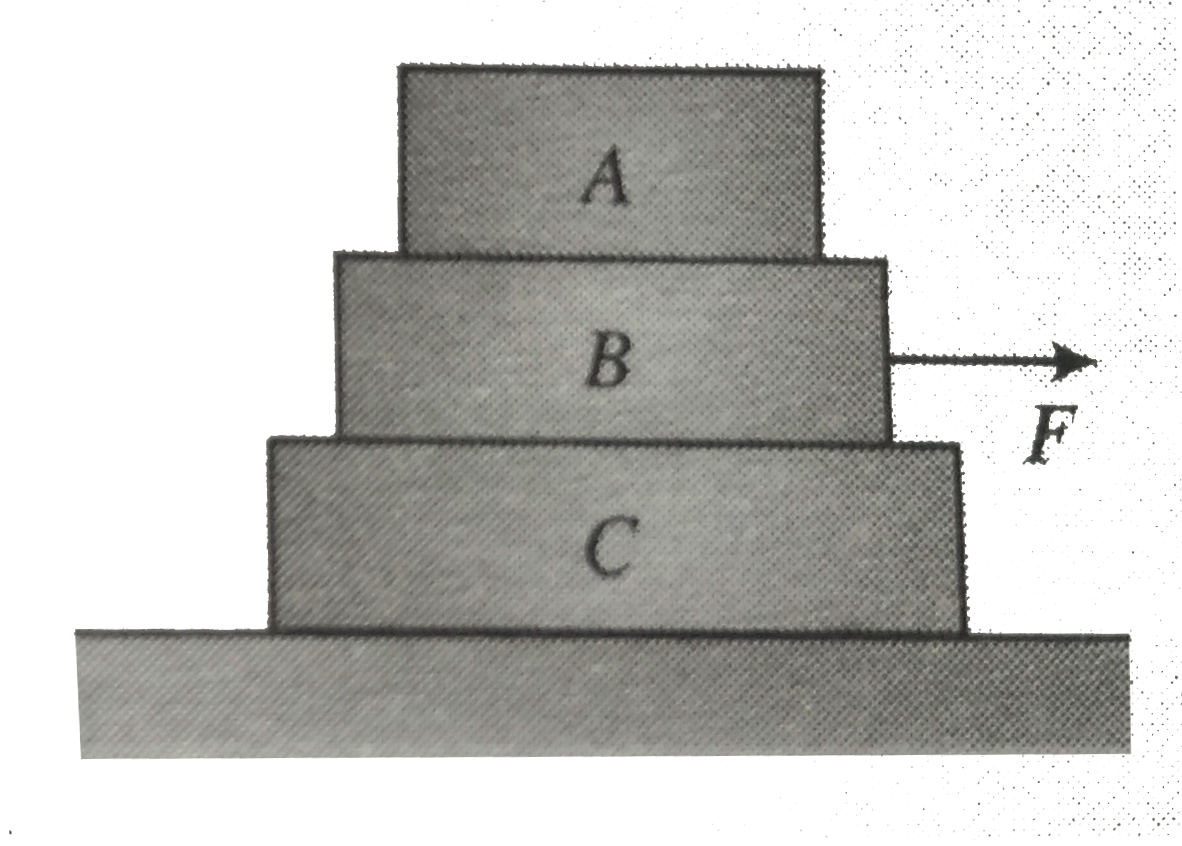
Three block A,B,and C of mass `m_(1),m_(2)` and `m_(3)`, respectively are resting one on top of the other as shown in fig. A horizontal force F is applied on block B. Assuming all the surfaces are frictionless, calculate (1) acceleration of block A, block B, and block C, (2) normal reactions between A and B, B and C, and between C and ground .

Text Solution

Verified by Experts
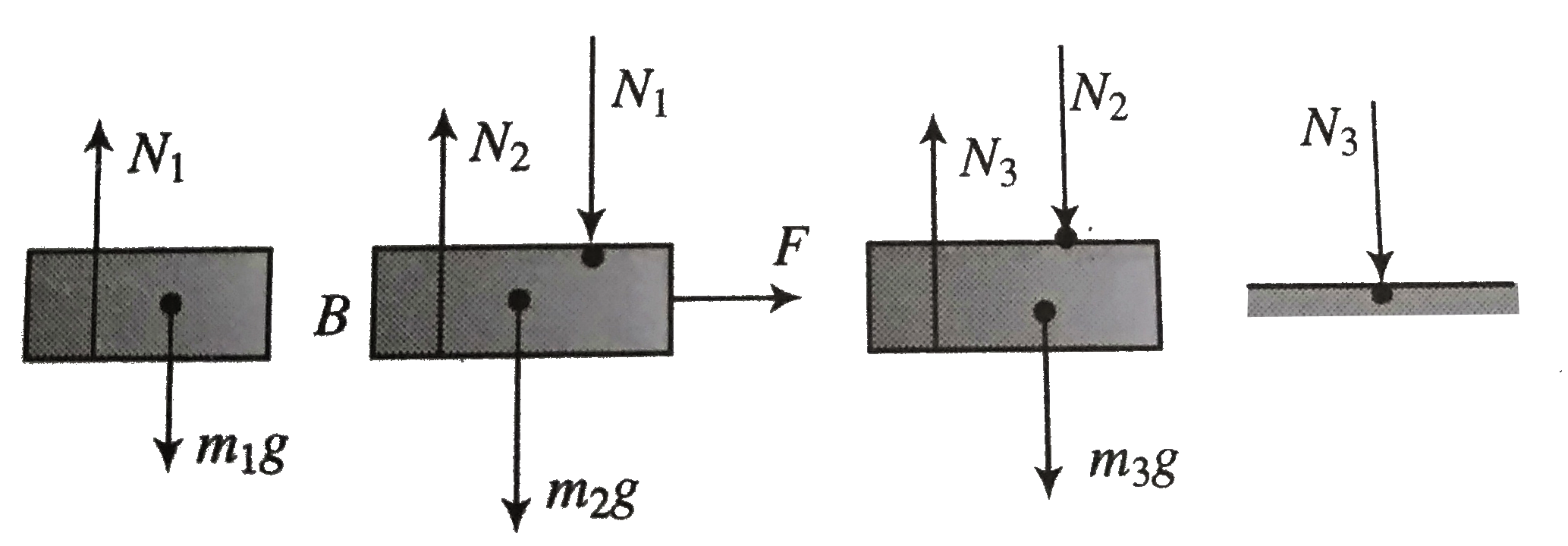
This system cannot be in equilibrium beacause in the horizontal direction, the system has a net external force F. As far as the vertical direction is concerned, all the force are internal action and reaction forces. These forces are equal and opposite, hence, they will cancel each other out

Body A : No external force is acting on it, hence, it will remain stationary in equilibrium. So acceleration at block A, `a_(A)=0` and
`N_(1)=m_(1)g`...(i) ltbr Body B: there is not external force acting on it vertically, hence, it will not have any acceletation in the vertical direction.
`N_(2)=N_(1)+m_(2)g=(m_(1)+m_(2))g` ...(ii)
However, there is one external force F action on it. so it will have some acceleration a in the horizontal direction such that
`F+m_(2)a_(B)` ...(iii)
which gives acceleration of block B , `a_(B) = (F)/(m_(2))`
Body C and earth: Same comments as in the case of body A above.
`N_(3)=N_(2)+m_(3)g` ...(iv)
and `N_(3)=(m_(1)+m_(2)+m_(3))g` ...(v)
No external force acts on block C in the horizontal direction, Hence, `a_( C)` is equal to 0.
Promotional Banner

Topper's Solved these Questions

  • NEWTON'S LAWS OF MOTION 1

    CENGAGE PHYSICS|Exercise Solved Examples|11 Videos
  • NEWTON'S LAWS OF MOTION 1

    CENGAGE PHYSICS|Exercise Exercise 6.1|11 Videos
  • MISCELLANEOUS VOLUME 2

    CENGAGE PHYSICS|Exercise INTEGER_TYPE|10 Videos
  • NEWTON'S LAWS OF MOTION 2

    CENGAGE PHYSICS|Exercise Integer type|1 Videos

Similar Questions

Explore conceptually related problems

Two block of masses m_(1) and m_(2) are placed side by side on a smooth horizontal surface as shown in fig. A horizontal force F is applied on the block . (a) Find the acceleration of each block. (b) Find the normal reaction between the two blocks.

Three blocks A , B and C of masses 4kg , 2kg and 1kg respectively are in contact on a frictionless surface, as shown. If a force of 14N is applied on the 4kg block, then the contact force between A and B is.

Two blocks of mass m_(1) and m_(2) lie on smooth horizontal table in contact with each other as shown in figure If a force F is applied to the mass m_(1) then the contact force between the block will be

A force F is applied on block A and B and between the blocks B and C respectively are (Assume frictionless surface)

Blocks are in contact on a frictionless table. A horizontal force F=3N is applied to one block as shown. The force exerted by the smaller block m_(2) on block m_(1) is :

Blocks are in contact on a frictionless table. A horizontal force F = 3N is applied to one block as shown. The force exerted by the smaller block m_(2) on block m_(1) is-

A single horizontal force F is applied to a block of mass M_(1) which is in contact with another block of mass M_(2) . If the surfaces are frictionless, the force between the blocks is

Two blocks A and B are as shown in figure. The minimum horizontal force F applied to the block B for which slipping behins between B and ground is :

The metal blocks A and B of masses 2 kg and 1 kg , respectively are in contact on a frictionless table A constant horizontal force of 3 N is applied to the block A . Calculate the force of constant between the two blocks . If the same force is applied to the block B then what will be the force of contact ? Can you explain the difference ?

