Home
Class 11
PHYSICS
A bead of mass m is fitted on a rod and ...

A bead of mass m is fitted on a rod and can move on it without friction. Initially the bead is at the middle of the rod moves transitionally in the vertical plane with an accleration `a_(0)` in direction forming angle `alpha` with the rod as shown. The acceleration of bead with respect to rod is:
`z`

Text Solution

Verified by Experts
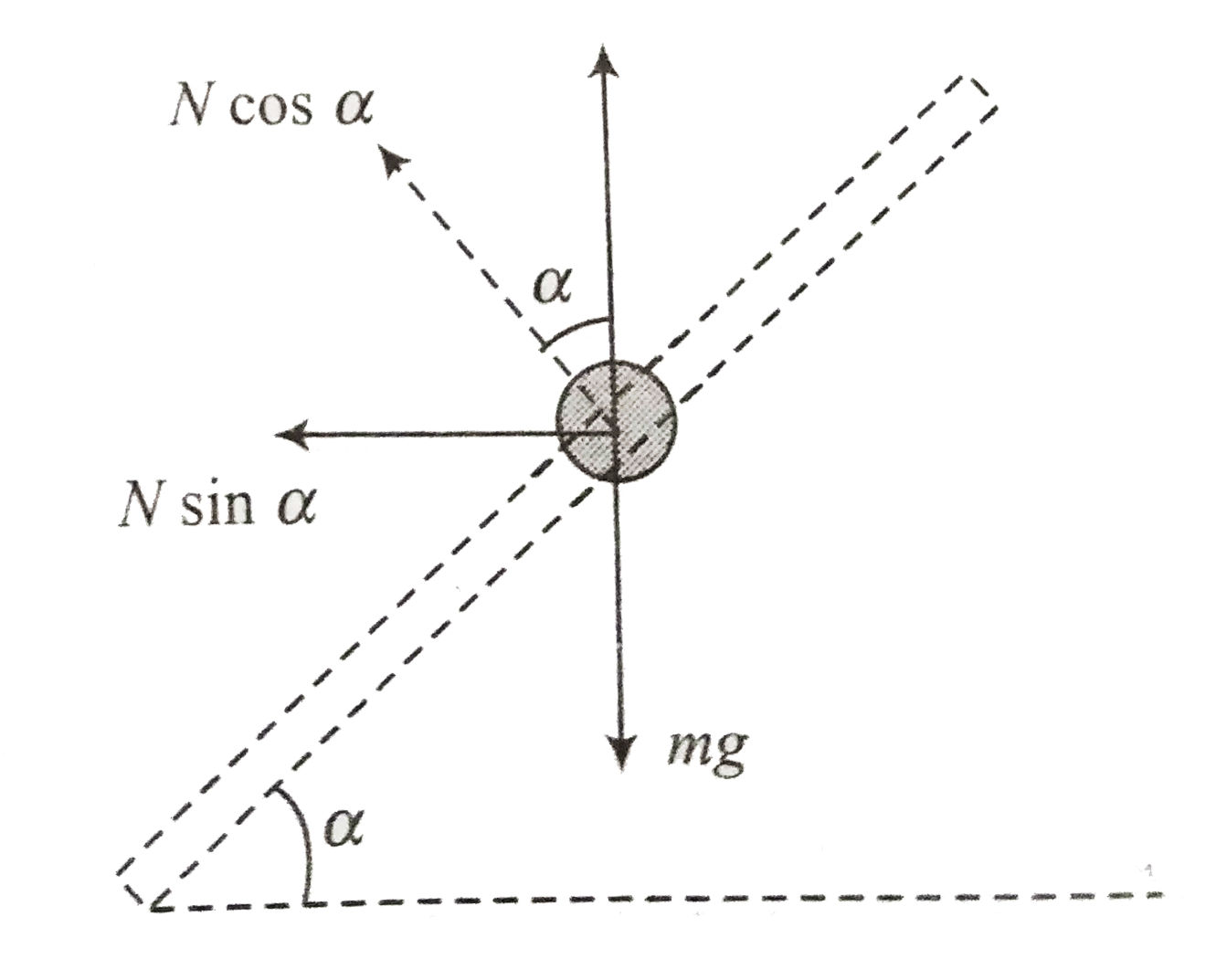
Method 1: Observation from ground frame. Let `(a_r)` be the acceleration of the bead relative to the rod. Then `a_( r) cos alpha` is the leftward acceleration of the bead relative to the bead relative to the rod and `a_( r) sin alpha` is downward relative acceleration of the rod. If `a_(y)` and `a_(x)` be the absolute leftward horizontal and downward vertical acceleration of the bead , then
`(vec(a)_(bead))_(x)=(vec(a)_(bead,rod))_(x)+(vec(a)_(rod))_(x)`
or `a_(x)=a_(r) cos alpha+a` ...(i)
and `a_( r) sin alpha =a_(y)-0`
or `a_(y)=a_(r )sin alpha`...(ii)
From FBD of the bead (projecting forces vertically and horizontally)

`mg-N cos alpha =ma_(r ) sin alpha` ...(i)
and `N sin alpha =m(a_(r ) cos alpha +a)` ...(ii)
Eliminating N between (i) and (ii)
`mg sin alpha = ma_(r)+ma cos (alpha)`
or, `a_(r ) = g sin alpha -a sin alpha`
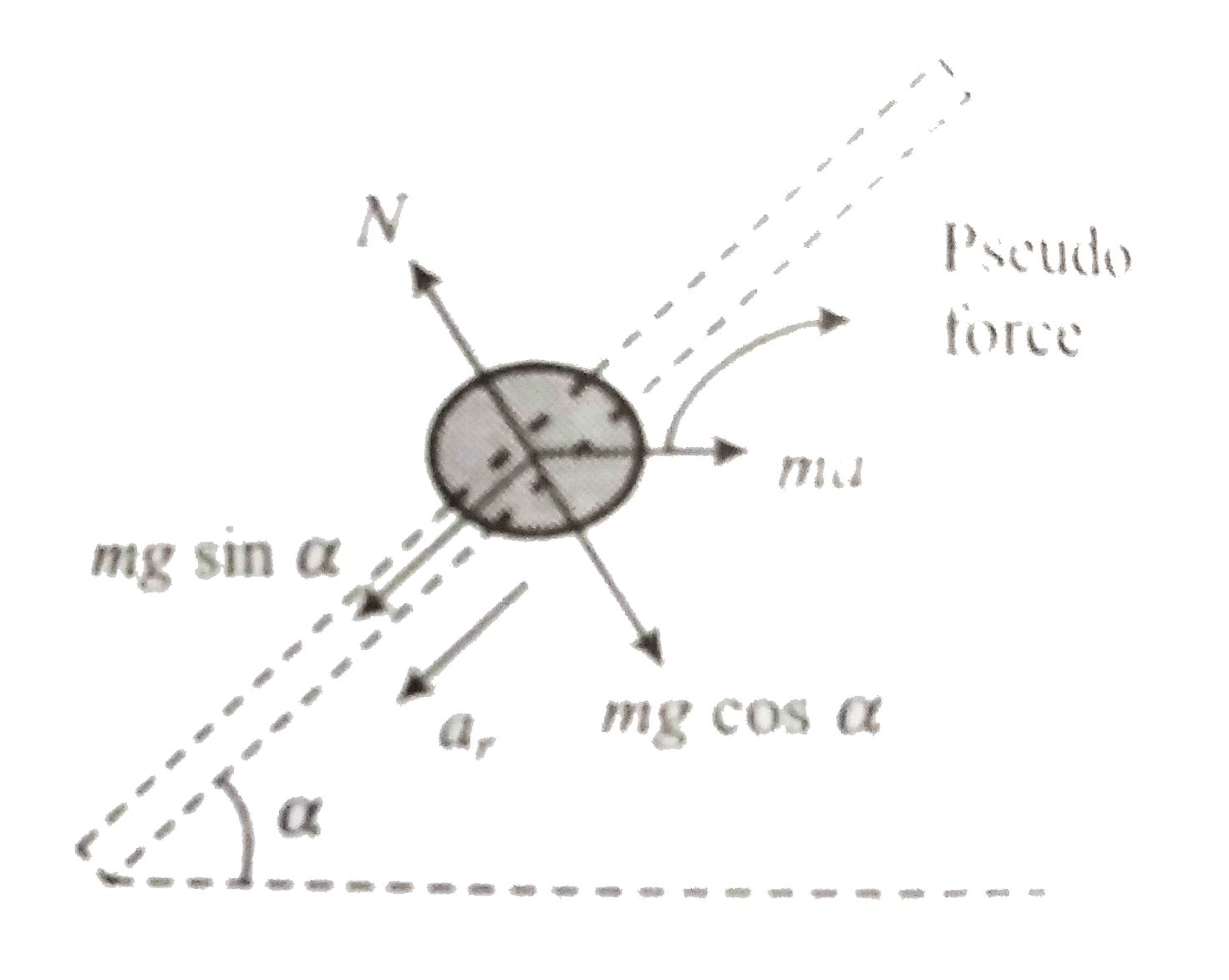
Method 2: Observation from an observer moving with rod. Consider bead w.r.t rod i.e. from non-inertial frame. A pseudo force of magnitude ma will act on the bead in the direction opposite to accelerator of rod, i.e. in right direction

The bead is not moving perpendicular to rod. Hence,
`N=mg cos alpha + ma sin alpha`
Also in the direction along the rod, let acceleration of the bead w.r.t rod is `a_(r )`.
Equation of motion of bead with rod,
`mg sin alpha - ma cos alpha = ma_(r )`
`implies a_( r) = g sin alpha - a cos alpha`.
Promotional Banner

Topper's Solved these Questions

  • NEWTON'S LAWS OF MOTION 1

    CENGAGE PHYSICS|Exercise Solved Examples|11 Videos
  • NEWTON'S LAWS OF MOTION 1

    CENGAGE PHYSICS|Exercise Exercise 6.1|11 Videos
  • MISCELLANEOUS VOLUME 2

    CENGAGE PHYSICS|Exercise INTEGER_TYPE|10 Videos
  • NEWTON'S LAWS OF MOTION 2

    CENGAGE PHYSICS|Exercise Integer type|1 Videos

Similar Questions

Explore conceptually related problems

A bead of mass m moves on a rod without friction. Initially the bead is at the middle of the rod and the rod moves translationally in a vertical plane with an acceleration a_(0) in a direction forming angle theta with the horizontal as shown in the given figure. The acceleration of bead with respect to rod is

A ring of radius R lies in vertical plane. A bead of mass 'm' can move along the ring without friction. Initially the bead is at rest the bottom most point on ring. The minimum horizontal speed v with which the ring must be pulled such that the bead completes the vertical circle.

A rod of mass 'm and length L is attached to a L shaped plank at 'A'. rod can move freely about A. A string is tied between rod and plank as shown in figure. Whole system is moving with a constant acceleration g in x-direction If string is cut at any instant then the angular acceleration of rod (with respect to the plank) at that instant is

A rod touches a disc kept on a smooth horizontal plane. If the rod moves with an acceleration a , the disc rolls on the rod without acceleration a , the disc rools on therod without slidding. Then , the acceleration of the disc w.r.t the rod is

A smooth uniform rod of length L and mass M has two identical beads of negligible size each of mass m which can slide freely along the rod. Initially the two beada are at the centre of the rod and the system is rotating with an angular velocity omega_0 about an axis perpenducular to the rod and passing through the midpoint of the rod. There are no external forces. When the beads reach the ends of the rod, the angular velocity of the system is ......

Two balls of mass m and 4m are connected by a rod of length L. The mass of the rod is small and can be treated as zero . The size of the balls also can of the neglected . We also assume the centre of the rod is hinged ,but the rod can rotate about its centre in the vertical plane without friction . What is the gravity - induced angular acceleration of the rod when the angle between the rod and the vertical is theta as shown ?

A unifrom rod of length l and mass m is free to rotate in a vertical plane about A as shown in Fig. The rod initially in horizontal position is released. The initial angular acceleration of the rod is

A rod of mass 'm and length L is attached to a L shaped plank at 'A'. rod can move freely about A. A string is tied between rod and plank as shown in figure. Whole system is moving with a constant acceleration g in x-direction Force exerted by hinge on the rod is

The Fig. showns a string of equally placed beads of mass m, separated by distance. The beads are free to slide without friction on a thin wire. A constant force F act on the first bead initially at rest till it makes collision with the second bead. The second bead then collides with the third and so on. Supposed that all collisions are elastic,