Home
Class 11
PHYSICS
If the pulley is massles and moves with ...

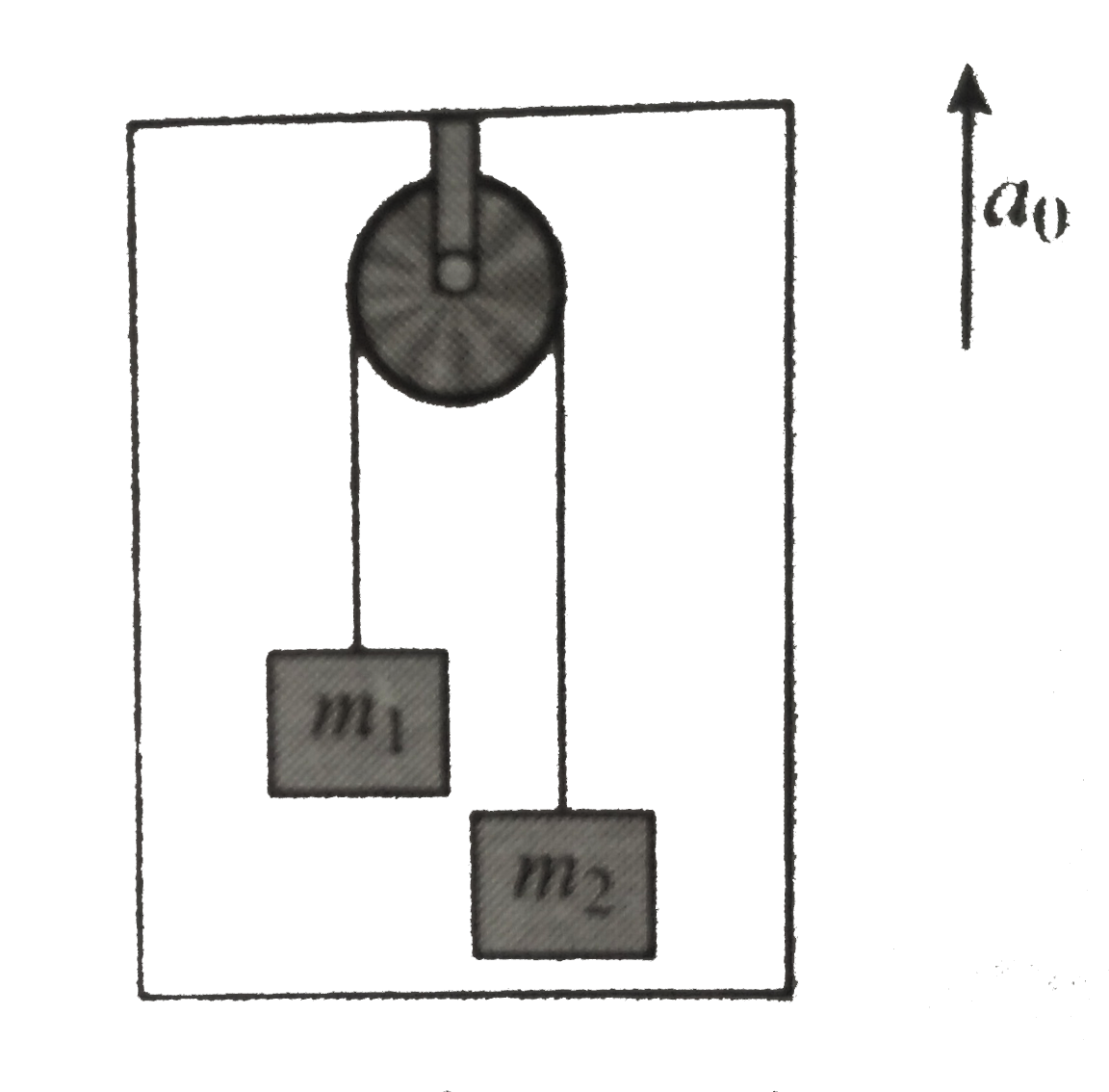
If the pulley is massles and moves with an upward acceleration `a_(0)`. Find the acceleration of `(m_1)and (m_2)` w.r.t to elevator.

Text Solution

Verified by Experts
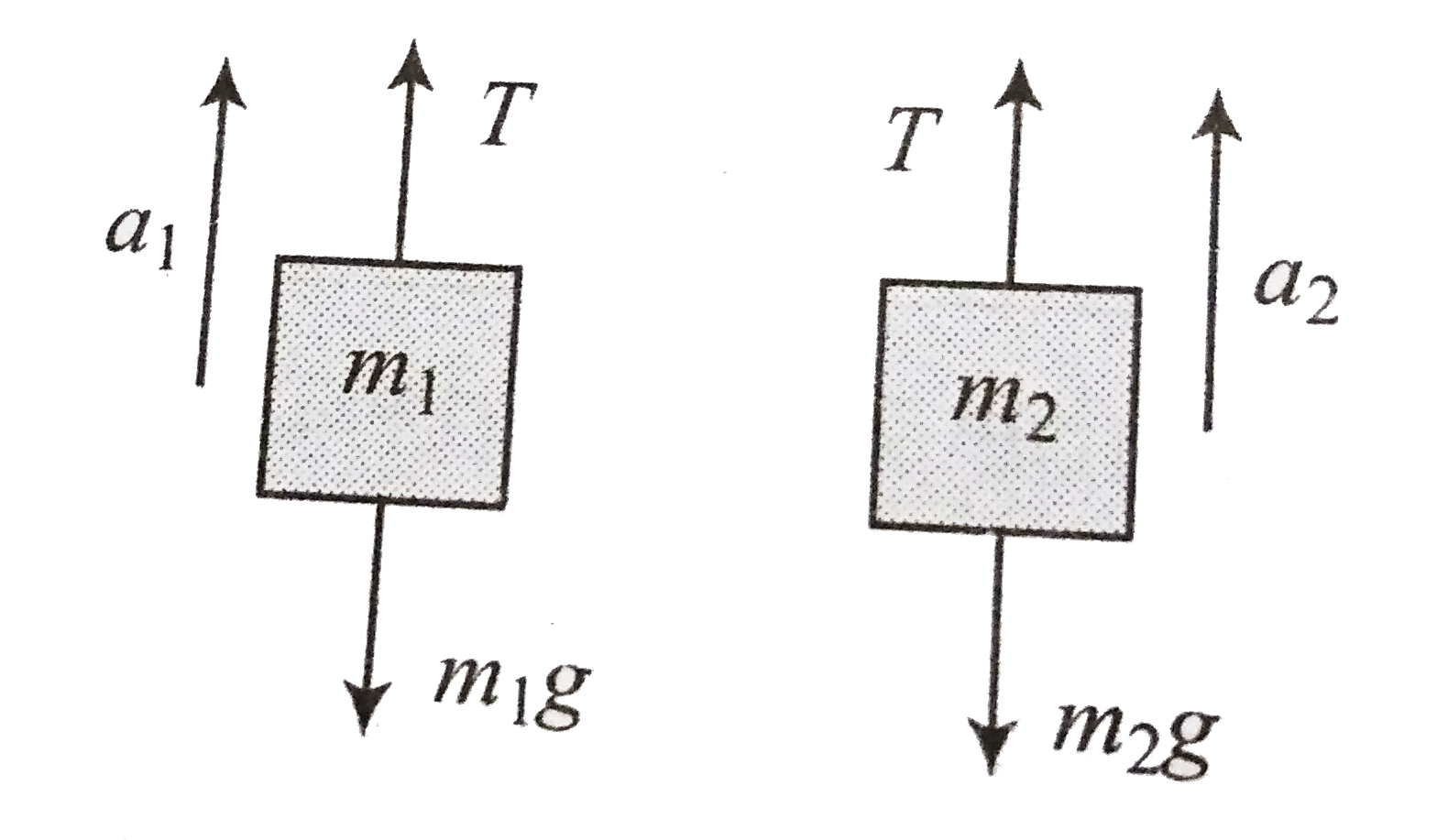
Method 1: (Ground frame) :

Let acceleration of block `m_(1)` with respect to pulley be a (upward) and the acceleration of `m_(2)` w.r.t pulley is a (down ward)
Equation of motion for '`m_(1)`'
`T-m_(1)g=m_(1)a_(1)` ...(i)
`T-m_(2)g=m_(2)a_(2)` ...(i)
`vec(a)_(1)=vec(a)_(1,p)+vec(a)_(p)=a+a_(0)` ...(iii)
`vec(a)_(2)=vec(a)_(2,p)+vec(a)_(p)= -a+a_(0)` ...(iv)
subsituting `a_(1)` from (iii) in (i),
`T-m_(1)g=m_(1)(a+a_(0))` ...(v)
Subsituting `a_(2)` from (iv) in (ii)
`T-m_(2)g=m_(2)(-a+a_(0))` ...(vi)
Solving (v) and (iv),
`T=(2m_(1)m_(2))/(m_(1)+m_(2))(g+a_(0))`
and `a=(m_(2)-m_(1))/(m_(1)+m_(2))(g+a_(0))` .
Method 2: Solving problem from non-inertial frame of reference
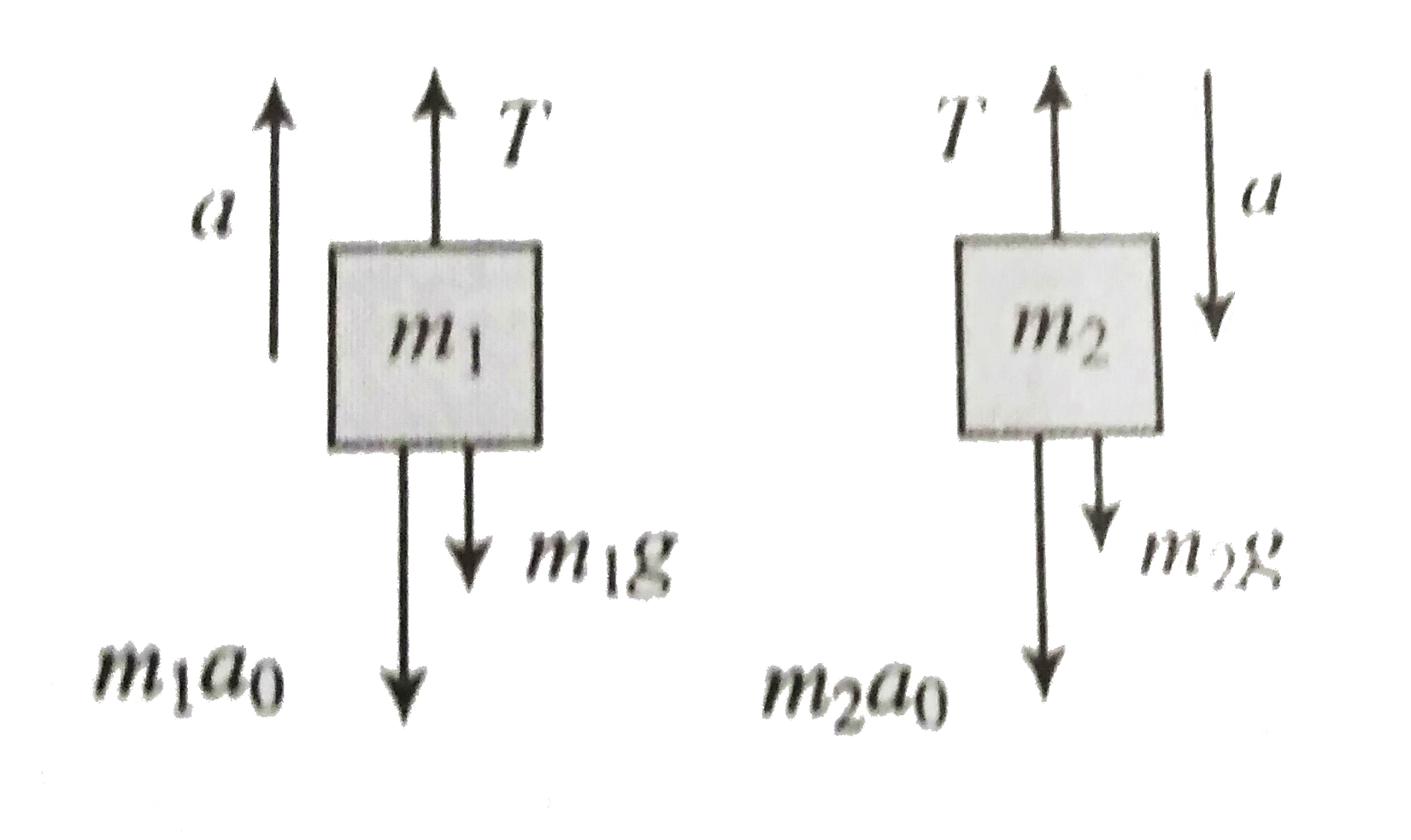
Let us build the equations by using Newton's second law sittion on the accelerationg pulley. Hence, we impose pseudo force `m_(1)a_(0)` darr and `m_(2)a_(0)darr` on both `m_(1)` and `m_(2)`, respectively, in addition to the upward tension and their weight 1 `m_(1)gdarr m_(2)g darr`, respectively. If `m_(1)` accelerates up relative to the pulley, `m_(2)` must accelerate down relative to the pulley with acceleration a.

Force equation:
for `m_(1):T-m_(1)g-m_(1)a_(0)=m_(1)a` ..(i)
for `m_(2):m_(2)a_(0)-T=m_(2)a`...(ii)
Solving (i) and (ii) we have
`a=(m_(2)-m_(1))/(m_(1)+m_(2))(g+a_(0))`.
Promotional Banner

Topper's Solved these Questions

  • NEWTON'S LAWS OF MOTION 1

    CENGAGE PHYSICS|Exercise Solved Examples|11 Videos
  • NEWTON'S LAWS OF MOTION 1

    CENGAGE PHYSICS|Exercise Exercise 6.1|11 Videos
  • MISCELLANEOUS VOLUME 2

    CENGAGE PHYSICS|Exercise INTEGER_TYPE|10 Videos
  • NEWTON'S LAWS OF MOTION 2

    CENGAGE PHYSICS|Exercise Integer type|1 Videos

Similar Questions

Explore conceptually related problems

In the fig, find the acceleration of m_(1) and m_(2)

In the fig, find the acceleration of m_(1) and m_(2) .

Find the acceleration of C w.r.t. ground.

In the Fig. shown pulley moves with acceleration vec(v)_(P) . Let acceleration of blocks m_(1) and m_(2) w.r.t. ground are vec(v)_(1) and

If block A is moving with an acceleration of 5ms^(-2) , the acceleration of B w.r.t. ground is

Two blocks of masses m_(1) and m_(2) are connected by massless threads. The pulleys are massless and smooth if a_(1) is the magnitude value of acceleration of m_(1) and a_(2) is the magnitude value of acceleration of m_(2) find the ratio of a_(1)/a_(2)

A pulley fixed to the ceiling of an elevator car carries a thread whose ends are attached to the masses m_(1) and m_(2) . The car starts going up with an acceleration a_(0) . Assuming the masses of the pulley and the thread as well as the friction to be negligible, find: (a) the acceleration of the load m_(1) relative to the elevator shaft and relative to the car (b) the force exerted by the pulley on the ceiling of the car. Given m_(1) gt m_(2) .

A pulley with two blocks system is attached to the ceiling of a lift upward with an acceleration a_(0) . Find the deformation in the spring.

A pulley fixed to the ceiling of an elevator car carries a thread whose ends are attached to the loads of masses m_1 and m_2 . The car starts going up with an acceleration w_o . Assuming the masses of the pulley and the thread, as well as the friction, to be negligible find: (a) the acceleration of the load m_1 relative to the elevator shaft and relative to the car, (b) the force exerted by the pulley on the ceiling of the car.

In the pulley system shown here, find the relationship between acceleration of m_(1),m_(2) and m_(3)