Home
Class 11
PHYSICS
A block of mass m is placed on the incli...

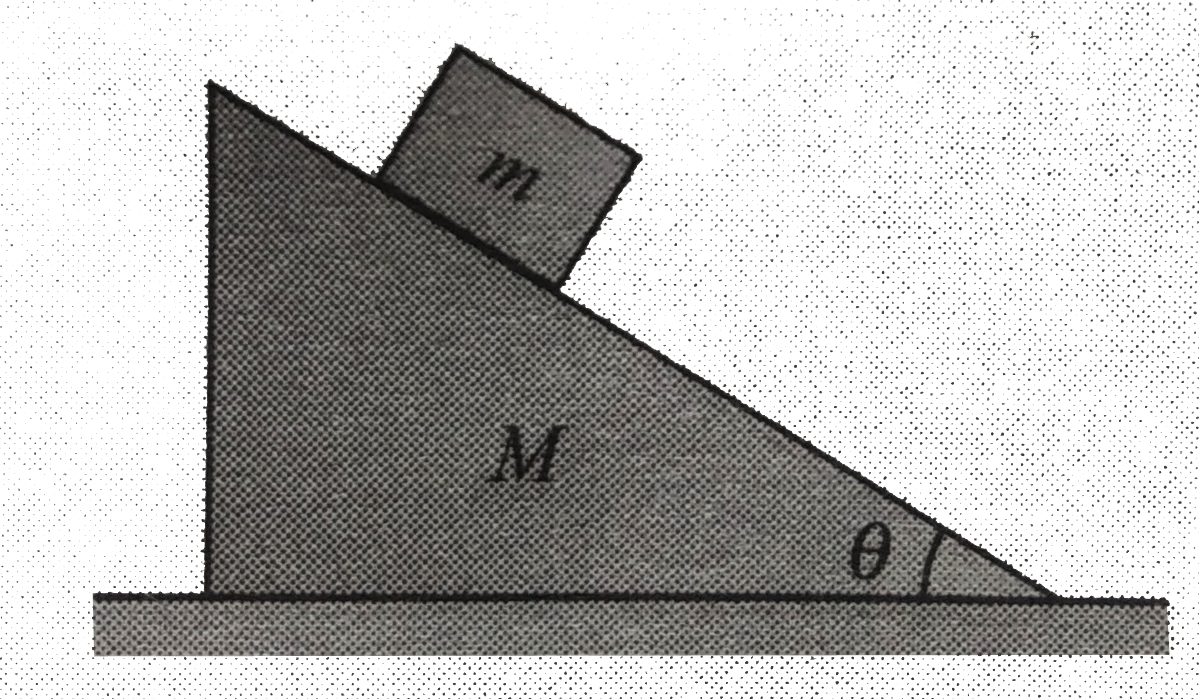
A block of mass m is placed on the inclined sufrace of a wedge as shown in fig. Calculate the acceleration of the wedge and the block when the block is released. Assume all surfaces are frictionless.

Text Solution

Verified by Experts

Constraint relation. Approach 1
We can observe that the wedge M can only move in horizontal direction towards left, and the block m can slide on inclined surface of M always in contact with the wedge.
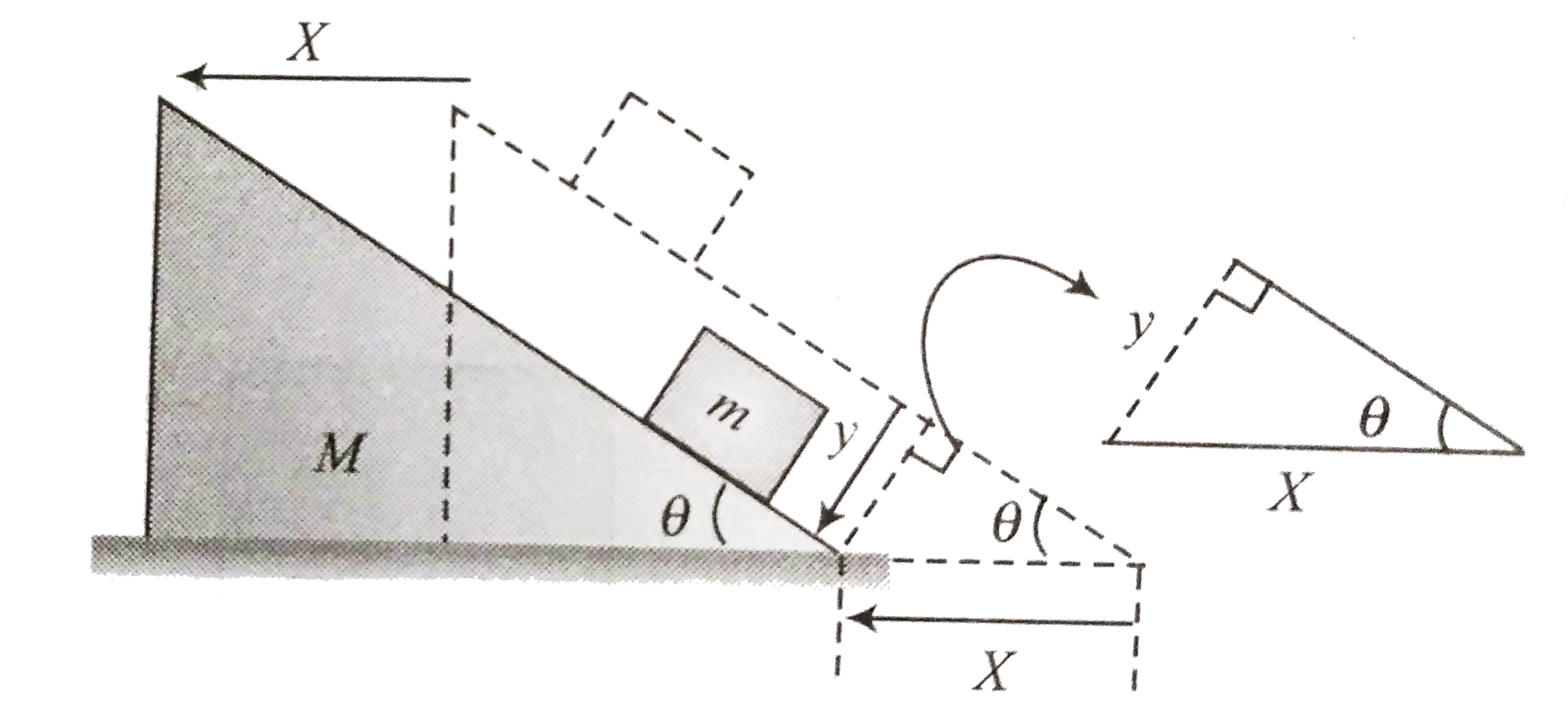
`*` Let us define our x and y axes parallel to the incline and perpendicular to incline. respectively.
`*` We can observe that the dispalcement of m and M in `-x'` direction will be same as the block never lose contact with the wedge.
`*` If the wedge moves in the horizontal direction by a distance x', during this time, the block will move x in x' direction.
`*` We can relate these displacement x and X as
`y/X = sin thata implies y=X sin theta` ..(i)
Hence, velocity relation can be written as :
`vy=V sin theta` ..(ii)
and acceleration relation can be written as:
`v_(x)=A sin theta` ..(iii)
Here `v_(y)` and `a_(y)` are the velocity and acceleration of the block, respectively, in the direction perpendicular to inclined surface.
Approach 2: We consider the motion of the block parallel to incline and perpendicular to inclined surface. Let the components of acceleration of block with respect to ground along these direction are `a_(x)` and `a_(y)` respectively.
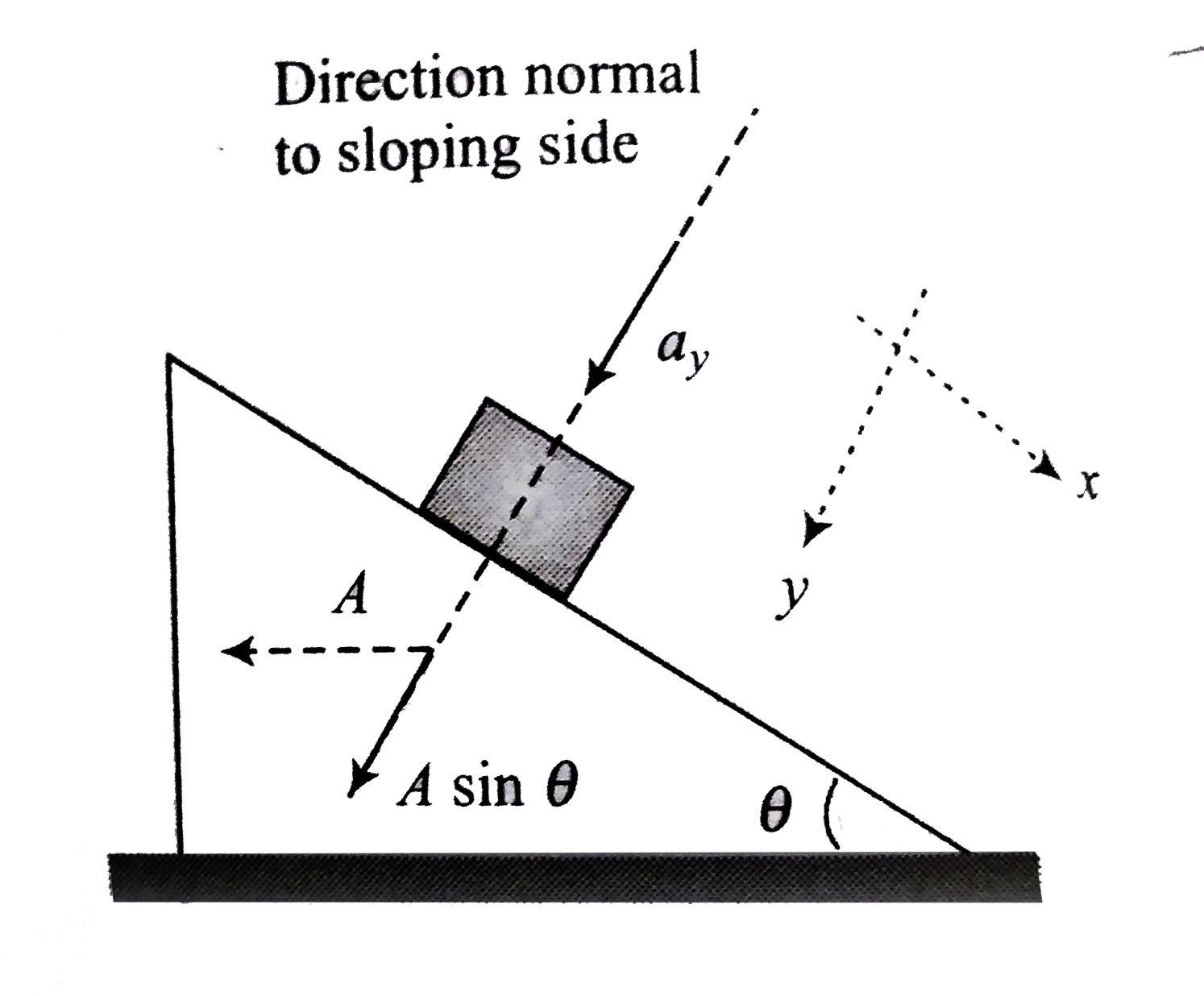
Then we can write `a_(y)=A sin theta`
For wedge:
`N sin theta=MA`...(i)
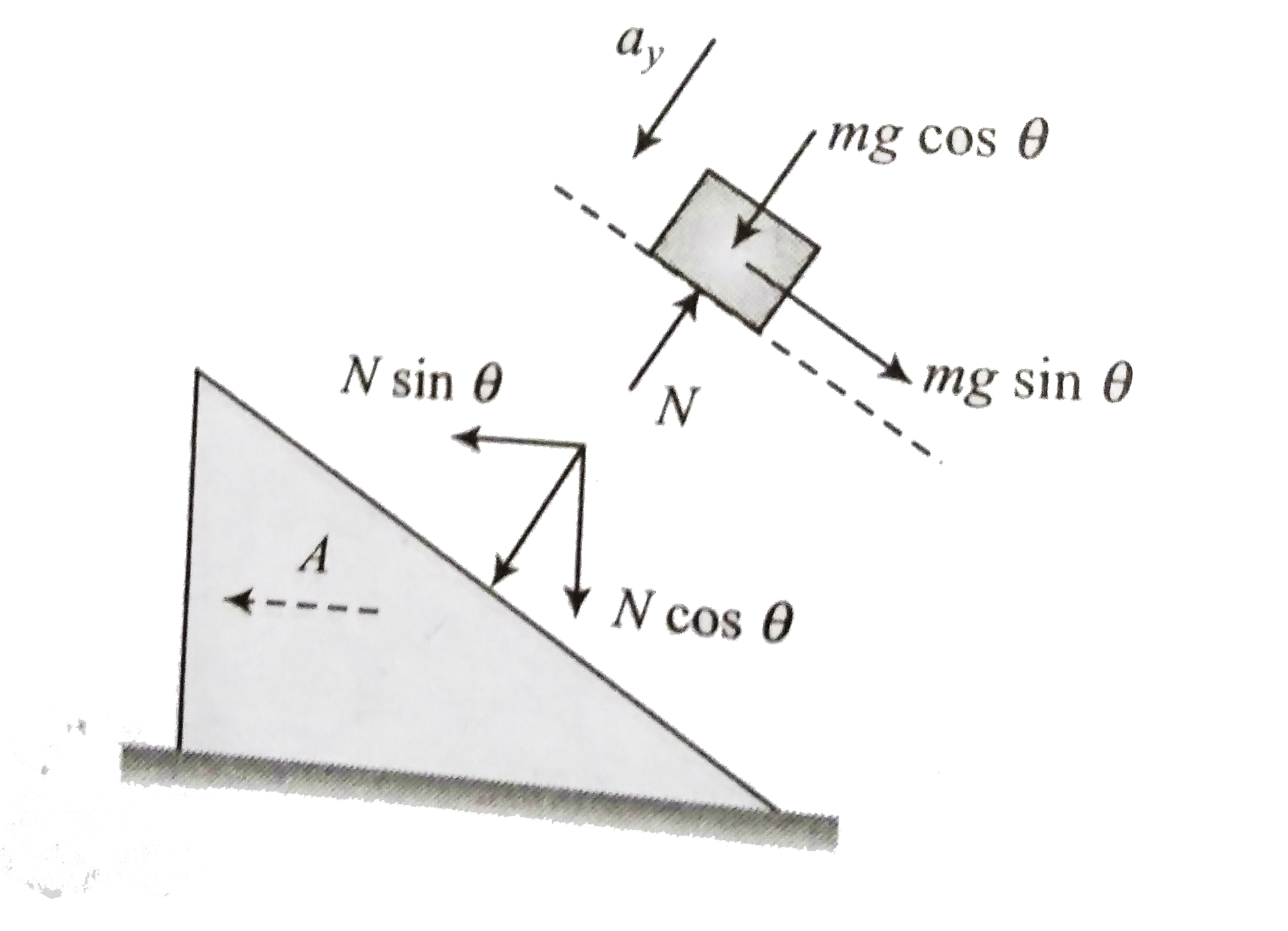
For block: Considering the block in the direction perpendicular to sloping surface.
`mg cos theta-N=ma_(y)`
but `a_(y)=A sin theta`
Hence, `mg cos theta-N=mA sin theta` ...(ii)
From (i) and (ii), we get
`A=(mg sin theta cos theta)/(M+m sin^(2)theta)`.
Promotional Banner

Topper's Solved these Questions

  • NEWTON'S LAWS OF MOTION 1

    CENGAGE PHYSICS|Exercise Solved Examples|11 Videos
  • NEWTON'S LAWS OF MOTION 1

    CENGAGE PHYSICS|Exercise Exercise 6.1|11 Videos
  • MISCELLANEOUS VOLUME 2

    CENGAGE PHYSICS|Exercise INTEGER_TYPE|10 Videos
  • NEWTON'S LAWS OF MOTION 2

    CENGAGE PHYSICS|Exercise Integer type|1 Videos

Similar Questions

Explore conceptually related problems

A block of mass m is initially lying on a wedge of mass M with an angle of inclination theta as shown in figure. Calculate the displacement of the wedge when the block is released and reaches to the bottom of the wedge.

A block is released on the convex surface of a hemispherical wedge as shown in Fig. Determine the displacement of the wedge when the block reaches the angular position theta

A block of mass m is at rest on a rought wedge as shown in figure. What is the force exerted by the wedge on the block?

In fig. mass m is being pulled on the incline of a wedge of mass M. All the surfaces are smooth. Find the acceleration of the wedge.

A block of mass 1 kg is placed on a wedge shown in figure. Find out minimum coefficient of friction between wedge and block to stop the block on it.

A block A (mass 4M) is placed on the top of a wedge block B of base length l (mass=20M) as shown in figure. When the system is released from rest. Find the distance moved by the block B till the block A reaches ground Assume all surfaces are frictionless.

A block of mass m slides down on inclined wedge of same mass m as shown in figure . Friction is absent everywhere . Acceleration of centre of mass of the block and wedge is

A wedge of mass M makes an angle theta with the horizontal. The wedge is placed on horizontal frictionless surface. A small block of mass m is placed on the inclined surface of wedge. What horizontal force F must be applied to the wedge so that the force of friction between the block and wedge is zero ?

A block of mass m is released from a wedge of mass m as shown in figure . Find the time taken by the block to reach the end of the wedge.

A block of mass m is released from the top of a wedge of mass M as shown in figure. Find the displacement of wedges on the horizontal ground when the block reaches the bottom of the wedges. Neglect friction everywhere.

