Home
Class 11
PHYSICS
A block of mass M is connected with a pa...

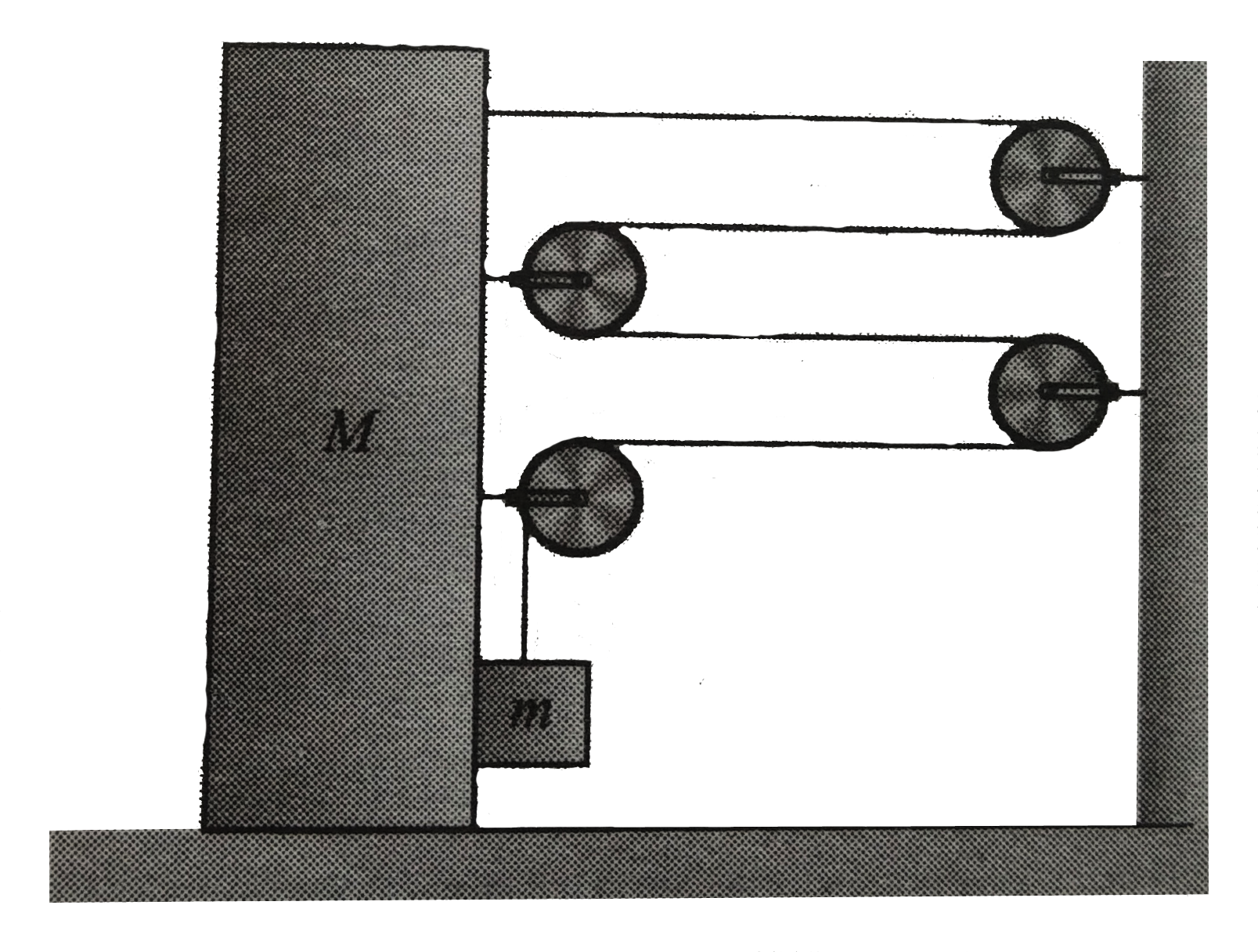
A block of mass M is connected with a particle of mass m by a light inextensible string as shown in fig. Assuming all contaction surfaces as smooth, find the acceleration of the wedge after releasing the system.

Text Solution

Verified by Experts
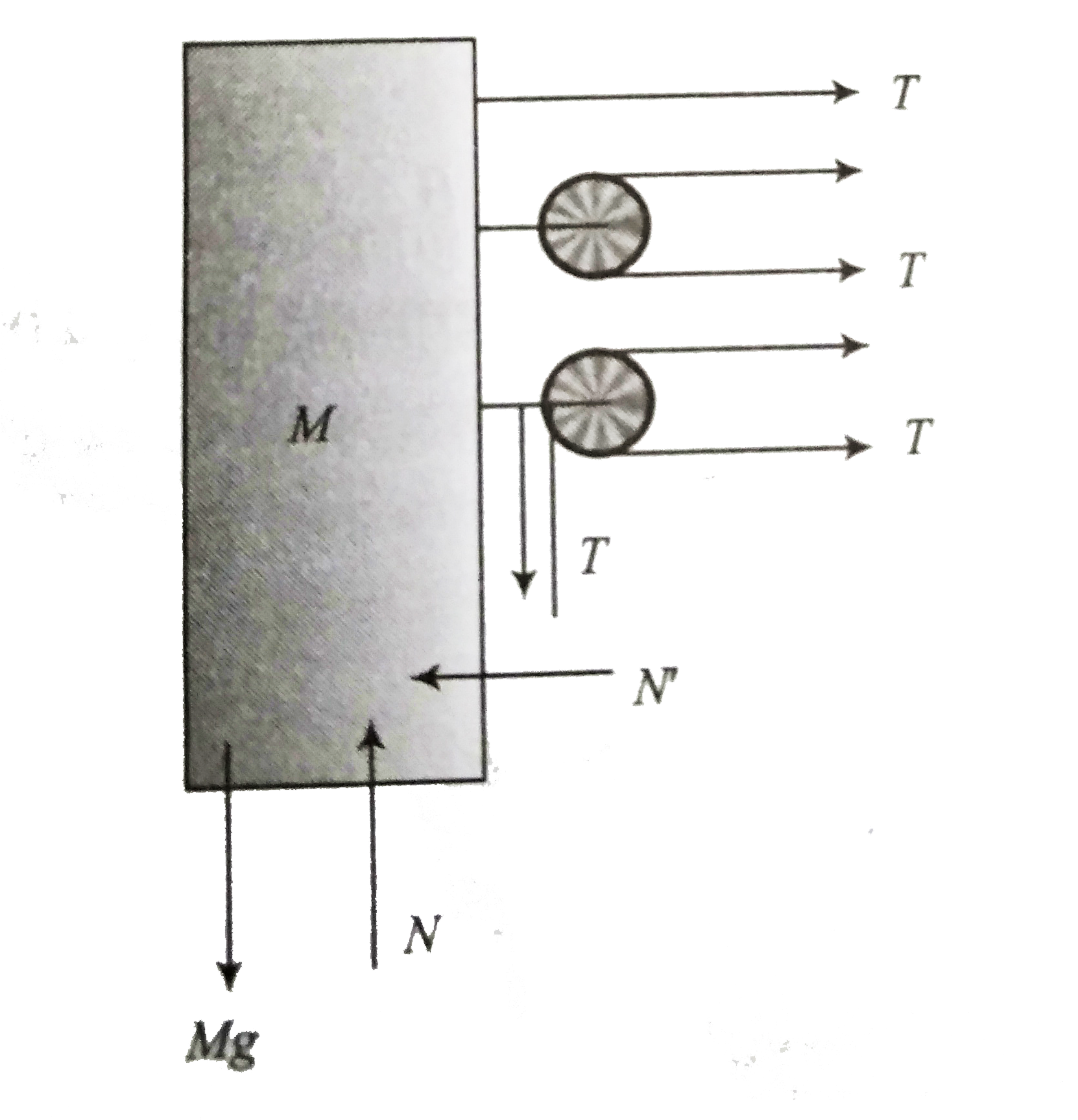
From the constraint relationship shown in fig.
`\`
`y+4x=l`
`implies (dy)/(dt)+(4dx)/(dt)=0`
`implies (d^(2)y)/(dt)+(4d^(2)x)/(dt)=0`
`implies a_(2)=4a_(1)` (numerically)...(i)
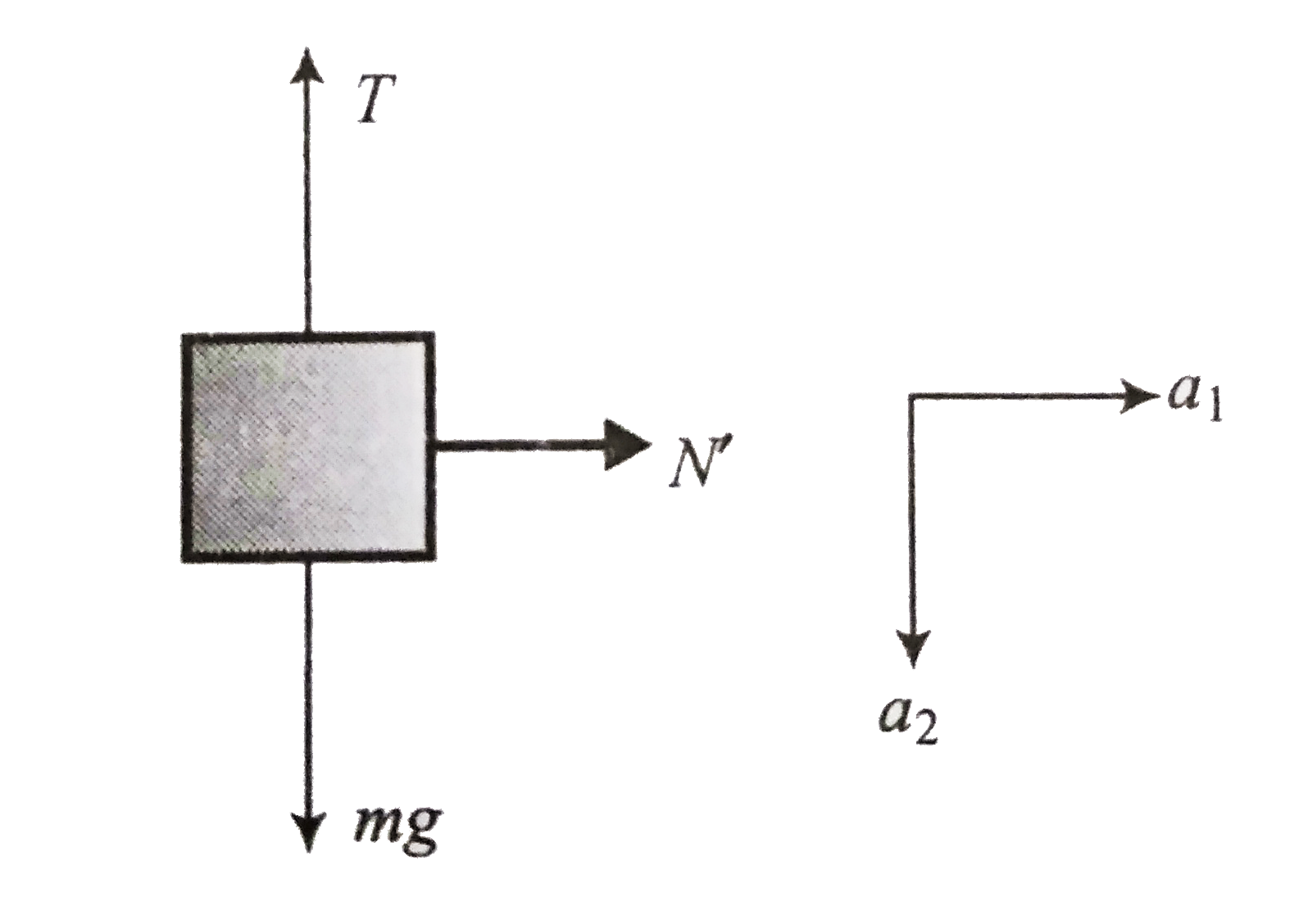
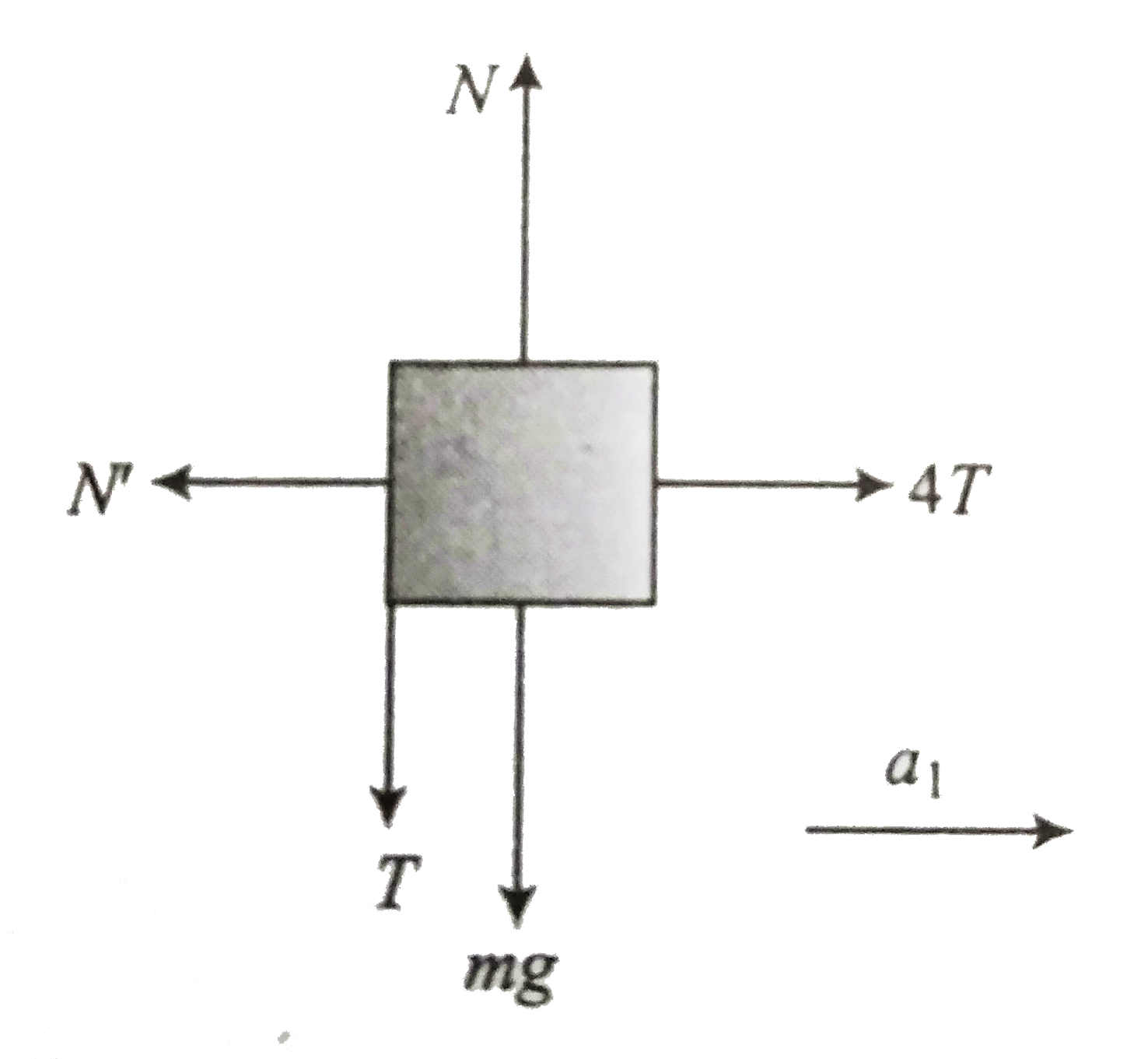
Where `a_(1)` is the acceleration fo M and `a_(2)` is the acceleration of m, with respect to M.
Equation for M
`Sigma F_(x)=Ma_(1)implies4T-N'=Ma_(1)` ...(ii)

For `m, Sigma F_(y)=ma_(2)implies mg - T=ma_(2)` ...(iii)
`Sigma F_(x)=ma_(1)implies N'=ma_(1)` ...(iv)
(ii)+(iv) `implies a_(1)=(4T)/(M+m)` ...(v)

Putting `a_(2)=4a_(1)` from (i) and `T=((M+m)a_(1))/(4)`
From (v) in (iii) we obtain
`mg-((M+m)a_(1))/(4)=m(4a_(1))`

`implies a_(1)=(4mg)/(M+17m)`.
Promotional Banner

Topper's Solved these Questions

  • NEWTON'S LAWS OF MOTION 1

    CENGAGE PHYSICS|Exercise Solved Examples|11 Videos
  • NEWTON'S LAWS OF MOTION 1

    CENGAGE PHYSICS|Exercise Exercise 6.1|11 Videos
  • MISCELLANEOUS VOLUME 2

    CENGAGE PHYSICS|Exercise INTEGER_TYPE|10 Videos
  • NEWTON'S LAWS OF MOTION 2

    CENGAGE PHYSICS|Exercise Integer type|1 Videos

Similar Questions

Explore conceptually related problems

All surfaces are smooth. The acceleration of mass m relative to the wedge is

All surfaces are smooth The acceleration of mass m relative to the wedge is .

In fig. mass m is being pulled on the incline of a wedge of mass M. All the surfaces are smooth. Find the acceleration of the wedge.

In the Fig. shown, mass 'm' is being pulled on the incline of a wedge of mass M. All the surface are smooth. Find the acceleration of the wedge.

Assuming all the surfaces to be smooth, find the acceleration of the triangular block of mass M when the block of mass m slides on it.

All the surfaces are smooth as shown in figure. The acceleration of mass m relative to wedge is :

A block of mass m_(1)=2 kg is kept on a smooth horizontal table. Another block of mass m_(2)=1 kg is connected to m_(1) by a light inextensible string passing over a smooth pulley as shown in the figure. If the blocks are released, what will be the (a) acceleration of each block (b) tension in the string?

Two block of masses m_(1) and m_(2) are in equilibrium. The block m_(2) hangs from a fixed smooth pulley by an inextensible string that is fitted with a light spring of stiffness k as shown in fig. Neglecting friction and mass of the string, find the acceleration of the bodies just after the string S is cut.

Two blocks of mass M and 2M are connected to the two ends of a light, inextensible string passing over an ideal pulley as shown in figure. The system is released from rest. (a) One second after the system is released, a particle of mass M hits the block of mass M and sticks to it. The particle hits the block with a speed of 10 m/s while travelling downward. Find the total distance travelled by block of mass 2M after it is released. (b) One second after the system is released, a particle of mass 2M hits the block of mass M and sticks to it. The particle hits the block with a speed of 10 m/s while travelling in upward direction. Find distance travelled by the block of mass 2M after it is released to the time it comes to rest for the first time (g = 10 m//s)^(2)

A block of mass m is placed on a wedge of mass M and a force F is acting on its as shown . If all surfaces are smooth , find the force F such that, there is no relative motion between m and M.