Home
Class 11
PHYSICS
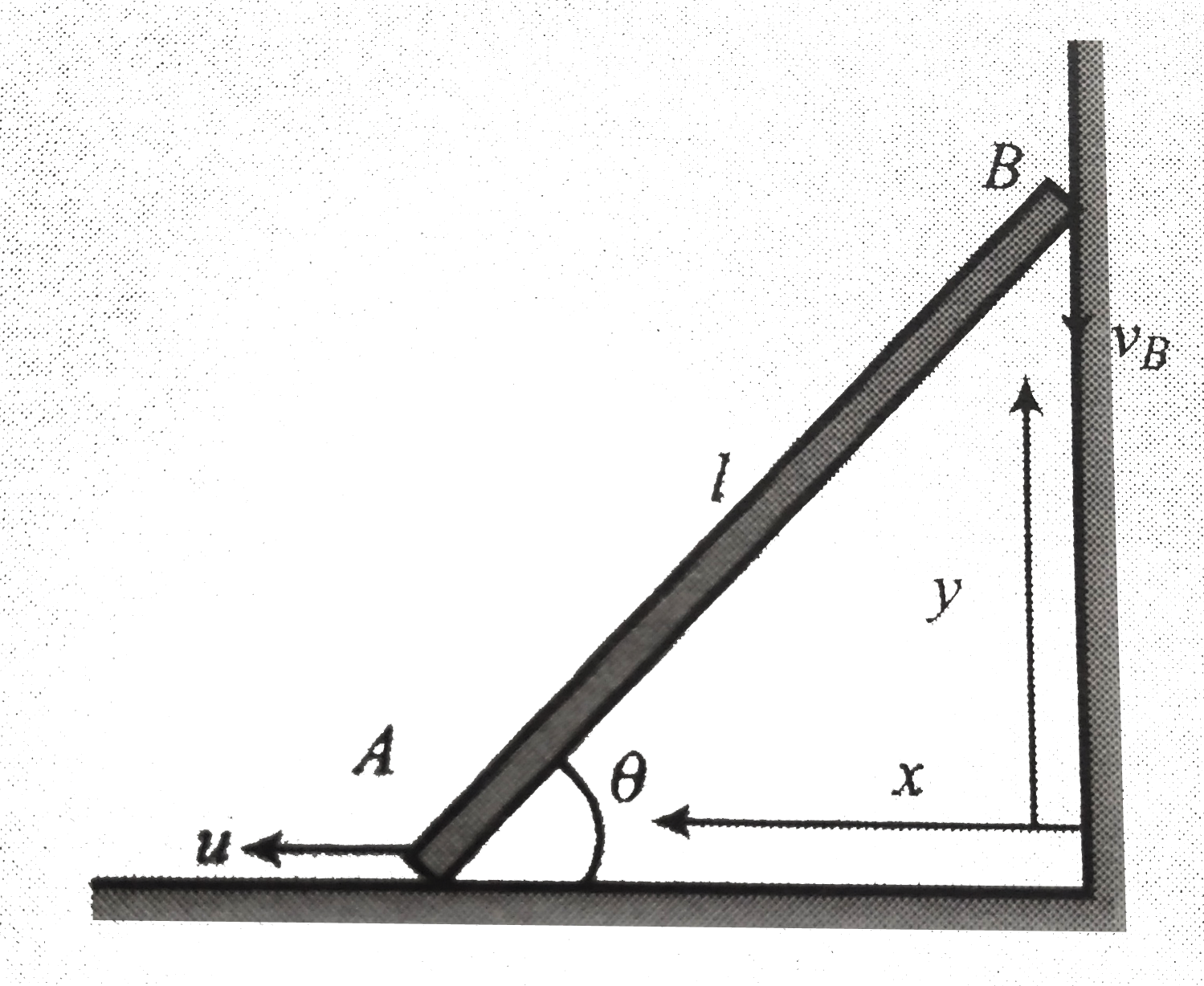
Figure shows a rod of length l resting o...

Figure shows a rod of length l resting on a wall and the floor. Its lower end A is pulled towards left with a constant velocity u. As a result of this, end A starts moving down along the wall. Find the velocity of the other end B downward when the rod makes an angle `theta` with the horizontal.

Text Solution

Verified by Experts

Let us first find the relation between the two displacements. Then differentiate with respect to time. Here if the distance from the corner to the point A is x and that up to B is y, the left velocity of pointA can be given as `v_(A)=(dx)//(dt)` and that of B can be given as `v_(B)=-(dy)//(dt)` (negative sign indicates y decreasing).
If we relate x and y: `x^(2)+y^(2)=l^(2)`
Differentiating with respect to t, `2x(dx)/(dt)+2y(dy)/(dt)=0`
`implies xv_(A) = yv_(B) =xu=yv_(B) implies v_(B) = u(x)/(y)=u cot theta`
Alternatively: In cases where distance between two points is always fixed, we can say the relative velocity of one point of an object with respect to any other point of the same object in the direction of the lime joining them will always remain zero, as their separation always remains constant.
Here, in the above example, the distance between the points A and B of the rod always remains constant, thus, the two points must have the same velocity components in the direction of their line joining, i.e., along the length of the rod.
If point B is moving down with velocity `v_(B)` its component along the length of the rod is `v_(B) sin theta`. Similarly the voelcity components of point A along the length of rod is `u cos theta`. Thus, we have `v_(B) sin theta=u cos theta` or `v_(B)=u cot theta`.
Promotional Banner

Topper's Solved these Questions

  • NEWTON'S LAWS OF MOTION 1

    CENGAGE PHYSICS|Exercise Solved Examples|11 Videos
  • NEWTON'S LAWS OF MOTION 1

    CENGAGE PHYSICS|Exercise Exercise 6.1|11 Videos
  • MISCELLANEOUS VOLUME 2

    CENGAGE PHYSICS|Exercise INTEGER_TYPE|10 Videos
  • NEWTON'S LAWS OF MOTION 2

    CENGAGE PHYSICS|Exercise Integer type|1 Videos

Similar Questions

Explore conceptually related problems

Figure shows a rod of length l resting on a wall and the floor. Its lower end A is pulled towards left with a constant velocity v. Find the velocity of the other end B downward when the rod makes an angle theta with the horizontal.

Consider a rod of length l resting on a wall and the floor. If the velocity of the upper end of a rod A is v_(0) in downward direction, find the velocity of the lower end B at this iinstant, when the rod makes an angle theta with horizontal

End A of a rod AB is being pulled on the floor with a constant velocity v_(0) as shown. Taking the length of the rod as l , at an instant when the rod makes an angle 37^@ with the horizontal, calculate the velocity of the CM of the rod

A uniform thin rod of mass m and length l is standing on a smooth horizontal suface. A slight disturbance causes the lower end to slip on the smooth surface and the rod starts falling. Find the velocity of centre of mass of the rod at the instant when it makes an angle theta with horizontal.

A uniform thin rod of mass m and length l is standing on a smooth horizontal surface. A slight disturbance causes the lower end to slip on the smooth surface and the rod starts falling. Find the velocity of centre of mass of the rod at the instant when it makes an angle theta with horizontal.

A rod of length 'l' is inclined at an angle 'theta' with the floor against a smooth vertical wall. If the end A moves instantaneously with velocity v_(1) what is the velocity of end B at the instant when rod makes 'theta' angle with the horizontal .

The end B of the rod AB which makes angle theta with the floor is being pulled with a constant velocity v_(v) as shown. The length of the rod is l .

A light rigid rod of length l is constrained to move in a vertical plane, so that its ends are along the x and y axes respectively. Find the instantaneous axis of rotation of the rod when it makes an angle theta with horizontal.

A rod of length L is sliding on a frictionless surface as shown in the figure. Velocity of end A is 4m//s along the wall. Find the velocity of end B, when end B makes 30^(@) with wall PQ.
