Home
Class 11
PHYSICS
A smooth semicircular wire-track of radi...

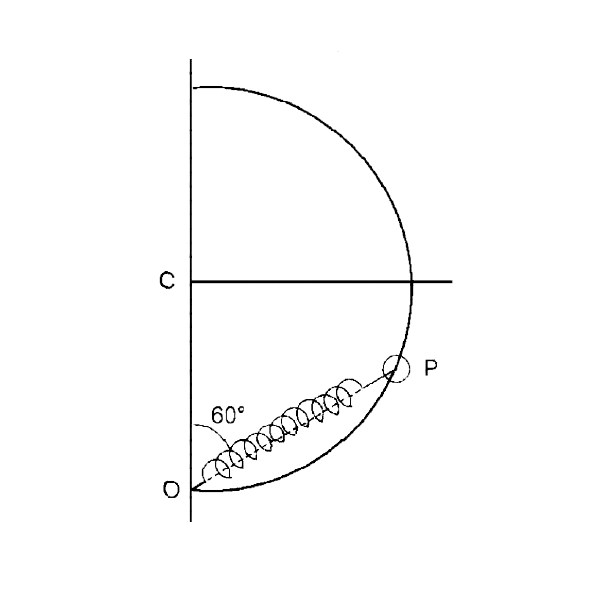
A smooth semicircular wire-track of radius R is fixed in a vertical plane. One end of a massless spring of natural length `3R//4` is attached to the lowest point O of the wire-track. A small ring of mass m, which can slide on the track, is attached to the other end of the spring. The ring is held staionary at point P such that the spring makes an angle of `60^@` with the vertical. The spring constant `K=mg//R`. Consider the instant when the ring is released, and (i) draw the free body diagram of the ring, (ii) determine the tangential acceleration of the ring and the normal reaction.

Text Solution

Verified by Experts
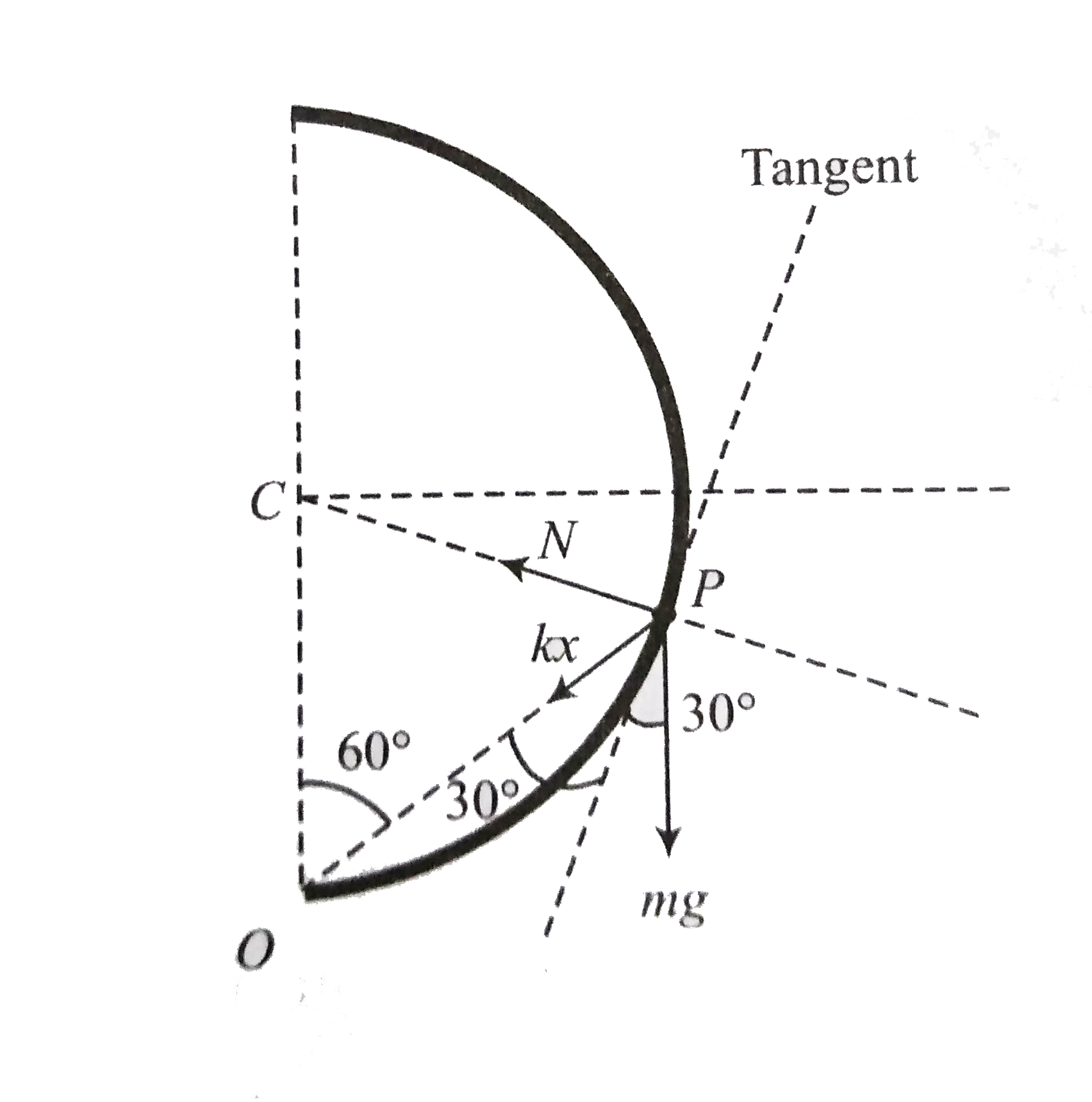
1. The free-body diagram of the ring is shown in fig. the force acting on the ring are:

a. The weight mg acting vertically downwards
(b) Normal force N by the wire track.
Normal force on the ring could be either radially outwards or radially inwards depending on whether the ring presses against the inner surface or outer surface of the track. To ascertaion whether normal force is inwards or outwards, assume thatm to begin with, it is inwards. Then from `Sigma vec(F)=mvec(a)`, find the value of normal force. If it is positive, it is inwards and if it id negative, it is outwards.
(c ) Force of the spring kx. In the given physical situation, the spring is extended, it will pull the ring. So the spring force kx is along the spring towards O.
2. Lenght of spring in the position shown=R.(CP=CO=R, `/_COP= /_OPC=60^(@), /_COP` is equilateral)
Change in length of the spring `=R-(3/4)R=(R/4)`
`kx=((mg)/(R ))(R/4)=(mg)/(4)`
Now from `F_(t)=ma_(t)`,
`((mg)/(4))cos 30^(@)+mg cos 30^(@)=ma_(t)implies a_(t)=(5sqrt(3))/(8)g`
Now consider in radial direction
`N+kx cos 60^(@)=mg cos 60^(@)`
`N=mg cos 60^(@)-kx cos 60^(@)`
`=mg(1/2)-((mg)/(4))*(1/2)=3/8 mg`.
Promotional Banner

Topper's Solved these Questions

  • NEWTON'S LAWS OF MOTION 1

    CENGAGE PHYSICS|Exercise Solved Examples|11 Videos
  • NEWTON'S LAWS OF MOTION 1

    CENGAGE PHYSICS|Exercise Exercise 6.1|11 Videos
  • MISCELLANEOUS VOLUME 2

    CENGAGE PHYSICS|Exercise INTEGER_TYPE|10 Videos
  • NEWTON'S LAWS OF MOTION 2

    CENGAGE PHYSICS|Exercise Integer type|1 Videos

Similar Questions

Explore conceptually related problems

A smooth semicircular wire track of radius R if fixed in a vertical plane. One end of massless spring of netural length (3R)/(4) is attached to the lowest point O of the wire track. A small ring of mass m which can slide on the track is attched to the other end of the spring. the ring is held stationary at point P such that the spring makes an angle of 60^(@) with the vertical. The spring constant is K = (mg)/(R ) . considering the instance when the ring is released, the free body diagram of the ring, when a_(T) is tengential acceleration, F is restoring force and N is normal reaction is

one end of a spring of naturla length ha and spring constant k is fixed at the ground and the other is fitted with a smooth ring of mass m which is alowed to slide on a horizontal rod fixed at a height h figure. Initialy, the spring makes an angle of 37^0 with the vertical when teh system is released from rest. find teh speed of the ring when teh spring becomes vertical.

One end of a light spring of natural length d and spring constant k is fixed on a rigid wall and the other is attached to a smooth ring of mass m which can slide without friction on a vertical rod fixed at a distance d from the wall. Initially the spring makes an angle of 37^(@) with the horizontal as shown in fig. When the system is released from rest, find the speed of the ring when the spring becomes horizontal. [ sin 37^(@) = 3/5]

A spring has natural length 40 cm and spring constant 500 N//m . A block of mass 1 kg is attached at one end of the spring and other end of the spring is attached to a ceiling. The block is relesed from the position, where the spring has length 45 cm .

A smooth circular track of mass M is vertically hung by a string down the ceiling. Two small rings, each of mass m , are initially at rest at the top of the track. They then slide down simultaneously along the track in opposite directions. Find the position of the rings when the tension in the string is zero.

A particle of mass m is fixed to one end of a massless spring of spring constant k and natural length l_(0) . The system is rotated about the other end of the spring with an angular velocity omega ub gravity-free space. The final length of spring is

One end of a light spring of natural length 4m and spring constant 170 N/m is fixed on a rigid wall and the other is fixed to a smooth ring of mass (1)/(2) kg which can slide without friction in a verical rod fixed at a distance 4 m from the wall. Initially the spring makes an angle of 37^(@) with the horizontal as shown in figure. When the system is released from rest, find the speed of the ring when the spring becomes horizontal.

One end a light spring of natural length d and spring constant k ( = mg //d) is fixed on a rigid support and the other end is fixed to a smoth ring of mass m which can slide without friction on a vertical rod fixed at a distance d from the support. Initially , the spring makes an angle of 37^(@) with the horizontal as shown in the figure. The system is released from rest. The speed of the ring at the same angle subtended downward will be

A spring with one end attached to a mass and the other to a right support is stretched and released

In the figure shown there is a smooth tube of radius 'R' fixed in the vertical plane A ball 'B' of mass 'm'is released from the top of the tube B slides down due to gravity and compresses the spring the end 'C' of the spring is fixed and the end A is free Initially the line OA makes an angle of 60^(@) with OC and finally it makes an angle of 30^(@) after compression find the spring constant of the spring

