Home
Class 11
PHYSICS
In fig. the man and the platform togethe...

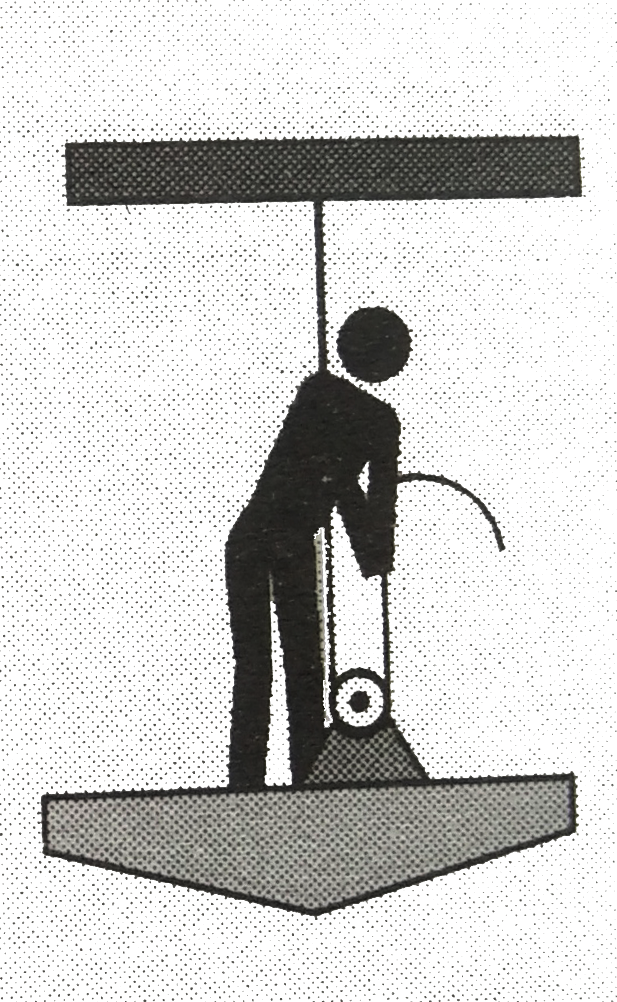
In fig. the man and the platform together weight 950N. The pulley can be treated as frictionless. Determine how hard the man has to pull on the rope to lift himself upward above the ground with constant velocity. If the weight of man is 550 N, what is the normal reaction between them?

Text Solution

Verified by Experts

Taking man and platform together on system with constant velocity.
`T=950 N`=force applied by man from FBD of man only,
`N=T+550 =950+550`
`=1500N`
Promotional Banner

Topper's Solved these Questions

  • NEWTON'S LAWS OF MOTION 1

    CENGAGE PHYSICS|Exercise Exercise 6.3|19 Videos
  • NEWTON'S LAWS OF MOTION 1

    CENGAGE PHYSICS|Exercise Exercise 6.4|13 Videos
  • NEWTON'S LAWS OF MOTION 1

    CENGAGE PHYSICS|Exercise Exercise 6.1|11 Videos
  • MISCELLANEOUS VOLUME 2

    CENGAGE PHYSICS|Exercise INTEGER_TYPE|10 Videos
  • NEWTON'S LAWS OF MOTION 2

    CENGAGE PHYSICS|Exercise Integer type|1 Videos

Similar Questions

Explore conceptually related problems

A man of mass M stands on a.box of mass m as shown in the Fig. 2E. l (a). A rope attached to 'the box and passing over an overhead pulley allows the man to raise himself and the box by , pulling the rope downward. (i) With what minimum force should the ' man pull the rope so as to prevent himself , from falling down. (ii) If the man pulls the rope with a force F greater than the minimum force, then determine the acceleration of the (man + box) system. (iii) Determine. the normal reaction between the man and the trolley.

A man with mass 85 kg stands on a platform with mass 25 kg. He pulls on the free end of a rope that runs over a pulley on the ceiling and has its other end fastened to the platform. The mass of the rope and the mass of the pulley can be neglected, and the pulley is frictionless. With what force does he have to pull so that he and the platform have an upward acceleration of 2.2m/s^(2) . (Take g= 10m/s^(2) )

A uniform ladder 5.0 m long rests against a frictionless, vertical wall with its lower end 3.0m to from the wall. The ladder weighs 160 N . The coefficient of static friction between the foot of the ladder and the ground is 0.40 . A man weighing 740 N climbs slowly up the ladder. What is the actual frictional force when the man has climbed 1.0 m along the ladder?

A 50 kg man is standing at the centre of a 30 kg platform A. Length of the platform is 10 m and coefficient of friction between the platform and the horizontal ground is 0.2. Man is holding one end of a light rope which is connected to a 50 kg box B. The coefficient of friction between the box and the ground is 0.5. The man pulls the rope so as to slowly move the box and ensuring that he himself does not move relative to the ground. If the shoes of the man does not slip on the platform, calculate how much time it will take for the man to fall off the platform. Assume that rope remains horizontal, and coefficient of friction between shoes and the platform is 0.6.

Blocks A, B and C are placed as shown in Fig and connected by the rops of negligible mass . Both A and B weigh 25.0 N each , and the coefficient of kinetic friction between each and the surface is 0.35 blocks C descends with constant velocity . a. Draw two separate free- body diagrams showing the forces acting on A and B b. Find the tension in the rope connecting blocks A and B c. What is the weight of blocks C? d. If the rope connecting A and B were cut, what would be the acceleration of C?

A circus wishes to develop a new clown act. Fig. (1) shows a diagram of the proposed setup. A clown will be shot out of a cannot with velocity v_(0) at a trajectory that makes an angle theta=45^(@) with the ground. At this angile, the clown will travell a maximum horizontal distance. The cannot will accelerate the clown by applying a constant force of 10, 000N over a very short time of 0.24s . The height above the ground at which the clown begins his trajectory is 10m . A large hoop is to be suspended from the celling by a massless cable at just the right place so that the clown will be able to dive through it when he reaches a maximum height above the ground. After passing through the hoop he will then continue on his trajectory until arriving at the safety net. Fig (2) shows a graph of the vertical component of the clown's velocity as a function of time between the cannon and the hoop. Since the velocity depends on the mass of the particular clown performing the act, the graph shows data for serveral different masses. If a clown holds on to hoop instead of passing through it, what is the position of the cable so that he doesn't hit his head on the ceiling as he swings upward?

Figure 5-55 shows a man sitting in a bosun's chair that dangles from a mass-less rope, which runs over a massless, frictionless pulley and back down to the man's hand. The combined mass of man and chair is 103.0 kg. With what force magnitude must the man pull on the rope if he is to rise (a) with a constant velocity and (b) with an upward acceleration of 1.30" m"//"s"^(2) ?

A man stands on a rotating platform with his arms stretched holding a 5 kg weight in each hand. The angular speed of the platform is 1.2 rev s^-1 . The moment of inertia of the man together with the platform may be taken to be constant and equal to 6 kg m^2 . If the man brings his arms close to his chest with the distance n each weight from the axis changing from 100 cm to 20 cm . The new angular speed of the platform is.

Suppose that a man (60 kg) is standing in an elevator. The elevator accelerates upward from rest at 1m//s^(2) for 2 sec then for further 10 sec it moves with the constant velocity and then decelerates at the same rate for 2 sec (a) For the whole motion, how much work is done by the normal force on the man by the elevator floor? (b) By man's weight (c) what average power is delivered by the normal force for the whole motion (d) What instantaneous power is delivered by the normal force at 7 sec ? (e) at 13 sec ?

A rope is stretched between two stationary boats on the surface of a lake. A man in the first boat pulls the rope with a constant force of 100 N. The distance between the boats is 100 m in the beginning. The mass of the first boat with the man is 250 kg ,while the mass of the other is 500 kg. Find :(i) the velocity of approach of the two boats 15 s after the start,(ii) the time taken for the two boats to meet each other. [Hint: Consider relative acceleration and apply kinematic equations.]

CENGAGE PHYSICS-NEWTON'S LAWS OF MOTION 1-Exercise 6.2
  1. A 20 kg monkey has a firm hold on a light rope that passes over a fric...

    Text Solution

    |

  2. A lift is going up. The total mass of the lift and the passengers is 1...

    Text Solution

    |

  3. A body hangs from a spring balance supported from the roof of an elev...

    Text Solution

    |

  4. In fig. the block of mass M is at rest on the floor . At what accelera...

    Text Solution

    |

  5. What should be the minimum force P to be applied to the string so that...

    Text Solution

    |

  6. Three blocks m(1), m(2), and m(3) are arranged as shown in fig. if m(...

    Text Solution

    |

  7. A block of mass m is placed on an inclined plane. With what accelerati...

    Text Solution

    |

  8. Man A of mass 60 kg pushes the other man B of mass 75 kg due to which ...

    Text Solution

    |

  9. Seven identical dominoes (i.., blocks) each of mass m=1kg are to be s...

    Text Solution

    |

  10. In fig. the man and the platform together weight 950N. The pulley can ...

    Text Solution

    |

  11. The masses of blocks A,B,and C are 1kg, 2kg,and 0.5kg, respectively. A...

    Text Solution

    |

  12. Consider the two configurations shown in equlibrium. Find the ratio of...

    Text Solution

    |

  13. A locomotive accelerates a train of identical railway carts. The carts...

    Text Solution

    |

  14. A uniform string of length 10 m and mass 20 kg lies on a smooth fricti...

    Text Solution

    |

  15. A man of mass m stands on a platform of equal mass m and pulls himself...

    Text Solution

    |

  16. A small cubical block is placed on a triangular block M so that they t...

    Text Solution

    |

  17. A block of mass 1kg is kept on the tilted floor of a lift moving down ...

    Text Solution

    |

  18. Two particles of mass m each are tied at the ends of a light string of...

    Text Solution

    |

  19. A block of weight W is placed on a wedge and arranged as shown in fig....

    Text Solution

    |

  20. A steel ball is suspended from the ceiling of an acceleration carriage...

    Text Solution

    |

