Home
Class 11
PHYSICS
The velocities of A and B shown in fig. ...

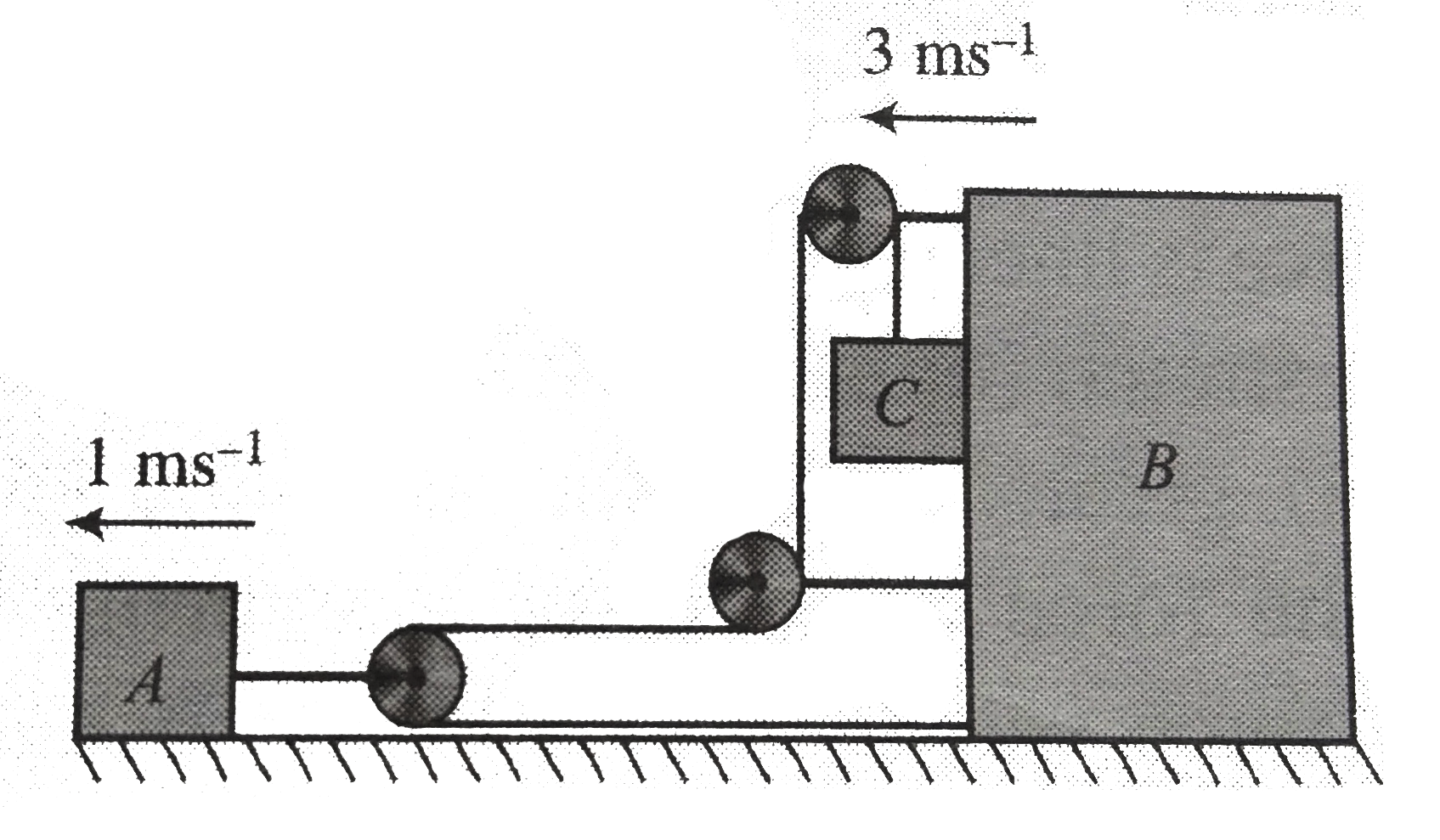
The velocities of A and B shown in fig. Find the speed (in `ms^(-1)`) of block C. (Assume that the pulleys and string are ideal).

Text Solution

Verified by Experts
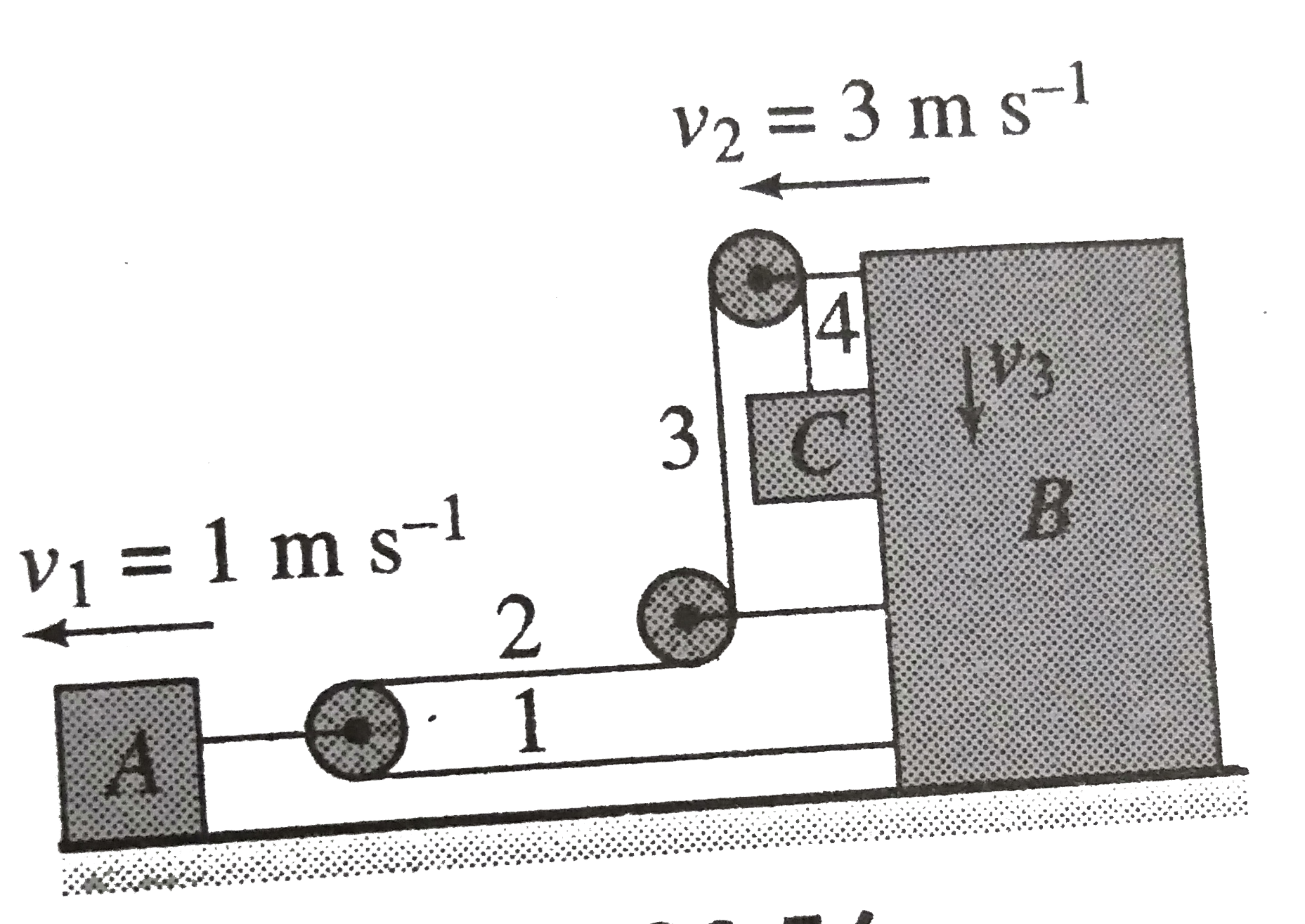
`v_(1)=1 ms^(-1), v_(2)=3 ms^(-1)`
Let the velocity of c is `v_(3)` downward w.r.t B. then
`(v_(1)-v_(2))+(v_(1)-v_(2))+v_(3)=0`
`implies v_(3)=2(v_(2)-v_(1))=2(3-1)`
`=4ms^(-1)`
Net velocity of C =` sqrt(v_(2)^(2)+v_(3)^(2))=sqrt(3^(2)+4^(2))=5 ms^(-1)`
Promotional Banner

Topper's Solved these Questions

  • NEWTON'S LAWS OF MOTION 1

    CENGAGE PHYSICS|Exercise Exercise 6.4|13 Videos
  • NEWTON'S LAWS OF MOTION 1

    CENGAGE PHYSICS|Exercise Subjective|15 Videos
  • NEWTON'S LAWS OF MOTION 1

    CENGAGE PHYSICS|Exercise Exercise 6.2|35 Videos
  • MISCELLANEOUS VOLUME 2

    CENGAGE PHYSICS|Exercise INTEGER_TYPE|10 Videos
  • NEWTON'S LAWS OF MOTION 2

    CENGAGE PHYSICS|Exercise Integer type|1 Videos

Similar Questions

Explore conceptually related problems

The velocities of A and B are marked in the figure-1.130. The velocity of block C is (assume that the pulleys are ideal and string inextensible) :

The block Q moves to the right with a constant velocity v_(0) as shown in figure. The relatives velocity of body P with respect to Q is ( assume all pulleys and strings are ideal)

In the figure-2.205 shown in blocks A, B and C has masses m_(A)= 5 kg, m_(B) = 5 kg and m_(C )= 10kg respectively, find the acceleration of the three blocks. Assume all pulleys and strings are ideal. (Take g = 10m//s^(2) )

A pulley-rope-mass arrangement is shown in fig. Find the acceleration of block m_(1) when the masses are set free to move. Assume that the pulley and the ropes are ideal.

Find the acceleration blocks in fig. The pulley and the string are massless.

If block B shown in figure-l.78(a) is going down with acceleration 5 m//s^(2) , find the acceleration of the block A. All pulleys and strings are ideal. Radii ratio for the two step pulleys are 1 : 3 : 5 and 1 :2 .

Find out velocity of block B in the given figure : (all the pulleys are ideal and string are inextensible massless)

In Fig. find the acceleration a of the system and the tesnions T_(1) and T_(2) in the strings. Assume that the table and the pulleys are frictionless and the strings are massless. Take g = 9.8ms^(2)

There blocks a,b and c of massses 10 kg ,10 kg and 20 kg respectivaly are arrenged as shown in figure all the surface are frictionless and string is inextensible A constant force F= 20N MN is applied on block a as shown .pulley and string are light . part of block a as shown . pulley and string are light . part of the string connecting both pulleys is vertical and part of hte stings connecting pulleys with masses a and b are horizontal .

CENGAGE PHYSICS-NEWTON'S LAWS OF MOTION 1-Exercise 6.3
  1. Block A is given an acceleration 12 ms^(-2) towards left as shown in f...

    Text Solution

    |

  2. The three block shown in fig. move with constant velocities. Find the ...

    Text Solution

    |

  3. For the system as shown in fig. find the acceleration of C. the accele...

    Text Solution

    |

  4. System is shown in fig. and wedge is moving toward left with speed 2ms...

    Text Solution

    |

  5. In fig. shown, the speed of the truck is v to the right. Find the spee...

    Text Solution

    |

  6. Determine the speed with which block B rises in fig. if the end of the...

    Text Solution

    |

  7. An inextensible string AB is tied to a block B of negligible dimension...

    Text Solution

    |

  8. Find the acceleration blocks in fig. The pulley and the string are mas...

    Text Solution

    |

  9. Figure shows, a system of four pulley with two masses A and B. Find at...

    Text Solution

    |

  10. Figure shows a pulley over which is string passes and connected to two...

    Text Solution

    |

  11. Find the relation in the accelerations of the three masses shown in fi...

    Text Solution

    |

  12. A ring A which can slide on a smooth wire is connected to one end of a...

    Text Solution

    |

  13. Figure shows a block A constrained to slide along the inclined plane o...

    Text Solution

    |

  14. Find the acceleration of block B as shown in fig. (a) and (b) relative...

    Text Solution

    |

  15. If the string is inextensible, determine the velocity u of each block ...

    Text Solution

    |

  16. Calculate the acceleration of block A and B in cases (a),(b), and (c )...

    Text Solution

    |

  17. A rod of mass m is supported on a wedge of mass M shown in fig. Find t...

    Text Solution

    |

  18. In fig, no relative motion takes place between the wedge and the block...

    Text Solution

    |

  19. The velocities of A and B shown in fig. Find the speed (in ms^(-1)) of...

    Text Solution

    |

