Home
Class 11
PHYSICS
A smooth block of mass m is connected wi...

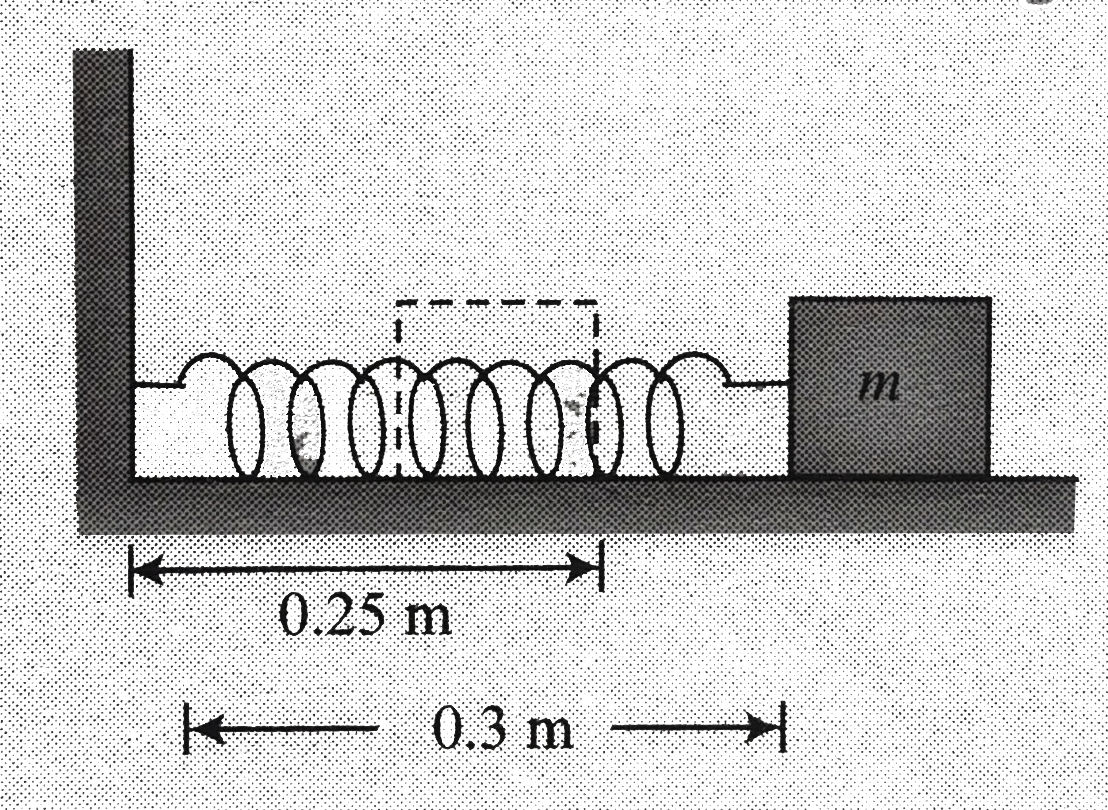
A smooth block of mass m is connected with a spring of stiffness `k(=20Nm^(-1)` )and natural length `l_(0)=0.25 m`. If the block is pulled such that the new length of the spring becomes `l=0.3m`, find the acceleration of the block at the moment when it is released from given positon.

A

`-1/m` `m//s^2`

B

`1/m^2` `m//s^2`

C

`3/(2m)` `m//s^2`

D

zero

Text Solution

Verified by Experts

The correct Answer is:

A

Given spring constant `k=20Nm^(-1)`
Initial length =`0.25 m`
Final length =`0.30 m`
`Delta x =0.30 -0.25 = 0.05 m (rarr)`
Mass of the block = m
`vec(F)=-kvec(x)impliesma=-kDeltax`
`a=-(k Delta x)/(m)=(-20 xx0.05)/(m)=-(1)/(m)`
Acceleration = `1//m (larr)`.
Promotional Banner

Topper's Solved these Questions

  • NEWTON'S LAWS OF MOTION 1

    CENGAGE PHYSICS|Exercise Subjective|15 Videos
  • NEWTON'S LAWS OF MOTION 1

    CENGAGE PHYSICS|Exercise Single Correct|76 Videos
  • NEWTON'S LAWS OF MOTION 1

    CENGAGE PHYSICS|Exercise Exercise 6.3|19 Videos
  • MISCELLANEOUS VOLUME 2

    CENGAGE PHYSICS|Exercise INTEGER_TYPE|10 Videos
  • NEWTON'S LAWS OF MOTION 2

    CENGAGE PHYSICS|Exercise Integer type|1 Videos

Similar Questions

Explore conceptually related problems

A block of mass m fitted with a light spring of stiffness k and natural length l_(0) kept on a smooth radial groove made on a disc rotaing with a constant angular axis . If the block is released slowly . Find the maximum elongation of the spring

A block of mass 2 kg is connected with a spring of natural length 40 cm of force constant K=200 N//m . The cofficient of friction is mu=0.5 . When released from the given position, acceleration of block will be

A block of mass m is connected at one end of spring fixed at other end having natural length l_0 and spring constant K . The block is rotated with constant angular speed (omega) in gravity free space. Find the elongation in spring.

A block of mass m compresses a spring iof stifffness k through a distacne l//2 as shown in the figure .If the block is not fixed to the spring the period of motion of the block is

Two blocks each of mass m are joined together using an ideal spring of force constant K and natural length l_(0) . The blocks are touching each other when the system is released from rest on a rough horizontal surface. Both the blocks come to rest simultaneously when the extension in the spring is (l_(0))/4 . The coefficient of friction between each block and the surface (assuming it to be same between any of the blocks and the surface) is :

A block of mass m connected to a spring of stiffness k is placed on horizontal smooth surface. When block is at x=0 , spring is in natural length. The block is also subjected to a force F=(k|x|)/(@) then

Two blocks A and B of masses m and 2m respectively are connected together by a light spring of stiffness k and then placed on a smooth horizontal surface. The blocks are pushed towards each other such that spring gets compressed by a length x_(0) and then released from rest. Find the work done on the block A by the spring, by the time the spring acquires its natural length.

Two smooth blocks of mases m_(1) and m_(2) attached with an ideal spring of stiffness k and kept on hrozontal surface. If m_(1) is projected with a horizontal velocity v_(0) . Find the maximum compression of the spring.

A block of mass m is pushed against a spring of spring constant k fixed at one end to a wall.The block can slide on a frictionless table as shown in the figure. The natural length of the spring is L_0 and it is compressed to one fourth of natural length and the block is released.Find its velocity as a function of its distance (x) from the wall and maximum velocity of the block. The block is not attached to the spring.
