Home
Class 11
PHYSICS
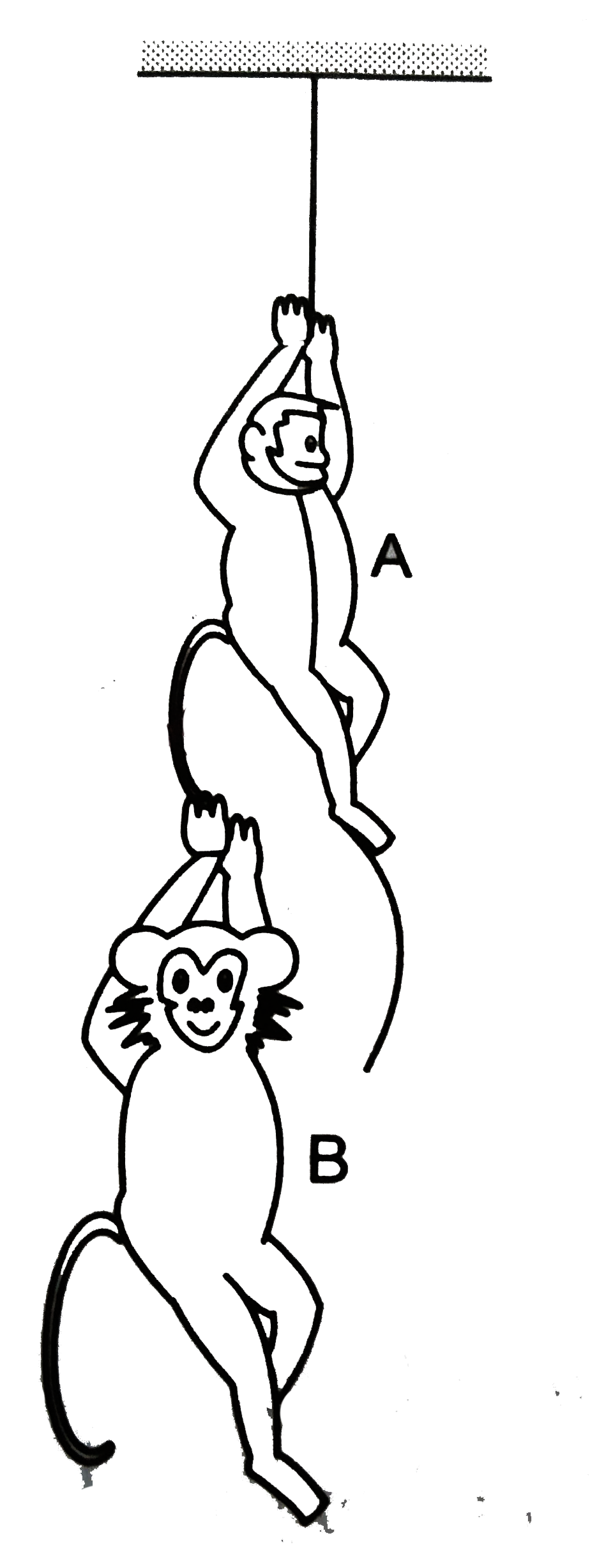
The monkey B shown in figure is holding ...

The monkey B shown in figure is holding on to the tail of the monkey A which is climbing up a rope. The masses of the monkeys A and B are 5 kg and 2kg respectively. If A can tolerate a tension of 30 N in its tail what force should it apply on the rope in order to carry the monkey B with it? Take g=10 ,m/`s^2`.

Text Solution

Verified by Experts

The correct Answer is:
105N

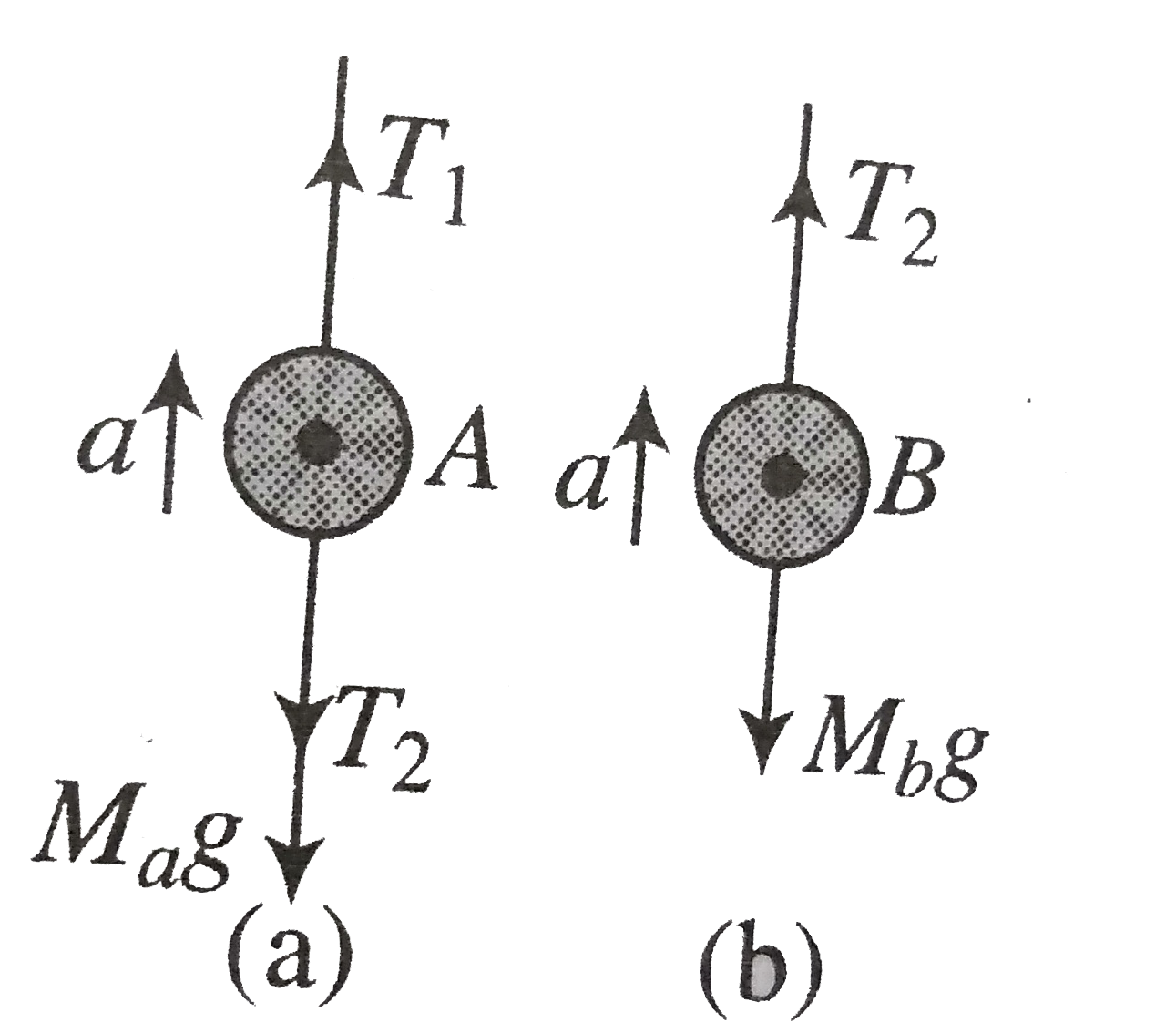
Let `T_(1)` be the tension in rope and `T_(2)` the tension in the tail of monkey A. Let the force exerted by monkey A on the rope of F.
Let `M_(A)` and `M_(B)` be masses of monkey A and B, respectively. The free-body diagram of monkeys A and B are shown in fig. (a) and (b) . `F=T_(1)`

The equation of motion of monkeys A and B are
`T_(1)=M_(A)g=T_(2)=M_(A)a` ..(i)
`T_(2)=M_(B)g=M_(B)a` ...(ii)
For maximum tension in tail.
From, Eq (ii), we get
`a=(T_(2)-M_(B)g)/(M_(B)) = (30-2xx10)/(2)= 5ms^(-2)`
Then from Eq. (i) we get,
`T_(1)=T_(2)=M_(A)(g+a)=30+5(10+5)=105N`.
Promotional Banner

Topper's Solved these Questions

  • NEWTON'S LAWS OF MOTION 1

    CENGAGE PHYSICS|Exercise Single Correct|76 Videos
  • NEWTON'S LAWS OF MOTION 1

    CENGAGE PHYSICS|Exercise Multiple Correct|11 Videos
  • NEWTON'S LAWS OF MOTION 1

    CENGAGE PHYSICS|Exercise Exercise 6.4|13 Videos
  • MISCELLANEOUS VOLUME 2

    CENGAGE PHYSICS|Exercise INTEGER_TYPE|10 Videos
  • NEWTON'S LAWS OF MOTION 2

    CENGAGE PHYSICS|Exercise Integer type|1 Videos

Similar Questions

Explore conceptually related problems

The monkey B shown in fig. is holding on to the tall of the monkey A which is climbing up a rope. The masses of the monkeys A and B are 5 kg and 2kg respectively. If A can tolerate a tension of 30N in its tall, what force should it apply on the rope in order to carry the monkey B with it ? (Take g=10 ms^(-2) )

The monkey B shown in the figure is holding on the tail of the monkey. A which is climbing up a rope. The masses of the monkeys A and B are 40kg and 20kg , respectively. If A can tolerate a tension of 300N in its fail, what force should it apply on the rope in order to carry the monkey B with it?

Two monkeys A and B are holding on the two sides of a light string passing over a smooth pulley.Mass of A and B are 6kg and 10 kg respectively. A holds the string tightly and B goes down with an acceleration 4m/s^(2) relative to string.Find the weight that A feels of his own body.

A monkey of mass 40kg climbs on a massless rope of breaking strenght 600N . The rope will break if the monkey (Take g =10 m//s^(2) ) .

A monkey of mass 20 kg climbs on a rope which can stand a maximum tension of 300 N. In which of the following case will the rope break . The monkey

A monkey of mass 30 kg climbs a rope which can withstand a maximum tension of 360 N. The maximum acceleration which this rope can tolerate for the climbing of monkey is: (g=10m//s^(2))

A monkey a mass 15 kg is climbing on a rope with one end fixed to the ceiling. If it whishes to go up with an acceleration of 1 m/s^2 , how much force should it apply to the rope? If the rope is 5 m long and the monkey starts from rest, how much time will it take to reach the ceiling?

In the arrangement shown in the fig. a monkey of mass M keeps itself as well as block A at rest by firmly holding the rope. Rope is massless and the pulley is ideal. Height of the monkey and block A from the floor is h and 2h respectively [h = 2.5 m] (a) The monkey loosens its grip on the rope and slides down to the floor. At what height from the ground is block A at the instant the money hits the ground? (b) Another block of mass equal to that of A is stuck to the block A and the system is released. The monkey decides to keep itself at height h above the ground and it allows the rope to slide through its hand. With what speed will the block strike the ground? (c) In the situation described in (b), the monkey decides to prevent the block from striking the floor. The monkey remains at height h till the block crosses it. At the instant the block is crossing the monkey it begins climbing up the rope. Find the minimum acceleration of the monkey relative to the rope, so that the block is not able to hit the floor. Do you think that a monkey can climb with such an acceleration? ( g = 10ms^(-2) )

As shown in figure a monkey of 20g mass is holding a light rope that passes over a frictionless pulley. A bunch of bananas of the same mass is tied to the other end of rope. Inorder to get access to the bunch the monkey starts climbing the rope. The distance between the monkey and the bananas is

