Home
Class 11
PHYSICS
The upper surface of blokc C is horizont...

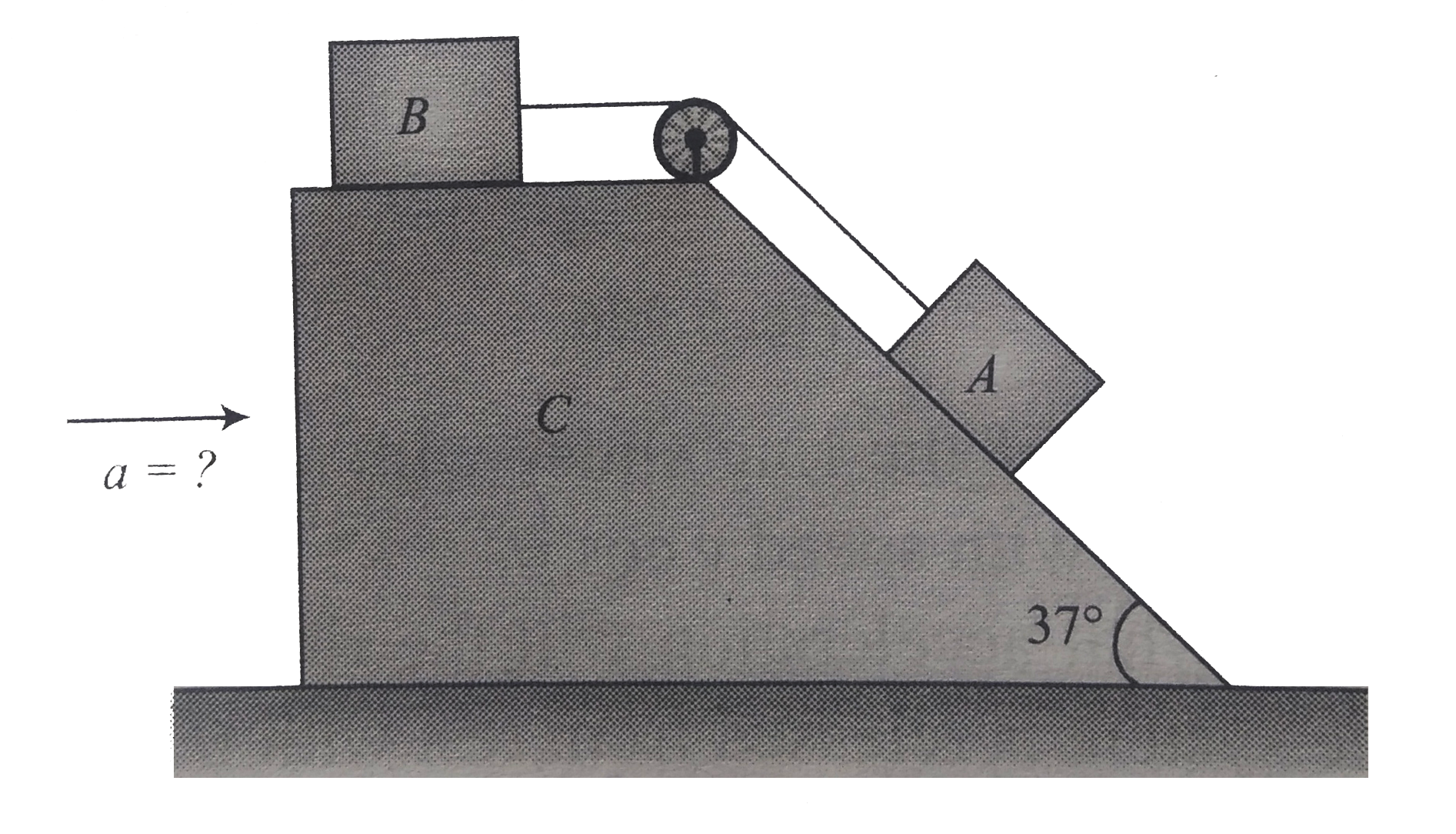
The upper surface of blokc C is horizontal and its right part is inclined to the horizontal at angle `37^(@)`. The mass of blocks A and B are `m_(1) = 1.4kg and m_(2)=5.5kg`, respectively. Neglect friction and mass of the pulley. Calculate acceleration a with which block C should be moved to the right so that A and B can remain stationary relative to it.

Text Solution

Verified by Experts

The correct Answer is:
`20//11 ms^(-2)`.

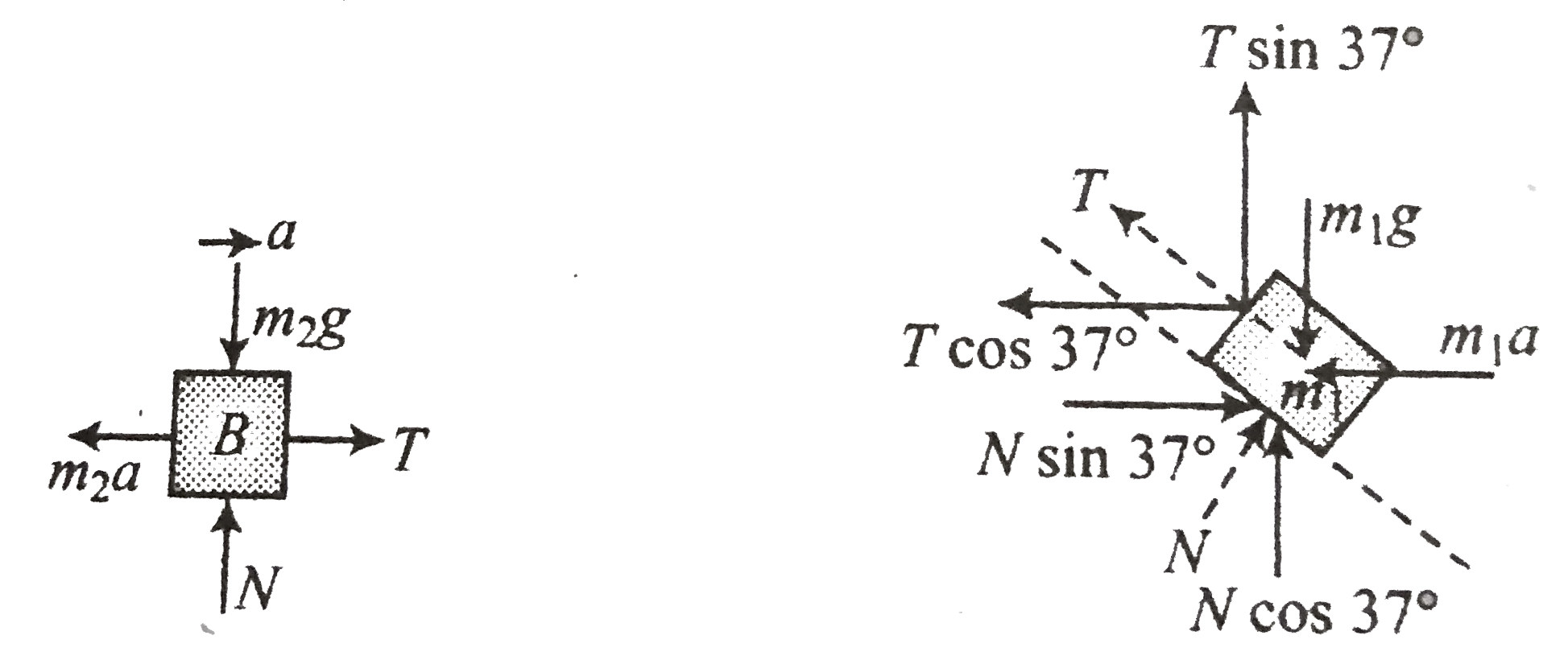
Since block A and B remain stationary relative to block C, it means motion of blocks A and B is identical with the block C or acceleration of all the three blocks is same as a horizontally (rightwards). Now considering FBD w.r.t wedge C

For block B,
`N_(2)=m_(2)g or, N_(2)=55 "newton"`
`T=m_(2)a` ...(i)
For block A, `N_(1) cos 37^(@)+T sin 37^(@)=m_(1)g` ..(ii)
`N_(1) sin 37^(@)-T cos 37^(@)=m_(1)a` ..(iii)
Solving above equations
`T=10N`
`N_(1)=20N`
and `a=20//11 ms^(-2)`.
Promotional Banner

Topper's Solved these Questions

  • NEWTON'S LAWS OF MOTION 1

    CENGAGE PHYSICS|Exercise Single Correct|76 Videos
  • NEWTON'S LAWS OF MOTION 1

    CENGAGE PHYSICS|Exercise Multiple Correct|11 Videos
  • NEWTON'S LAWS OF MOTION 1

    CENGAGE PHYSICS|Exercise Exercise 6.4|13 Videos
  • MISCELLANEOUS VOLUME 2

    CENGAGE PHYSICS|Exercise INTEGER_TYPE|10 Videos
  • NEWTON'S LAWS OF MOTION 2

    CENGAGE PHYSICS|Exercise Integer type|1 Videos

Similar Questions

Explore conceptually related problems

Pulleys shown in the system are massless and fricionless. Threads are inextensible. The mass of blocks A, B, and C are m_(1)=2kg, m_(2)=4kg , and (m_3)=2.75 kg , respectively. Calculate the acceleration of each block.

In the arrangement shown in figure pulleys are mass of block A,b and C is m_(1) = 5 kg m_(2) = 4 kg and m_(3) = 2.5 kg respectively .Co-efficient acceleration of friction for both the plane is mu = 0.50 Calculate acceleration of which block when system is released from rest

Pulleys shown in the system of the figure are massless and friction less. Threads are inextensible. Mass of block A, B and C are m_(1) kg,m_(2) =4kg and m_(3) = 2.75kg , respectively .Calculate acceleration of A block

The pulley of the system shown in Fig is massless and frictionless and thread and thread is inextensible Then horizontal surface over which block C is smooth while for all the remaining surface is mu Calculate minimum acceleration a with which the system should be moved to the right so that suspented block A (mass m ) and B (mass M and M gt m ) can remain stationary relative to C

In the figure-2.205 shown in blocks A, B and C has masses m_(A)= 5 kg, m_(B) = 5 kg and m_(C )= 10kg respectively, find the acceleration of the three blocks. Assume all pulleys and strings are ideal. (Take g = 10m//s^(2) )

Two blocks connected by a massless string slide down an inclined plane having angle of inclination 37º. The masses of the two blocks are M1 = 4 kg and M2 = 2 kg respectively and the coefficients of friction 0.75 and 0.25 respectively- The common acceleration of the two masses is 1.3 ms^(-2) b, The tension in the string is 14.7 N c The common acceleration of the two masses is 2.94 ms^(-2) d, The tension in the string is 5.29N

Two blocks of masses 4 kg and 6 kg are kept on a rough horizontal surface as shown. If the acceleration of 6 kg block is 5n , then n is :

Block B of mass m_(B) = 0.5 kg rests on block A, with mass m_(A) = 1.5kg which in turn is on a horizontal tabletop (as shown in figure) .The coefficient of kinetic friction between block A and the tabletop is mu_(k) = 0.4 and the coefficient of static friction between block A and blockB is mu_(s) = 0.6 A light string attached block A passes over a frictionless, massless pulley and block C is suspeneded from the other end of the string. What is the largest mass m_(c) (in kg) that block C can have so that block A and B still slide together when the system is relaced from rest?

A block of mass m is placed on the rough incline of a wedge of mass M and inclination alpha to the horizontal. Calculate the maximum and minimum acceleration that can be imparted to the wedge so that the block may remain stationary relative to the wedge. The coefficient iof friction between the block and the wedge is mu .

