Home
Class 11
PHYSICS
In the arrangement shown in fig. a wedge...

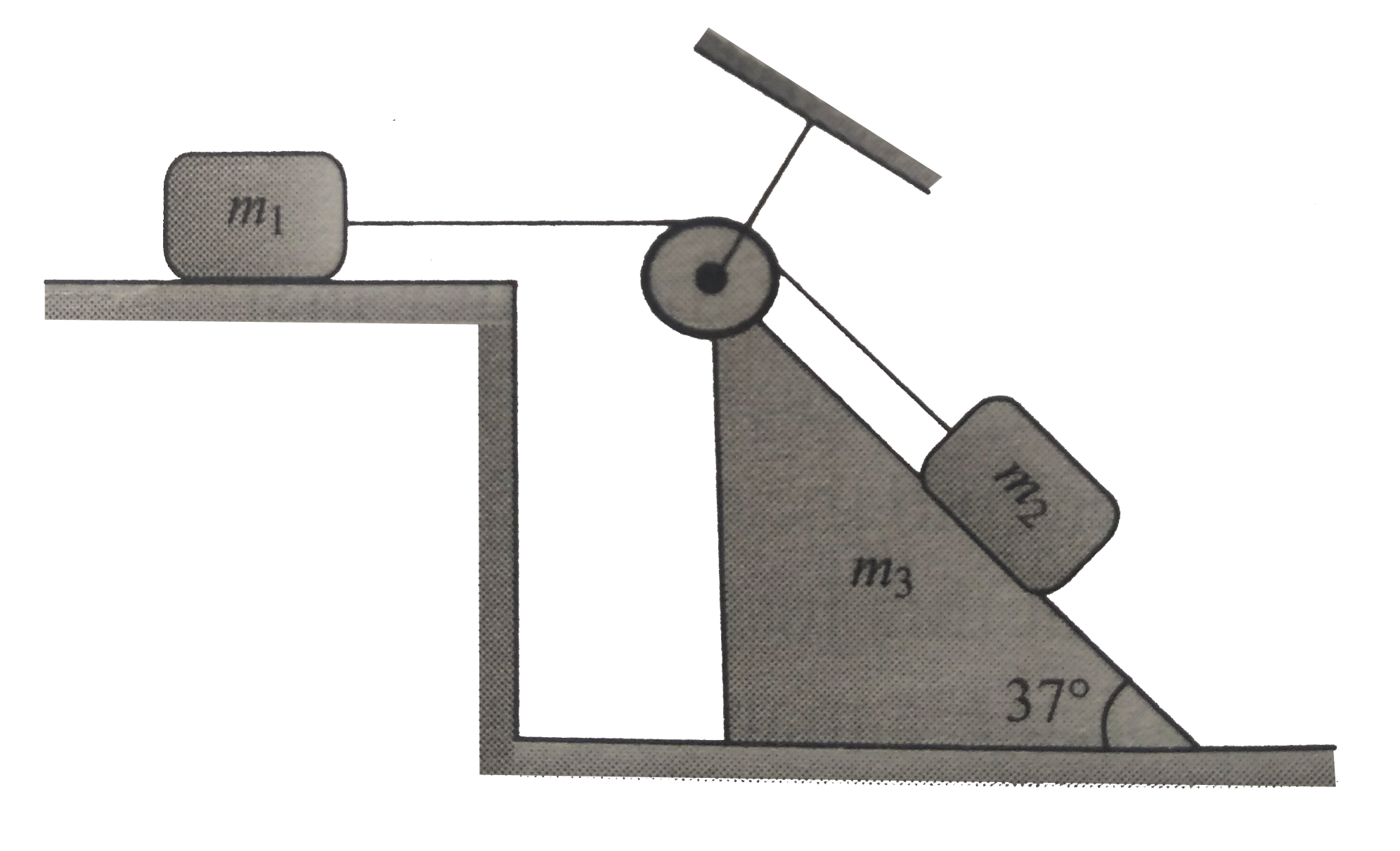
In the arrangement shown in fig. a wedge of mass `m_(3) =3.45 kg` is placed on a smooth horizontal surface. Small and light pulley is connected on its top edge, as shown. A light, flexible thread passes over the pulley. Two block having mass `m_(1)=1.3kg and m_(2) =1.5 kg` are connected at the ends of the thread.

`m_(1)` is on smooth horizontal surface and `m_(2)` rests on inclined smooth surface of the wedge. the base length of wedge is 2m and inclination is `37^(@)`. `m_(2)` is initially near the top edge of the wedge.
If the whole system is released from rest, calculate:
(a) velocity of wedge when `m_(2)` reaches its bottom.
(b) velocity of `m_(2)` at that instant.
`(g=10ms^(-2))`.

Text Solution

Verified by Experts

The correct Answer is:
`2ms^(-1); sqrt(13)ms^(-1)`

Let acceleration of `m_(1)` be a (rightwards) and that of wedge be b(leftwards). Acceleration of `m_(2)` (relative to wedge) becomes `(a+b)`, down the plane. Therefore, resulant acceleration of `m_(2)` is vector sum of the two acceleration.
(a) `(a+b)` down the plane and
(b) b leftwards.
Hence, components of this resultant acceleration are
(a) `[(a+b) cos 37^(@)-b]=((4a-b))/(5)` horizontal rightward, and
(b) `(a+b) sin 37^(@)=3/5 (a+b)` vertically downward.
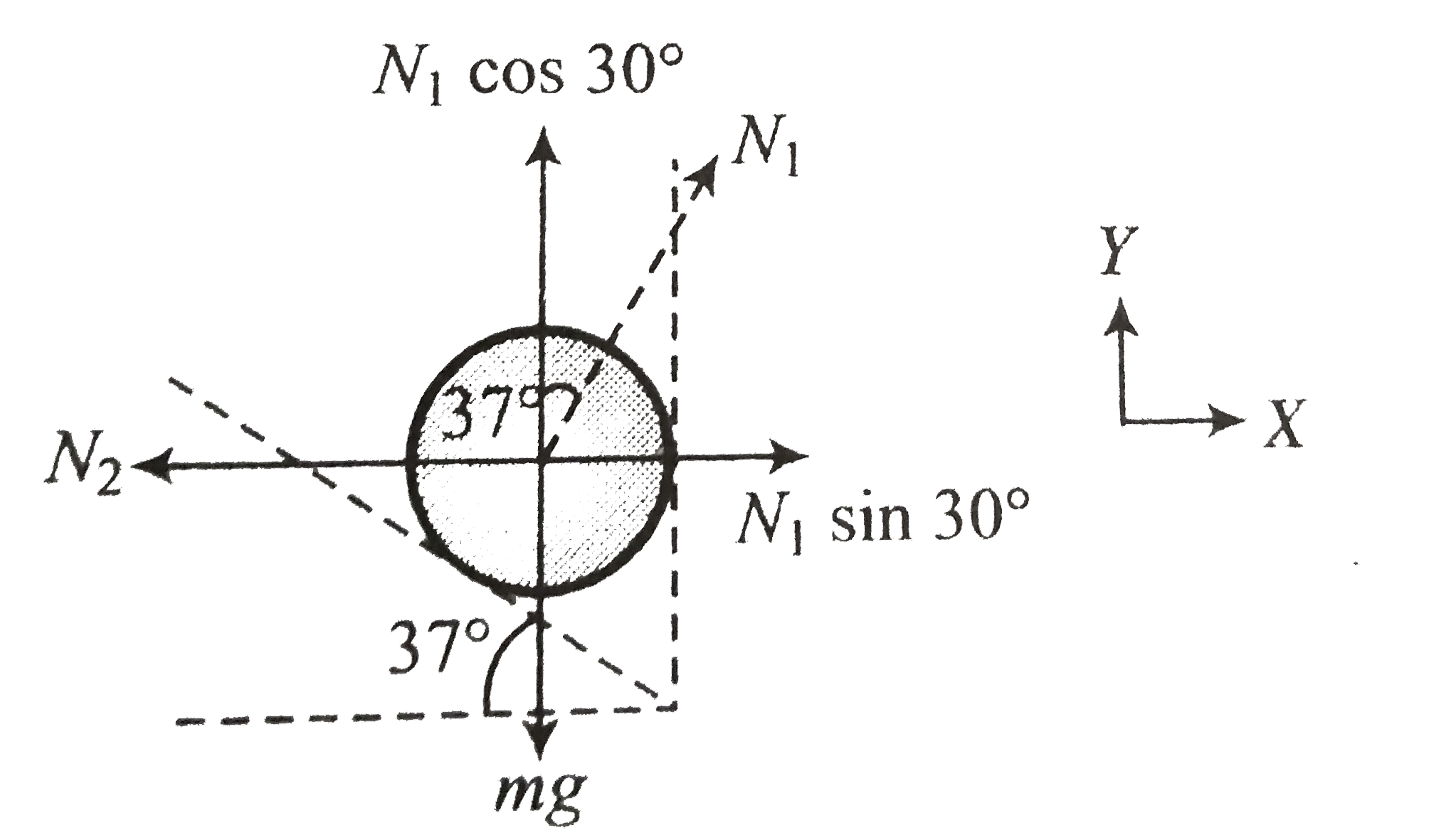
Considering free body diagrams

For horizontal force on `m_(1), T=m_(1)a` ...(i)
For horizontal force on wedge,
`T-T cos 37^(@)+N_(2) sin 37^(@)=m_(3)b`...(ii)
For horizontal force on `m_(2)`
`N_(2). sin 37^(@)-T cos 37^(@)=m_(2)(0.8a-0.2)` ...(iii)
For vertical force on `m_(2)`
`m_(2)g-N_(2) cos 37^(@)-T sin 37^(@)=m_(2)(0.6 a + 0.6b)`...(iv)
From above equations , `a=3ms^(-2), b=2ms^(-2)`
Since base angle and base length of wedge are `37^(@)` and 2m respectively, therefore, height of its vertical faces is `2tan 37^(@)=1.5m`.
Now considering vertical motion of `m_(2)` from top of bottom of the wedge, `u=0`, acceleration =`(0.6a=0.6b)=3ms^(-2)` and displacement = `1.50m`.
`t=1s`
At this instant, horizontal component of velocity of `m_(2)` is
`v_(2x)=(0.8a-0.2b)t=2ms^(-1)`
and vertical component,
`v_(2y)=(0.6a+0.6b)t=3ms^(1)`
Vertical of `m_(2)` is
`v_(2)=sqrt(v_(2x)^(2)+v_(2y)^(2))=sqrt(13)ms^(-1)`
Velocity of wedge at this instant = `bt=2ms^(-1)`.
Promotional Banner

Topper's Solved these Questions

  • NEWTON'S LAWS OF MOTION 1

    CENGAGE PHYSICS|Exercise Single Correct|76 Videos
  • NEWTON'S LAWS OF MOTION 1

    CENGAGE PHYSICS|Exercise Multiple Correct|11 Videos
  • NEWTON'S LAWS OF MOTION 1

    CENGAGE PHYSICS|Exercise Exercise 6.4|13 Videos
  • MISCELLANEOUS VOLUME 2

    CENGAGE PHYSICS|Exercise INTEGER_TYPE|10 Videos
  • NEWTON'S LAWS OF MOTION 2

    CENGAGE PHYSICS|Exercise Integer type|1 Videos

Similar Questions

Explore conceptually related problems

In the arrangement shown in fig. the block of mass m=2kg lies on the wedge of mass M=8kg . The initial acceleration of the wedge, if the surfaces are smooth, is

A block of mass m is placed at rest on a smooth wedge of mass M placed at rest on a smooth horizontal surface. As the system is released

Two blocks of masses m_1 = 4 kg and m_2 = 2 kg are connected to the ends of a string which passes over a massless, frictionless pulley. The total downwards thrust on the pulley is nearly

A block of mass m_(1)=2 kg is kept on a smooth horizontal table. Another block of mass m_(2)=1 kg is connected to m_(1) by a light inextensible string passing over a smooth pulley as shown in the figure. If the blocks are released, what will be the (a) acceleration of each block (b) tension in the string?

Three blocks, placed on smooth horizontal surface are connected by ideal string and a disc shaped pulley of radius r, and mass m. Find the accelerations of the blocks. Masses of the blocks are given as M_(1) = 10kg, M_(2) = 5 kg , M_(3) = 2kg, m = 2kg .

A block of mass M is placed on a rough horizontal surface. It is connected by means of a light inextensible string passing over a smooth pulley . The other end of string is connected to a block of mass m. There is no friction between vertical surface and block m The minimum value of coefficient of friction mu such that system remains at rest , is

A block of mass M is placed on a rough horizontal surface. It is connected by means of a light inextensible string passing over a smooth pulley . The other end of string passing over a smooth pulley. The other end of string is connected to a block of mass m. There is no friction between vertical surface and block m If the whole system ( horizontal surface + blocks ) accelerates towards right the value of maximum on the horizontal surface is

Two blocks of masses m_(1) and m_(2) are connected by a massless pulley A, slides along th esmooth sides of a rectangular wedge of mass m, which rests on a smooth horizontal plane. Find the distance covered by the wedge on the horizontal plane till the mass m_(1) is lowered by the vertical distance h.

