Home
Class 11
PHYSICS
In fig., the mass m(2) starts with veloc...

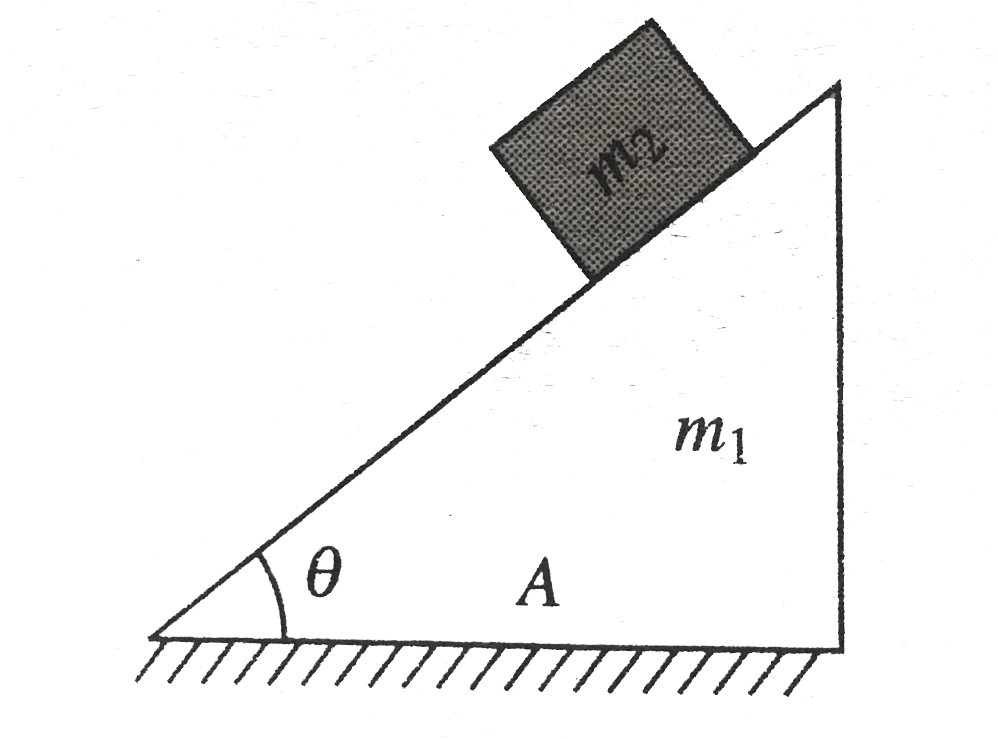
In fig., the mass `m_(2)` starts with velocity `v_(0)` and moves with constant velocity on the surface. During motion, the normal reaction between the horizontal surface and fixed triangle block `m_(1)` is `N`. Then during motion.

A

`N=(m_(1)+m_(2))g`

B

`N=m_(1)g`

C

`Nlt(m_(1)+m_(2))g`

D

`Ngt(m_(1)+m_(2))g`

Text Solution

Verified by Experts

The correct Answer is:

A

As `m_(2)` moves with constant velocity. There is no acceleration in the centre of mass. Net force should be zero. For this
`N=m_(1)g+m_(2)g`.
Promotional Banner

Topper's Solved these Questions

  • NEWTON'S LAWS OF MOTION 1

    CENGAGE PHYSICS|Exercise Multiple Correct|11 Videos
  • NEWTON'S LAWS OF MOTION 1

    CENGAGE PHYSICS|Exercise Assertion-reasoning|15 Videos
  • NEWTON'S LAWS OF MOTION 1

    CENGAGE PHYSICS|Exercise Subjective|15 Videos
  • MISCELLANEOUS VOLUME 2

    CENGAGE PHYSICS|Exercise INTEGER_TYPE|10 Videos
  • NEWTON'S LAWS OF MOTION 2

    CENGAGE PHYSICS|Exercise Integer type|1 Videos

Similar Questions

Explore conceptually related problems

A particle moves with constant angular velocity in a circle. During the motion its

A block of mass 2 kg is kept on a smooth wedge of mass 3 kg and wedge is kept on a rough horizontal surface. A vertical force of 60 N is applied on the minimum coefficient of friction between the wedge and horizontal surface, so that wedge remains at rest during the motion of block on the wedge ?

In the fig 4.24 a block of mass m moves with velocity v_(0) toward a stationaly block of a mass M on a smooth horizontal surface. Find the maximum compression in the spring of stiffnesss constant K.

A block of mass m moving with velocity v_(0) on a smooth horizontal surface hits the spring of constant k as shown. Two maximum compression in spring is

A uniform cube of mass m and edge a moves on a horizontal surface along the positive x-axis, with initial velocity v_(0) . Then

Asseration : A block of mass m starts moving on a rough horizontal surface with a velocity v. It stops due to friction between the block and the surface after moving through a ceratin distance. The surface is now tilted to an angle of 30^@ with the horizontal and same block is made to go up on the surface with the same initial velocity v. The decrease in the mechanical energy in the second situation is small than the first situation. Reason : The coefficient of friction between the block and the surface decreases with the increase in the angle of inclination.

A constant force F is pushing a 5 kg mass on a horizontal surface at a constant velocity of 2 m/s. The coefficient of friction between the surface and the mass is 0.3 (Take g = 10 m/s^2 ). If F acts along the direction of motion, the rate at which F is doing work (in watt)

Two particles of masses m_(1) and m_(2) move with velocities upsilon_(1) and upsilon_(2) towards eachother on a smooth horizontal surface. What is the velocity of their centre of mass ?

A horizontal bar of mass m_(1) Prism of mass m_(2) can move as shown. There is no friction at any contact point. During the motion the length of the rod is always horizontal Now, magnitude valuse of .

CENGAGE PHYSICS-NEWTON'S LAWS OF MOTION 1-Single Correct
  1. Two beads of equal masses m are attached by a string of length sqrt2a ...

    Text Solution

    |

  2. Block A and C starts from rest and move to the right with acceleration...

    Text Solution

    |

  3. In fig., the mass m(2) starts with velocity v(0) and moves with consta...

    Text Solution

    |

  4. In fig., blocks A and B move with velocities v(1) and v(2) along horiz...

    Text Solution

    |

  5. A rope is strecthed between two boats at rest. A sailor in the first b...

    Text Solution

    |

  6. If block B moves towards right with acceleration b, find the net accel...

    Text Solution

    |

  7. If the blocks A and B are moving towards each other with accelerations...

    Text Solution

    |

  8. A small marble is projected with a velocity of 10 m//s in a direction ...

    Text Solution

    |

  9. A lift is moving down with acceleration a. A man in the lift drops a b...

    Text Solution

    |

  10. Block B has mass m and is released from rest when it is on top of wedg...

    Text Solution

    |

  11. A particle of mass 2kg moves with an initial velocity of vec(v)=4hat(i...

    Text Solution

    |

  12. Three blocks A,B, and C are suspended as shown in fig. Mass of each of...

    Text Solution

    |

  13. A particle of small m is joined to a very heavy body by a light string...

    Text Solution

    |

  14. An object is suspended from a spring balance in a lift. The reading is...

    Text Solution

    |

  15. In the following arrangement, the system is initially at rest. The 5-k...

    Text Solution

    |

  16. As shown in fig, if acceleration of M with respect to ground is 2ms^(-...

    Text Solution

    |

  17. A block A has a velocity of 0.6ms^(-1) the right. Determine the veloc...

    Text Solution

    |

  18. For the pulley system shown in fig. each of the cables at A and B is g...

    Text Solution

    |

  19. A man pulls himself up the 30^(@) incline by the method shown in fig. ...

    Text Solution

    |

  20. A painter of mass M stands on a platform of mass m and pulls himself u...

    Text Solution

    |
