Home
Class 11
PHYSICS
In fig., blocks A and B move with veloci...

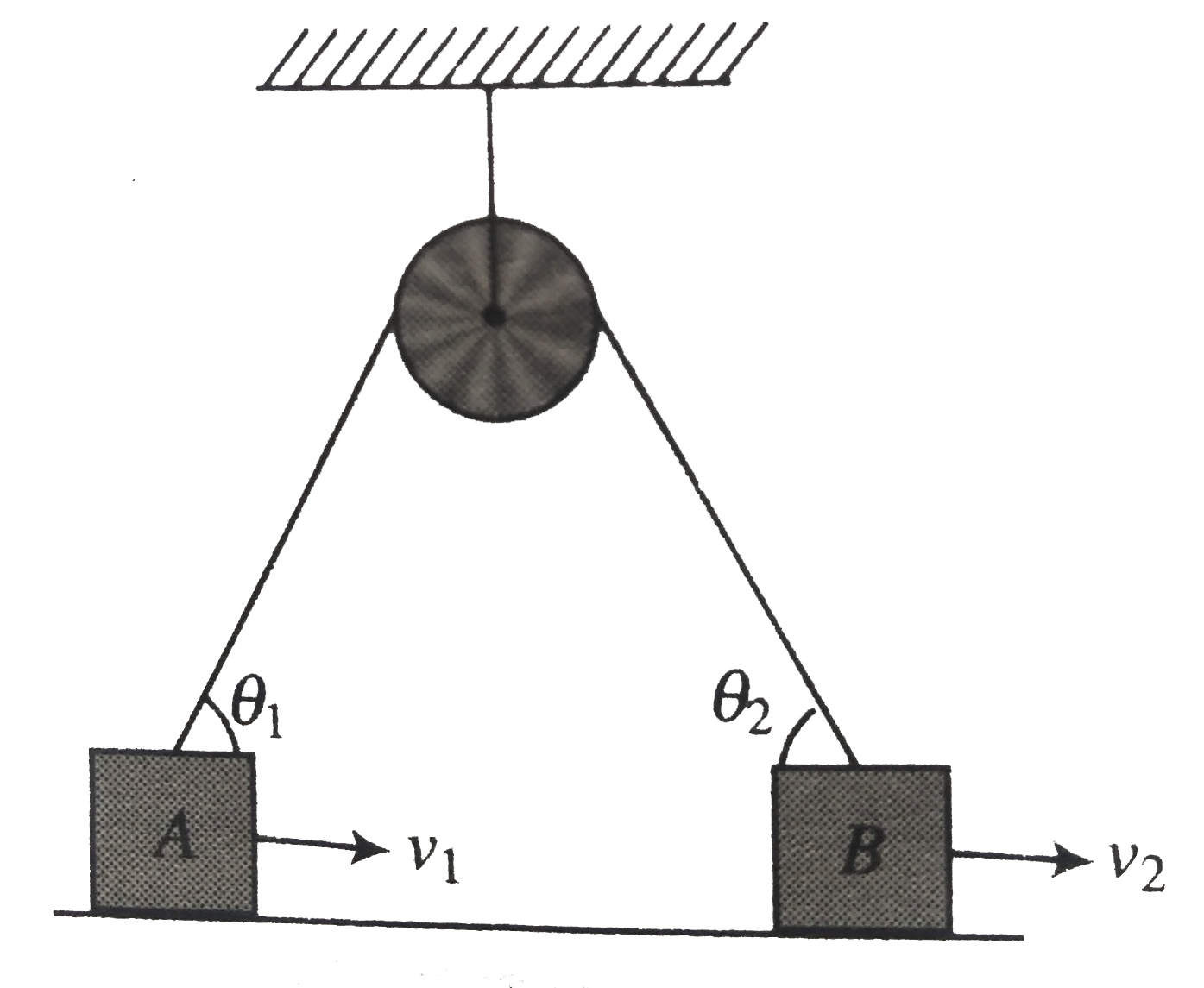
In fig., blocks A and B move with velocities `v_(1)` and `v_(2)` along horizontal direction. Find the ratio of `v_(1)//v_(2)`

A

`(sin theta_(1))/(sin theta_(2))`

B

`(sin theta_(2))/(sin theta_(1))`

C

`(cos theta_(2))/(cos theta_(1))`

D

`(cos theta_(1))/(cos theta_(2))`

Text Solution

Verified by Experts

The correct Answer is:
C

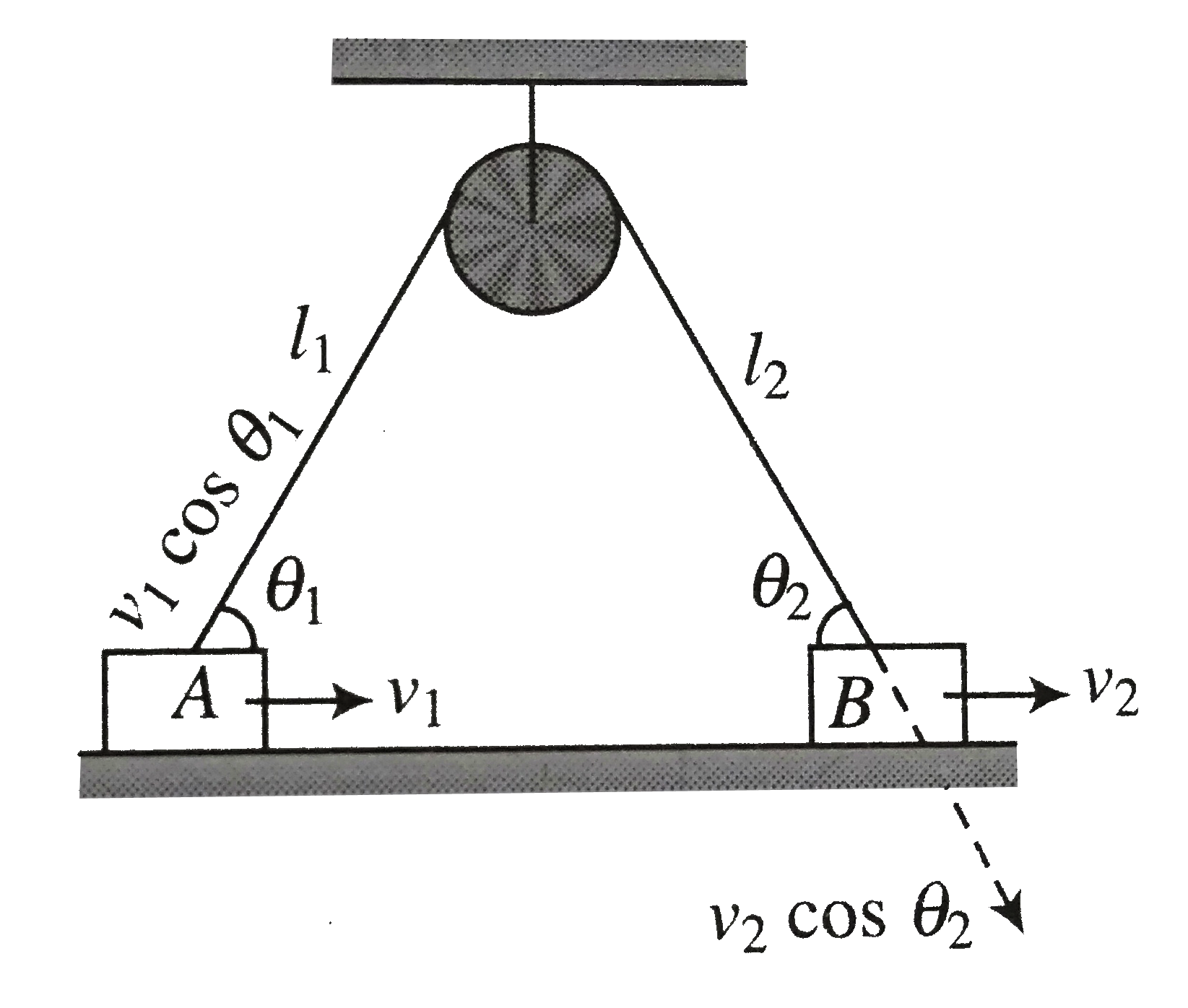
From fig., `l_(1)+l_(2)=C or (dl_(1))/(dt) +(dl_(2))/(dt) =0`

`-v_(1) cos theta_(1)+v_(2) cos theta_(2) =0` or `(v_1)/(v_2) = (cos theta_(2))/( cos theta_(1))`
Promotional Banner

Topper's Solved these Questions

  • NEWTON'S LAWS OF MOTION 1

    CENGAGE PHYSICS|Exercise Multiple Correct|11 Videos
  • NEWTON'S LAWS OF MOTION 1

    CENGAGE PHYSICS|Exercise Assertion-reasoning|15 Videos
  • NEWTON'S LAWS OF MOTION 1

    CENGAGE PHYSICS|Exercise Subjective|15 Videos
  • MISCELLANEOUS VOLUME 2

    CENGAGE PHYSICS|Exercise INTEGER_TYPE|10 Videos
  • NEWTON'S LAWS OF MOTION 2

    CENGAGE PHYSICS|Exercise Integer type|1 Videos

Similar Questions

Explore conceptually related problems

In the arrangement shown, blocks A and B connected with an inextensible string move with velocities v_(1) and v_(2) along horizontal direction. The ratio of v_(2)/v_(1) is:

Two particles move in a uniform gravitational field with an acceleration g. At the intial moment the particles were located at one point and moved with velocity v_(1)=1" "ms^(-1)" and "v_(2)=4" "ms^(-1) horizontally in opposite directions. Find the time interval after their velocity vectors become mutually perpendicular

Two blocks of mass m_(1) and m_(2) are moving along a smooth horizontal floor. A non-ideal spring is attached at the back of mass m_(2) . Initial velocities of the blocks are u_(1) and u_(2) as shown, with u_(1) gt u_(2) . After collision the two blocks were found to be moving with velocities V_(1) and V_(2) respectively. Find the ratio of impulse (on each block) during the deformation phase of the spring and that during its restoration phase. [By non ideal spring we mean that it does not completely regain its original shape after deformation. You can neglect the mass of the spring.]

Two cars 1 and 2 move with velocities v_(1) and v_(2) , respectively, on a straight road in same direction When the crs are separated by a destance d the driver of car 1 applies brakes and the car moves with uniform retardation a_(1) , Simultaneously, car 2 starts accelerating with a_(2) , If v_(1) lt v_(2) , find the minimum initial separation between the cars to avoid collision between then.

Two objects A and B are moving with velocities v_(A) and v_(B) respectively along positive x-axis. If v_(A) lt v_(B) then, which of the following position-time graphs is correctly showing the velocity of A and B ?

Two balls are thrown horizontally from the top of a tower with velocities v_(1) and v_(2) in opposite directions at the same time. After how much time the angle between velocities of balls becomes 90^(@) ?

A block A is placed over a long rough plank B of same mass shown below. The plank is placed over a smooth horizontal surface. At time t=0 , block A is given a velocity v_(o) in horizontal direction. Let v_(1) and v_(2) be the velocity of A & B at time 't' . Then choose the correct graph between v_(1) or v_(2) and t :

A block A is placed over a long rough plank B same mass as shown below. The plank is placed over a smooth horizontal surface. At time t = 0 , block A is given a velocity v_(0) in horizontal direction. Let v_(1) and v_(2) be the velocity of A & B at time 't'. Then choose the correct graph between v_(1) or v_(2) and t.

Two masses m_(A) and m_(B) moving with velocities v_(A) and v_(B) in opposite direction collide elastically after that the masses m_(A) and m_(B) move with velocity v_(B) and v_(A) respectively. The ratio (m_(A)//m_(B)) is

CENGAGE PHYSICS-NEWTON'S LAWS OF MOTION 1-Single Correct
  1. Block A and C starts from rest and move to the right with acceleration...

    Text Solution

    |

  2. In fig., the mass m(2) starts with velocity v(0) and moves with consta...

    Text Solution

    |

  3. In fig., blocks A and B move with velocities v(1) and v(2) along horiz...

    Text Solution

    |

  4. A rope is strecthed between two boats at rest. A sailor in the first b...

    Text Solution

    |

  5. If block B moves towards right with acceleration b, find the net accel...

    Text Solution

    |

  6. If the blocks A and B are moving towards each other with accelerations...

    Text Solution

    |

  7. A small marble is projected with a velocity of 10 m//s in a direction ...

    Text Solution

    |

  8. A lift is moving down with acceleration a. A man in the lift drops a b...

    Text Solution

    |

  9. Block B has mass m and is released from rest when it is on top of wedg...

    Text Solution

    |

  10. A particle of mass 2kg moves with an initial velocity of vec(v)=4hat(i...

    Text Solution

    |

  11. Three blocks A,B, and C are suspended as shown in fig. Mass of each of...

    Text Solution

    |

  12. A particle of small m is joined to a very heavy body by a light string...

    Text Solution

    |

  13. An object is suspended from a spring balance in a lift. The reading is...

    Text Solution

    |

  14. In the following arrangement, the system is initially at rest. The 5-k...

    Text Solution

    |

  15. As shown in fig, if acceleration of M with respect to ground is 2ms^(-...

    Text Solution

    |

  16. A block A has a velocity of 0.6ms^(-1) the right. Determine the veloc...

    Text Solution

    |

  17. For the pulley system shown in fig. each of the cables at A and B is g...

    Text Solution

    |

  18. A man pulls himself up the 30^(@) incline by the method shown in fig. ...

    Text Solution

    |

  19. A painter of mass M stands on a platform of mass m and pulls himself u...

    Text Solution

    |

  20. A block is lying on the horizontal frictionless surface. One end of a ...

    Text Solution

    |

