Home
Class 11
PHYSICS
Two identical balls A and B. each of mas...

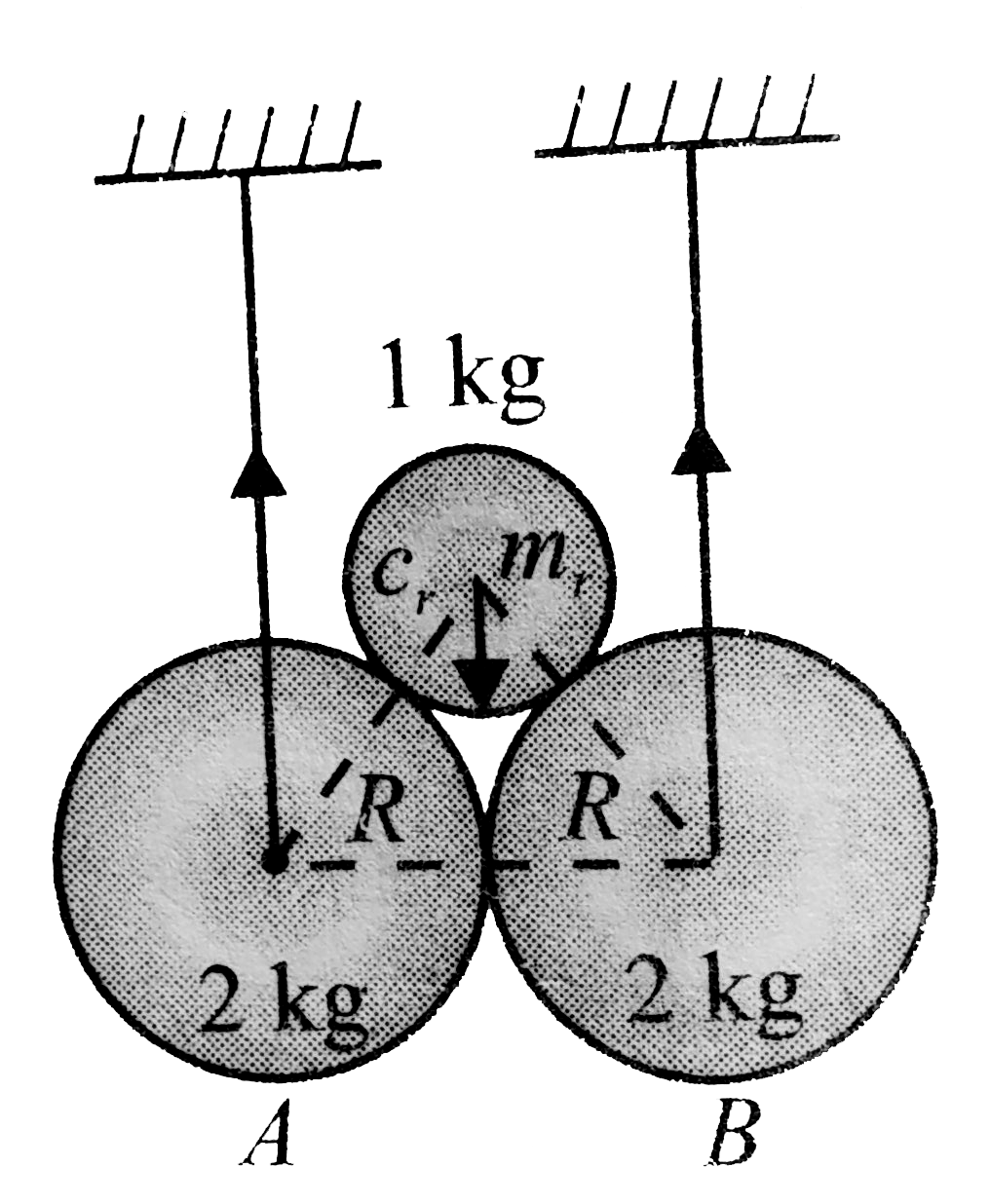
Two identical balls `A` and `B`. each of mass `2 kg` and radius `R`, are suspended vertically from inextensible strings as shown in Fig. The third ball `C` of mass `1 kg` and radius `r=(sqrt(2)-1)R` falls and hits `A` and `B` symmetrically with `10 m//s`. Speed of both `A` and `B` just after the collision is `3 m//s`.

speed of `C` just asfter collision is

A

`2m//s`

B

`2sqrt(2)m//s`

C

`5m//s`

D

`(sqrt(2)-1)m//s`

Text Solution

Verified by Experts

The correct Answer is:
A

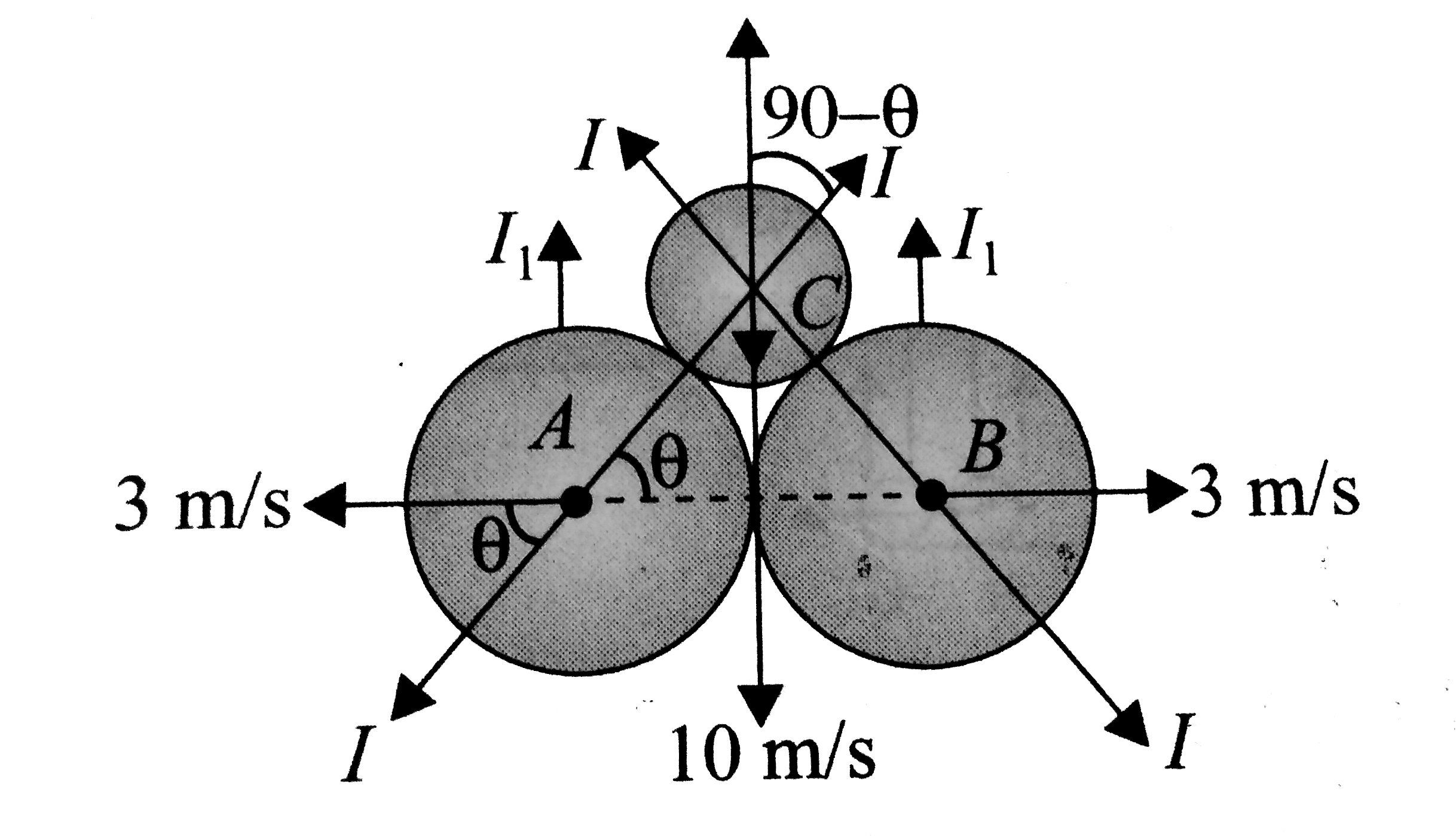
First calculate `theta=45^(@)`. As the balls `A` and `B` are constained to move horizontally (immediately after collision) if `'I'` be the impulse impated by ball `C` to each of `A` and `B`, the mpulse received by ball `C` from them would be `2Isintheta`

Now, each of ball `B` and `C` received impulse `'I'` as shown in figure. but moves impulse imparted to ball `B` and `C` by the respective strings and hence,
`Icostheta=M_(A)V_(A)=M_(B)V_(B)`
Now, for ball `C` if its final velocity is `V_(C)^(')` downwards we have
`M_(C)V_(C)^(')=M_(C)V_(C)-2Isintheta`
`impliesV_(C)^(')=V_(C)-2(MA)/(MC)V_(A)` (`:'theta=45^(@))`
`=-2m//s` (`-ve` sign indcates that it is directed upwards)
Promotional Banner

Topper's Solved these Questions

  • CENTRE OF MASS

    CENGAGE PHYSICS|Exercise Integer|16 Videos
  • CENTRE OF MASS

    CENGAGE PHYSICS|Exercise Fill In The Blanks|2 Videos
  • CENTRE OF MASS

    CENGAGE PHYSICS|Exercise Assertion - Reasoning|2 Videos
  • CALORIMETRY

    CENGAGE PHYSICS|Exercise Solved Example|13 Videos
  • DIMENSIONS & MEASUREMENT

    CENGAGE PHYSICS|Exercise Integer|2 Videos

Similar Questions

Explore conceptually related problems

In the figure shown, the two identical balls of mass M and radius R each, are placed in contact with each other on the frictionless horizontal surface. The third ball of mass M and radius R/2, is coming down vertically and has a velocity = v_(0) when it simultaneously hits the two balls and itself comes to rest. The each of the two bigger balls will move after collision with a speed equal to

In the figure shown, the two identical balls of mass M and radius R each, are placed in contact with each other on the frictionless horizontal surface. The third ball of mass M and radius (R )/(2') is coming down vertically and has a velocity =upsilon_(0) when it simultaneously hits the two balls and itself comes to rest. Then, each of the two bigger balls will move after collision with a speed equal to :

Three solid spheres each of mass m and radius R are released from the position shown in Fig. What is the speed of any one sphere at the time of collision?

Two smooth balls A and B , each of mass m and radius R , have their centres as shown in fig. Ball A , moving along positive x-axis, collides with ball B . Just before the collision, speed of ball 'A' is 4m//s and ball 'B' is stantionary. The collision Velocity of the ball 'A' just after the collision is

A particle of mass m strikes a disc of radius R and mass m with a speed u as shown in the figure. What is the speed of the particle just after the collision if the collision is perfectly inelastic ?

A ball of mass 1 kg strink a heavy platform, elastically, moving upwards with a velocity of 5 m//s . The speed of the ball just begore the collision is 10 m//s downwards. Then the impulse imparted by the platform on the ball is :-

Two identical balls moving in opposite directions with speed 20 m/s and 25 m/s undergo head on perfectly inelastic collision. The speed of combined mass after collision is

CENGAGE PHYSICS-CENTRE OF MASS-Linked Comprehension
  1. According to the principle of conservation of linear momentum if the e...

    Text Solution

    |

  2. According to the principle of conservation of linear momentum if the e...

    Text Solution

    |

  3. Two identical balls A and B. each of mass 2 kg and radius R, are suspe...

    Text Solution

    |

  4. Two identical balls A and B. each of mass 2 kg and radius R, are suspe...

    Text Solution

    |

  5. Two identical balls A and B. each of mass 2 kg and radius R, are suspe...

    Text Solution

    |

  6. After falling from rest through a height h, a body of mass m begins to...

    Text Solution

    |

  7. After falling from rest through a height h, a body of mass m begins to...

    Text Solution

    |

  8. Three identical balls are connected by light inextensible strings with...

    Text Solution

    |

  9. Three identical balls are connected by light inextensible strings with...

    Text Solution

    |

  10. Three identical balls are connected by light inextensible strings with...

    Text Solution

    |

  11. In Fig. a pulley is shown which is frictionless and a ring of mass m c...

    Text Solution

    |

  12. In Fig. a pulley is shown which is frictionless and a ring of mass m c...

    Text Solution

    |

  13. In Fig. a pulley is shown which is frictionless and a ring of mass m c...

    Text Solution

    |

  14. A system of men and trolley is shown in Fig. To the left, end of the s...

    Text Solution

    |

  15. A system of men and trolley is shown in Fig. To the left, end of the s...

    Text Solution

    |

  16. A system of men and trolley is shown in Fig. To the left, end of the s...

    Text Solution

    |

  17. Two beads A and B of masses m(1) and m(2) respectively, are threaded o...

    Text Solution

    |

  18. Two beads A and B of masses m(1) and m(2) respectively, are threaded o...

    Text Solution

    |

  19. Two beads A and B of masses m(1) and m(2) respectively, are threaded o...

    Text Solution

    |

  20. Two blocks of equal mass m are connected by an unstretched spring and ...

    Text Solution

    |

