Home
Class 11
PHYSICS
Two identical blocks A and B each of mas...

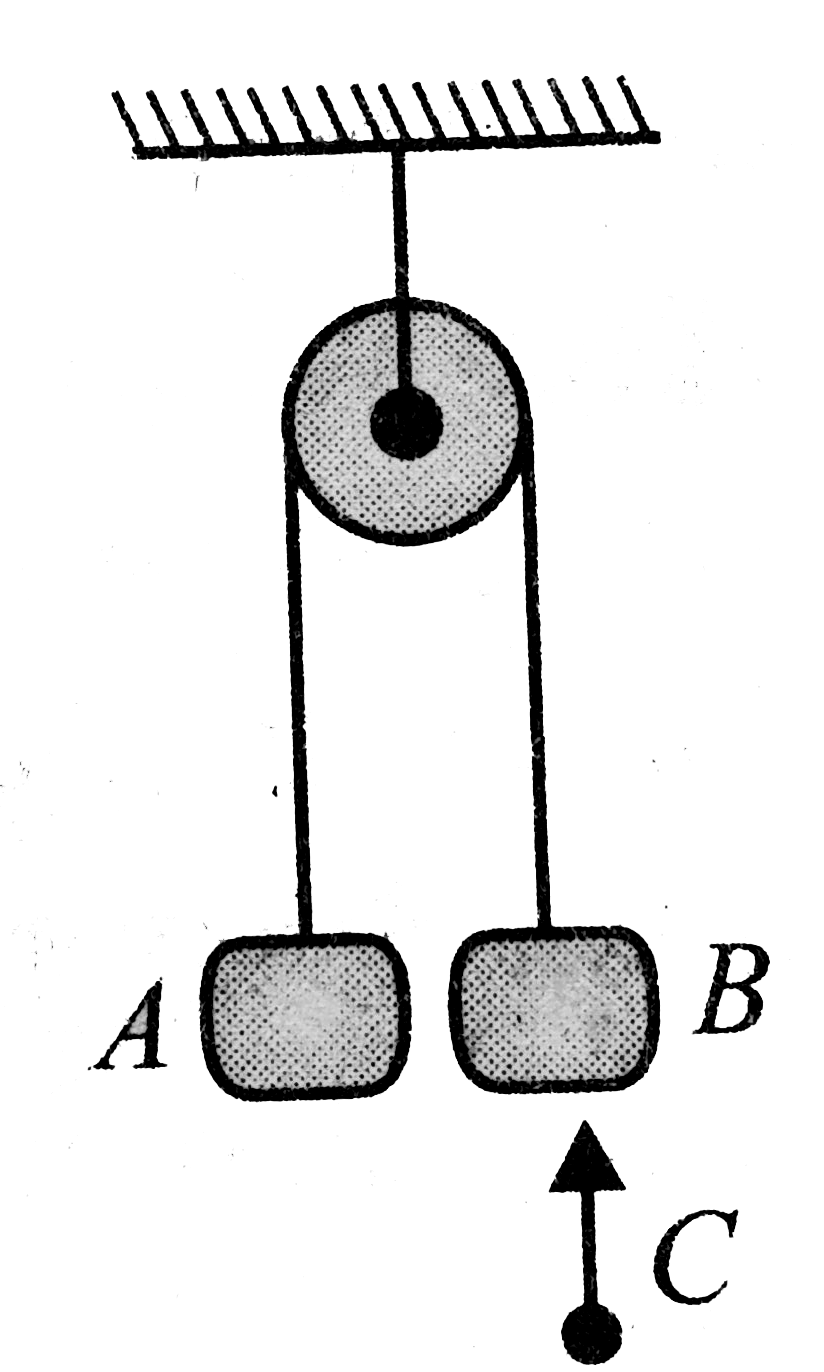
Two identical blocks `A` and `B` each of mass `2 kg` are hanging stationary by a light inextensible flexible string, passing over a light and frictionless pulley, as shown in Fig. A shell `C` of mass `1 kg` moving vertically upwards with velocity `9 m//s` collides with block `B` and gets stuck to it.

Calculate the time after which block `B` starts moving downwards.

A

`0.90s`

B

`1s`

C

`0.60s`

D

`0.30s

Text Solution

Verified by Experts

The correct Answer is:

A

When `C` strikes with `B`, the combined body starts to rise vertically upward. According to law of conservation of momentum, velocity `v_(0)` of combined body (just after collision) is given by
`(2+1)v_(0)=1xx9` or `v_(0)=3 m//s`
But `A` is at rest. Therefore, string becomes slack and bodies move under gravity, combined body upwards and `A` downwards till string again becomes taut. This happens when downward displacement of `A` becomes equal to upward displacement of combined body. Let it happen at instant `t_(1)`. Then,
`1/2"gt"_(1)^(2)=3t_(1)-1/2"gt"_(1)^(2)`
or `t_(1)=0.3s` Displacement of each block at that instant,
`h_(1)=1/2"gt"_(1)^(2) 0.45m`
And velocity of combined body is `3-"gt"_(1)=0` and velocity of `A` is `"gt"_(1)=3m//s` (downward).
Since at this instant, velocities are different, therefore an impulse is developed in the string and magnitude of velocities of bodies becomes equal. Let that velocity magnitude be `v` and impulse developed be `J`. This impulse acts upwards on both the bodies.
Hence for `A`
`2xx3-J=v’`………i
and for combined body,
`J=3v’`…………..ii
From above equations
`v’=1.2m//s`
Now combined body starts to move upwards with velocity `v’=1.2m//s` and retardation a, where
`a=(3-2)/(3+2)=2m//s^(2)`
Combined body comes to an instantaneous rest after time
`t_(2)=(v^('))/a=0.6s`
After this instant, combined body starts moving down. Time interval between this instant and instant of collision is given by
`t_(1)+t_(2)=0.3+0.6=0.9s`
Further height ascended by combined body during time `t_(2)` is
`h_(2)=v’v_(2)-1/2at_(2)^(2)=0.36m`
Maximum height raised by combined body is
`h=h_(1)+h_(2)=0.81m`
Loss of energy during collision of `B` and `C` is
`E_(1)=1/2xx1xx9^(2)-1/23v_(0)^(2)=27J`
Loss of energy when impulse is developed in string is
`E_(2)=1/2xx2x3^(2)-1/2(2+3)3v_(0)^(2)(2+3)(v’)^(2)=5.4J`
Loss of mechanical energy till `B` reaches highest point is
`E=E_(1)+E_(2)=27+5.4=32.4J`
Promotional Banner

Topper's Solved these Questions

  • CENTRE OF MASS

    CENGAGE PHYSICS|Exercise Integer|16 Videos
  • CENTRE OF MASS

    CENGAGE PHYSICS|Exercise Fill In The Blanks|2 Videos
  • CENTRE OF MASS

    CENGAGE PHYSICS|Exercise Assertion - Reasoning|2 Videos
  • CALORIMETRY

    CENGAGE PHYSICS|Exercise Solved Example|13 Videos
  • DIMENSIONS & MEASUREMENT

    CENGAGE PHYSICS|Exercise Integer|2 Videos

Similar Questions

Explore conceptually related problems

Two identical blocks A and B each of mass 2 kg are hanging stationary by a light inextensible flexible string, passing over a light and frictionless pulley, as shown in Fig. A shell C of mass 1 kg moving vertically upwards with velocity 9 m//s collides with block B and gets stuck to it. The maximum height reached by B

Two identical blocks A and B each of mass 2 kg are hanging stationary by a light inextensible flexible string, passing over a light and frictionless pulley, as shown in Fig. A shell C of mass 1 kg moving vertically upwards with velocity 9 m//s collides with block B and gets stuck to it. The loss of mechanical energy up to that instant is

Two blocks of masses of 40 kg and 30 kg are connected by a weightless string passing over a frictionless pulley as shown in the figure.

Three blocks A,B and C of mass 10 kg each are hanging on a string passing over a fixed frictionless pulley as shown in figure. The tension in the string connecting blocks B and C is (g=10m//s^(2))

Two blocks A and B , each of mass 10 kg , are connected by a light string passing over a smooth pulley as shown in the figure. Block A will remain at rest if the friction on it is

In the shown ,two blocks one of mass 5kg and the other of mass 2kg are connected by light and inextensible string Pulleys are light an d frictionless Choose the correct statement .

Two masses 2 kg and 4 kg are connected at two ends of light inextensible string passing over a frictionless pulley . If the masses are released , then find the accelaration of the masses and the tension in the string .

Two masses m_(1) and m_(2) are connected by light inextensible string passing over a smooth pulley P . If the pulley moves vertically upwards with an acceleration equal to g then .

Two blocks of masses m and 3m are connected by an inextensible string and the string passes over a fixed pulley which is massless and frictionless. A bullet of mass m moving with a velocity 'u' hits the hanging block of mass 'm' and gets exbedded in it. Find the height through which block A rises after the collision.

CENGAGE PHYSICS-CENTRE OF MASS-Linked Comprehension
  1. Two balls of masses m(1)=100 g and m(2)=300 g are suspended from point...

    Text Solution

    |

  2. Two balls of masses m(1)=100 g and m(2)=300 g are suspended from point...

    Text Solution

    |

  3. Two identical blocks A and B each of mass 2 kg are hanging stationary ...

    Text Solution

    |

  4. Two identical blocks A and B each of mass 2 kg are hanging stationary ...

    Text Solution

    |

  5. Two identical blocks A and B each of mass 2 kg are hanging stationary ...

    Text Solution

    |

  6. A pan of mass m = 1.5 kg and a block of mass M = 3 kg are connected to...

    Text Solution

    |

  7. A pan of mass m = 1.5 kg and a block of mass M = 3 kg are connected to...

    Text Solution

    |

  8. A pan of mass m = 1.5 kg and a block of mass M = 3 kg are connected to...

    Text Solution

    |

  9. A pan of mass m = 1.5 kg and a block of mass M = 3 kg are connected to...

    Text Solution

    |

  10. A horizontal frictionless rod is threaded through a bead of mass m. Th...

    Text Solution

    |

  11. A horizontal frictionless rod is threaded through a bead of mass m. Th...

    Text Solution

    |

  12. A horizontal frictionless rod is threaded through a bead of mass m. Th...

    Text Solution

    |

  13. An initially stationary box on a frictionless floor explodes into two ...

    Text Solution

    |

  14. An initially stationary box on a frictionless floor explodes into two ...

    Text Solution

    |

  15. A circular disc of mass '2m' and radius '3r' is resting on a flat fric...

    Text Solution

    |

  16. A circular disc of mass '2m' and radius '3r' is resting on a flat fric...

    Text Solution

    |

  17. A circular disc of mass '2m' and radius '3r' is resting on a flat fric...

    Text Solution

    |

  18. Two blocks of masses m(1) and m(2) are connected by an ideal sprit, of...

    Text Solution

    |

  19. Two blocks of masses m(1) and m(2) are connected by an ideal sprit, of...

    Text Solution

    |

  20. Two blocks of masses m(1) and m(2) are connected by an ideal sprit, of...

    Text Solution

    |
