Home
Class 11
PHYSICS
A frog sits on the end pf a long boord o...

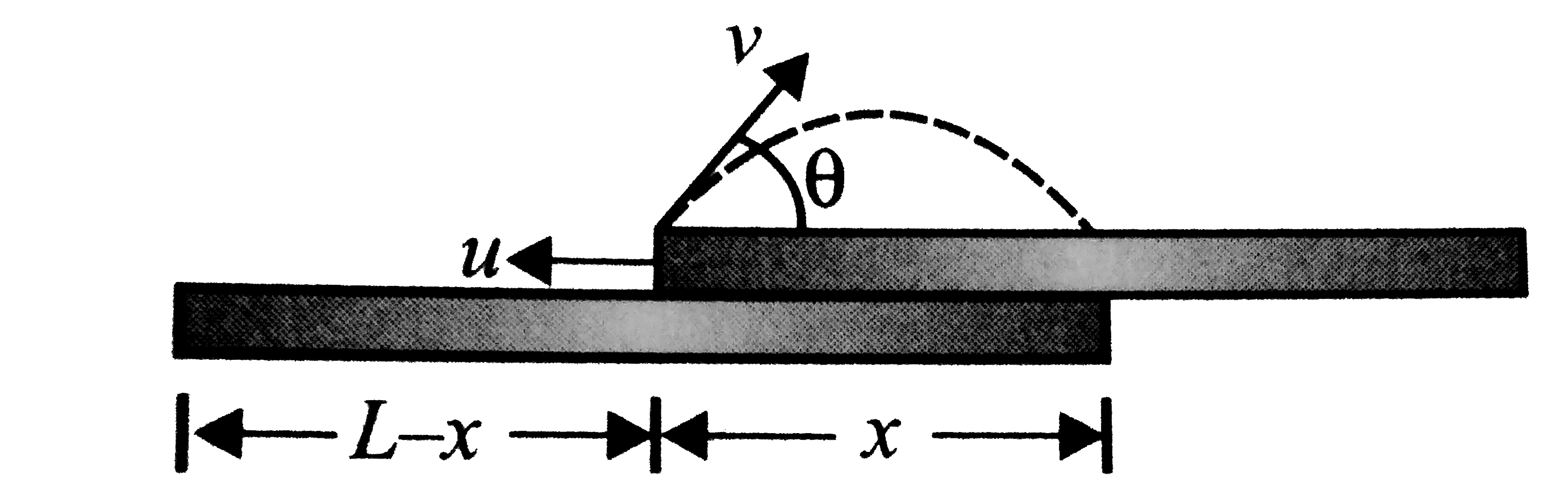
A frog sits on the end pf a long boord of length L. the boord rests on a fricationless horizontal table. The frog wants os the minimum takes - off speed i.e relative to ground v that allows the frog yo do the trick? The board and the frog have equal masses.

Text Solution

Verified by Experts

The correct Answer is:
2

Apply conservation of momentum in horizontal direction

`mvcostheta-mu=0implies u=vcostheta`
`L-x, ut, xv=vcosthetat`
Solve to get `x=L/2`
`x=(v^(2)sin2theta)/gimpliesL/2=(v^(2)sin2theta)/g`
`implies v=((gL)/(2sintheta))` for minimum `v, sin 2theta=1`
`implies v=sqrt((gL)/2)=sqrt((10xx5)/2)=2ssqrt5m//s,` Hence `n=2`
Promotional Banner

Topper's Solved these Questions

  • CENTRE OF MASS

    CENGAGE PHYSICS|Exercise Fill In The Blanks|2 Videos
  • CENTRE OF MASS

    CENGAGE PHYSICS|Exercise SCQ_TYPE|12 Videos
  • CENTRE OF MASS

    CENGAGE PHYSICS|Exercise Linked Comprehension|105 Videos
  • CALORIMETRY

    CENGAGE PHYSICS|Exercise Solved Example|13 Videos
  • DIMENSIONS & MEASUREMENT

    CENGAGE PHYSICS|Exercise Integer|2 Videos

Similar Questions

Explore conceptually related problems

A table cloth of length L is lying on a table with one of its end at the edge of the table. A block is kept at the centre of the table cloth. A man pulls the end of the table cloth horizontally so as to take it off the table. The cloth is pulled at a constant speed V_(0) . What can you say about the coefficient of friction between the block and the cloth if the block remains on the table (i.e., it does not fall off the edge) as the cloth is pulled out.

A uniform bar of length 12 L and mass 48 m is supported horizontally on two smooth tables as shown in the figure. A small moth (an insect) of mass 8m is sitting on end A of the rod and a spider (an insect) of mass 16 m is sitting on the other end B . Both the insects start moving towards each other along the rod with moth moving at speed 2v and the spider at half of this speed. They meet at a point P on the rod and the spider eats the moth. After this the spider moves with a velocity v//2 relative to the rod towards the end A . The spider takes negligible time in eating the insect. Also, let v = L//T , where T is a constant having value 4 sec . The speed of the bar after the spider eats up the moth and moves towards A is

A uniform bar of length 12 L and mass 48 m is supported horizontally on two smooth tables as shown in the figure. A small moth (an insect) of mass 8m is sitting on end A of the rod and a spider (an insect) of mass 16 m is sitting on the other end B . Both the insects start moving towards each other along the rod with moth moving at speed 2v and the spider at half of this speed. They meet at a point P on the rod and the spider eats the moth. After this the spider moves with a velocity v//2 relative to the rod towards the end A . The spider takes negligible time in eating the insect. Also, let v = L//T , where T is a constant having value 4 sec . Displacement of the rod by the time when the insects meet is

A uniform bar of length 12 L and mass 48 m is supported horizontally on two smooth tables as shown in the figure. A small moth (an insect) of mass 8m is sitting on end A of the rod and a spider (an insect) of mass 16 m is sitting on the other end B . Both the insects start moving towards each other along the rod with moth moving at speed 2v and the spider at half of this speed. They meet at a point P on the rod and the spider eats the moth. After this the spider moves with a velocity v//2 relative to the rod towards the end A . The spider takes negligible time in eating the insect. Also, let v = L//T , where T is a constant having value 4 sec . The point P is at

Figure shows a wire ab of length L and resistance R which can slide on a smooth pair of rails. I_(g) is current generator which supplies a constant current i in the circuit. If the wire ab slide at a speed v towards right, find the potential difference below a and b (b) The current generator I_(g) show in the figure sends a constant current i through the circiut. The wire ab has a length L and mass m and can slide on the smooth horizontal rails connect to I_(g) . The entire system lies in a vertical magnetic field B . Find the velocity of the wire as a function of time. (c) The system containing the rails and the wire of the previous part is kept vertically in a uniform horizontal magnetic field B that is perpendicular to the plane of the rails (figure). If is found that the wire stays in equilibrium. If th ewire ab is replaced by another wire of double its mass, how long will lit take in falling through a distance equal to its length? The current generator I_(g) shown in figure sends a constant current i through the circuit. The wire cd is fixed and wire ab is made to slide on the smooth, thick rails with a constant velocity v toward right. Each of these wires has resistance r . Find the current through the wire cd .

