Home
Class 11
PHYSICS
The ends A and B of a eod of length l ha...

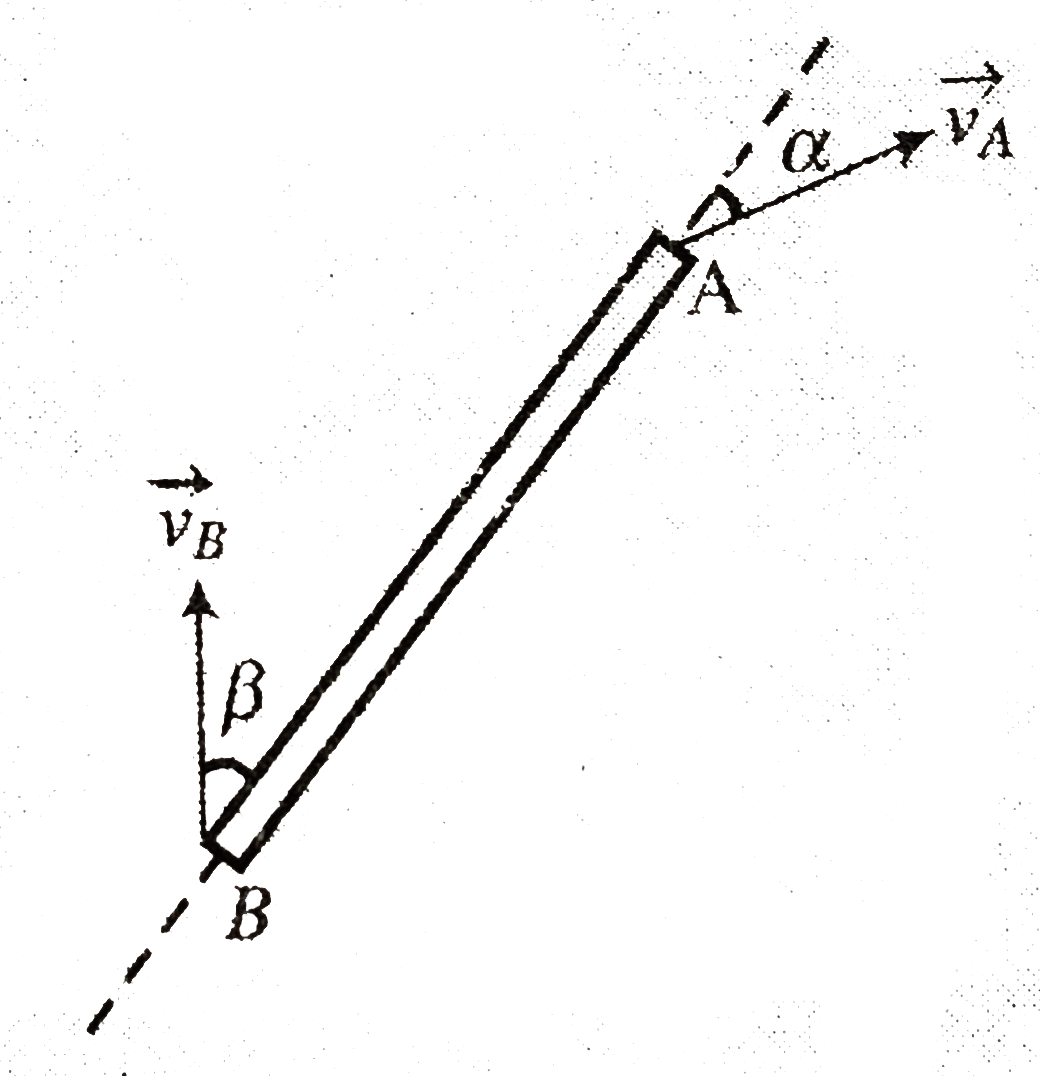
The ends `A` and `B` of a eod of length `l` have velocities of magnitudes `|vecv_(A)|=v` and `|vecv_(B)|=2v` respectively. If the inclination of `vecv_(A)` relationn to the rod is `alpha` find the
a. Inclination `beta` of `vecc_(B)` relative of the rod.
b. angular velocity of the rod.

Text Solution

Verified by Experts
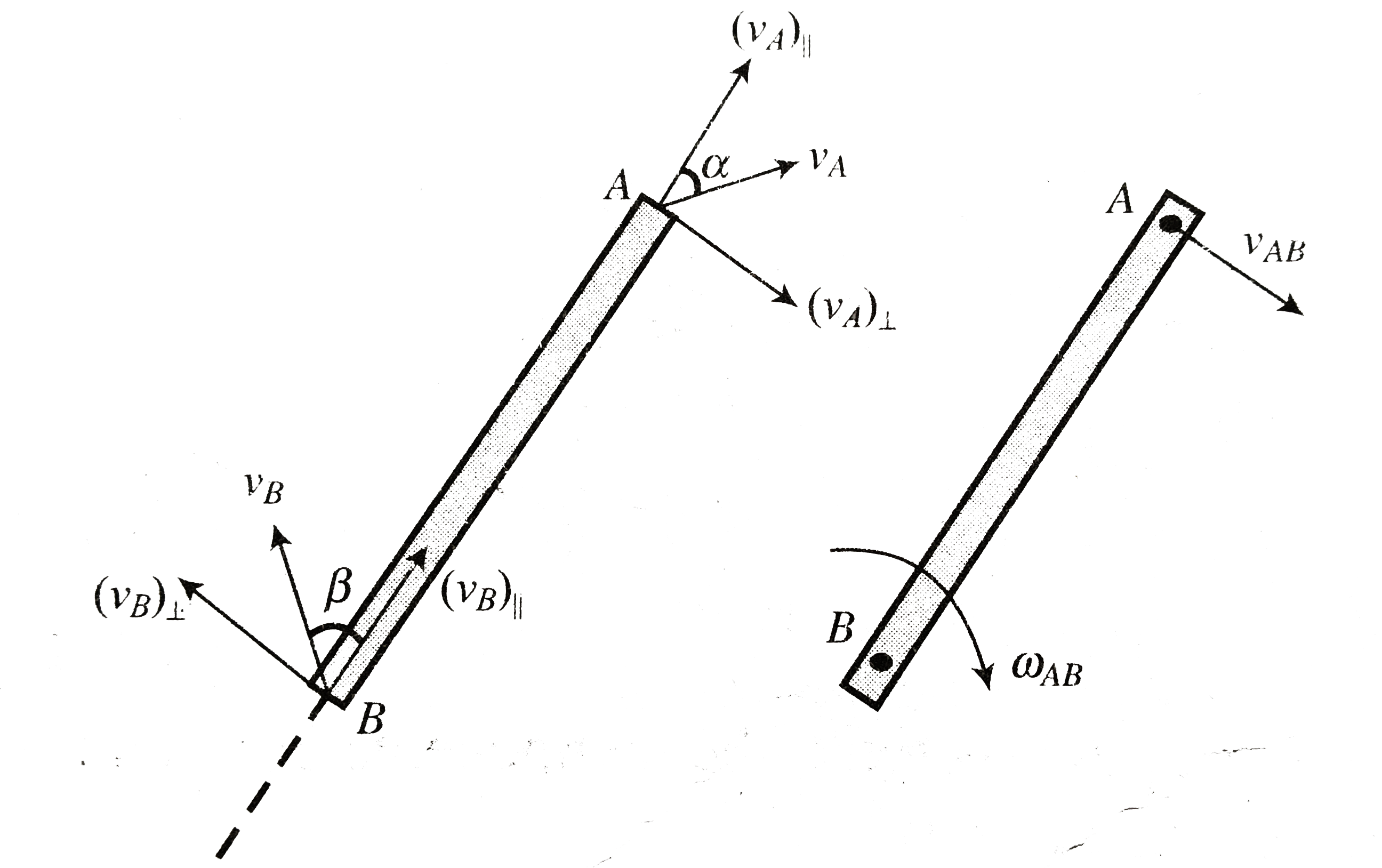

We know in a rigid body the velocities of two points along the line joining two should remain same.
i.e., `(v_(A))_(||)=(v_(B))_(||)`
Hence `v costheta=2vcosbeta`
`cosbeta=1/2cosalpha` or `beta=cos^(-2)(1/2cosalpha)`
b. for angular velocity of the rod we can write
`omega=(|(vecv_(AB))_(_|_)|)/l=(|(vecv_(A)-vecv_(B))_(_|_)|)/l`
`|vecv_(AB)|=|vecv_(A)-vec_(B)|=vsinalpha(-2vsinbeta)=v(sinalpha+2sinbeta)`
`implies omega=((sinalpha+2sinbeta)v)/l` (in clockwise direction)
we have calculated `cosbeta=(cosalpha)/2.` Thus,
`sinbeta=sqrt(1-cos^(2)beta)implies sinbeta=sqrt((3+sin^(2)alpha)/2)`
Hence `omega=(sinalpha+sqrt(3+sinalpha))/l` ( in clockwise direction)
Promotional Banner

Topper's Solved these Questions

  • RIGID BODY DYNAMICS 1

    CENGAGE PHYSICS|Exercise Solved Examples|9 Videos
  • RIGID BODY DYNAMICS 1

    CENGAGE PHYSICS|Exercise Exercise 2.1|6 Videos
  • PROPERTIES OF SOLIDS AND FLUIDS

    CENGAGE PHYSICS|Exercise INTEGER_TYPE|2 Videos
  • RIGID BODY DYNAMICS 2

    CENGAGE PHYSICS|Exercise Interger|2 Videos

Similar Questions

Explore conceptually related problems

In the figure shown the instantaneous speed of end A of the rod is v to the left the angular velocity of the rod of lengthL must be

In the figure shown, the instantaneous speed of end A of the rod is v to the left. The angular velocity of the rod of length L must be

The velociies of A and B are vecv_(A)= 2hati + 4hatj and vecv_(B) = 3hati - 7hatj , velocity of B as observed by A is

There is rod of length l. The velocities of its two ends are v_(1) and v_(2) is opposite directions normal to the rod. The distance of the instantaneous axis of rotation from v_(1) is :

Suppose that two objects A and B are moving with velocities vecv_(A) and vecv_(B) (each with respect to some common frame of refrence). Let vecv_(AB) represent the velocity of with respect to B. Then

Two objects A and B are moving in opposite directions with velocities v_(A) and v_(B) respectively, the magnitude of relative velocity of A w.r.t. B is

A rod od length l is moving in a vertical plane ( x-y ) when the owest point A of the rod is moved with a velociy v . find the a angular velocity of the rod and b velocity of the end B .

A uniform rod of mass M and length a lies on a smooth horizontal plane. A particle of mass m moving at a speed v perpendicular to the length of the rod strikes it at a distance a/4 from the centre and stops after the collision. Find a. the velocity of the cente of the rod and b. the angular velocity of the rod abut its centre just after the collision.

A rod AB of length 2m moves in horizontal x-y plane. At any instant end a of the rod is at origin and has velocity vecv_(A)=2hati+v_(y)hatj . The other end B at the same instant is moving with velocity vecv_(B)=3hati+6hatj . The rod makes an angle of 30^(@) with the x- axis at this instant (see figure) The magnitude of angular velocity of the rod is

