Home
Class 11
PHYSICS
A uniform ladder of mass 10 g leans agai...

A uniform ladder of mass 10 g leans against a smooth vertical wall making an angle of `53^0` with it. The other end rests on a rough horizontal floor. Find the normal force and the frictional force that the floor exerts on the ladder

Text Solution

Verified by Experts
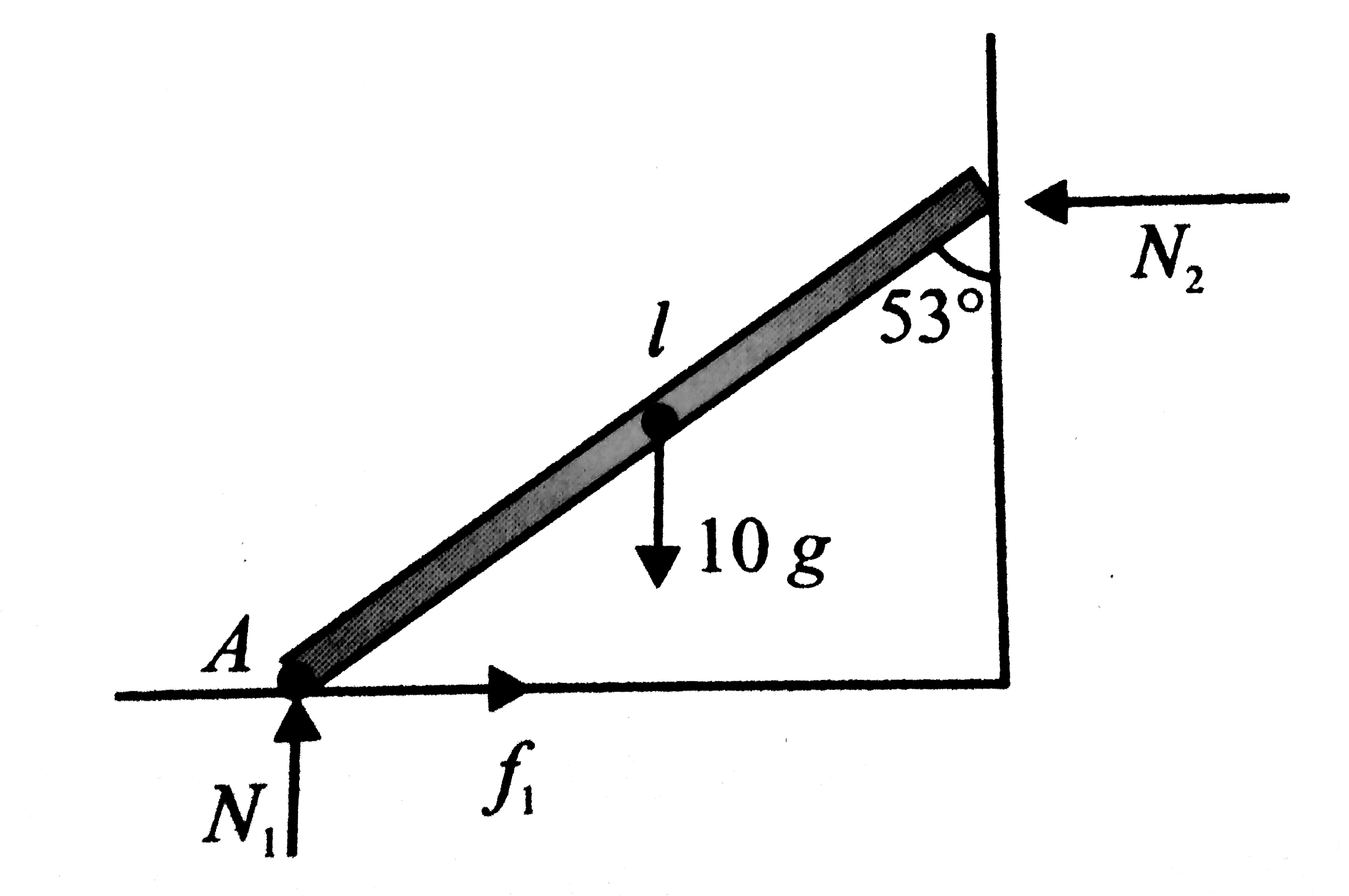
`N_(1)=10g=100N`

Balancing torque about `A`
`10gl/2cos37^@=N_(2)lcos53^@`
`N_(2)=(2omega)/3N`
Now `f_(1)N_(2)=200/3N`
Promotional Banner

Topper's Solved these Questions

  • RIGID BODY DYNAMICS 1

    CENGAGE PHYSICS|Exercise Exercise 2.4|11 Videos
  • RIGID BODY DYNAMICS 1

    CENGAGE PHYSICS|Exercise Subjective|13 Videos
  • RIGID BODY DYNAMICS 1

    CENGAGE PHYSICS|Exercise Exercise 2.2|17 Videos
  • PROPERTIES OF SOLIDS AND FLUIDS

    CENGAGE PHYSICS|Exercise INTEGER_TYPE|2 Videos
  • RIGID BODY DYNAMICS 2

    CENGAGE PHYSICS|Exercise Interger|2 Videos

Similar Questions

Explore conceptually related problems

A stationary uniform rod of mass 'm', length 'l' leans against a smooth vertical wall making an angle theta with horizontal floor. Find the normal force & frictional force that is exerted by the floor on the rod ?

A ladder of mass 20 kg is resting against a vertical smooth wall. Ladder makes an angle 37° with the wall. Other end of the ladder is resting on a rough horizontal floor. Find normal force and force of friction applied on the ladder by horizontal surface.

A ladder 10m long is leaning against a vertical wall, it makes an angle of 60° with the ground.How far is the foot of the ladder from the wall?

A uniform ladder of length L and mass m_(1) rests against a frictionless wall. The ladder makes an angle theta with the horizontal. (a) Find the horizontal and vertical forces the ground exerts on the base of the ladder when a firefighter of mass m_(2) is a distance x from the bottom. (b) If the ladder is just on the verge of slipping when the firefighter is a distance d from the bottom, what is the coefficient of static friction between ladder and ground?

A ladder wighing 300 N is placed against a smooth vertical wall having a coefficient of friction between it and the floor of 0.2. What is the maximum force of friction available at the point of contact between the ladder and the floor?

A uniform ladder of length 10.0 m and mas 16.0 kg is resting against a vertical smooth wall making an angle of 37^@ with it. An electrian weighing 60.0 kg climbs up the ladder. If the stays on the ladder at a point 8.00 m from the lower end, what will be normal force and the force of friction on the ladder by the ground? What should be the minimum coefficient of friction for the electician to work safely?

A ladder of mass 10kg is held at reat against a smooth wall on a rough ground as shown in figure. The normal reaction between the wall and the ladder is

(i) A uniform ladder of length L and weight w rests against a vertical wall and makes an angle theta with the horizontal ground. If the coefficient of friction at the point of contact of the ladder with the wall and ground is mu , show that the greatest height x, measured along the ladder from the foot to which a man of weight w may climb without the ladder slipping is given by (x)/(L) = (mu(W+w))/(W(1+mu^(2))) (mu +tan theta) - (w)/(2W) (ii) If the wall be smooth and coefficient of friction between ladder and ground be 0.25, show that x = (L)/(4) (1-(w)/(W)) tan theta - (wL)/(2W)

In the figure, a ladder of mass m is shown leaning against a wall. It is in static equilibrium making an angle theta with the horizontal floor. The coefficient of friction between the wall and the ladder is mu_1 and that between the floor and the ladder is mu_2. the normal reaction of the wall on the ladder is N_1 and that of the floor is N_2. if the ladder is about to slip. than

