Home
Class 11
PHYSICS
A uniform beam of mass m is inclined at ...

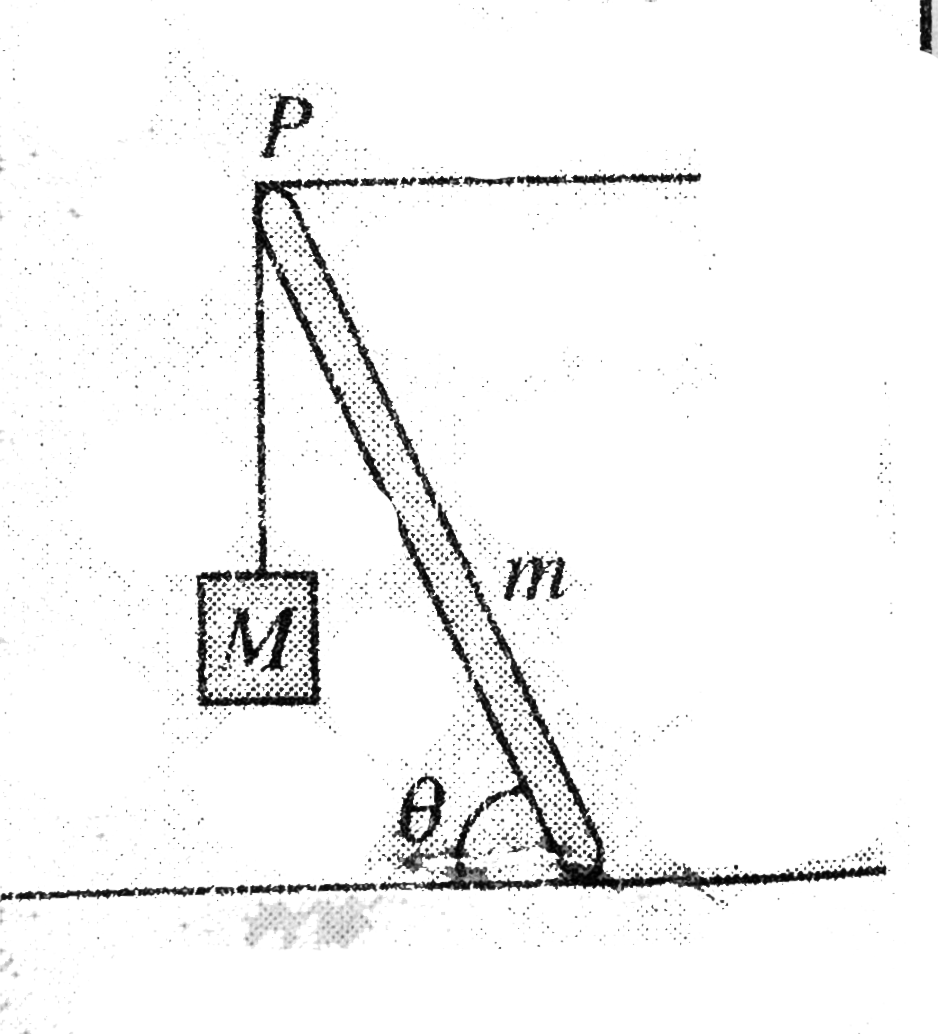
A uniform beam of mass `m` is inclined at an angle `theta` to the horizontal. Its upper end produces a ninety degree bend in a very rough rope tied to a wall, and its lower end rests on a rough floor (a) If the coefficient of static friction between beam and floor is `mu_(s)` determine an expression for the maximum mass `M` that can be suspended from the top before the beam slips. (b) Determine the magnitude of the reaction force at the floor and the magnitude of the force exerted by the beam on the rope at `P` in terms of `m, M` and `mu_(s)`
.

Text Solution

Verified by Experts

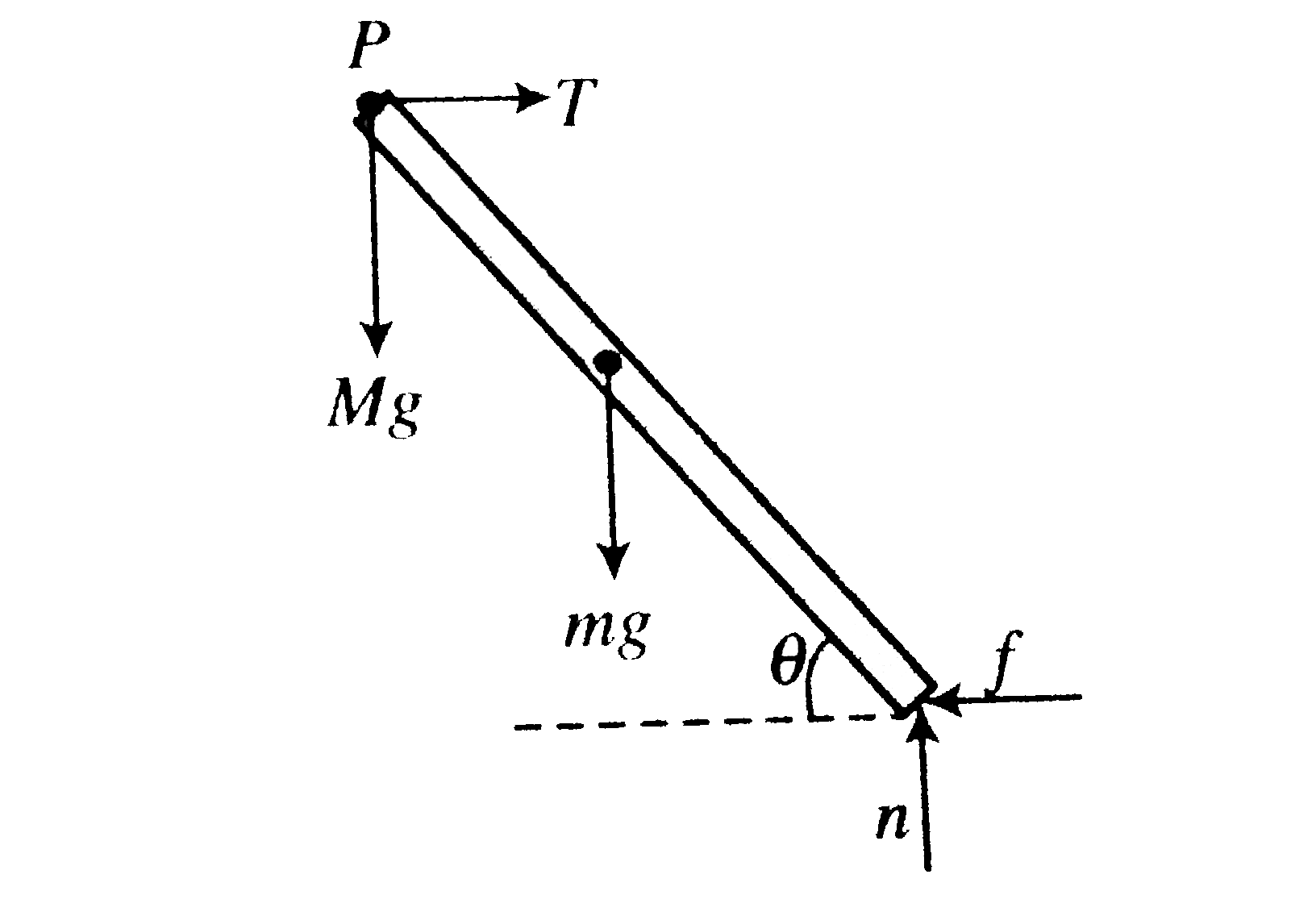
We can use `sumF_(x)=sumF_(y)=0` and `sumtau=0` with pivot point at the contact on the floor.

Then `sumF_(x)=T-mu_(s)n=0`
`sumF_(y)=n-Mg-mg=0`
`sumtau=Mg(Lcostheta)+mg(L/2costheta)-T(Lsintheta)=0`
Solving the above equations gives
`M=m/2((2mu_(s)sintheta-costheta)/(costheta-mu_(s)sintheta))`
This answer is the maximum value of `M` if `mu_(s)ltcottheta`. If `mu_(s)ge cot theta`, the mass `M` can increase without limit. it has no maximum value, and part b. cannot be answered an stated either. In the case `mu_(s)ltcottheta,` we proceed.
b. At the floor we have the normal force in the `y`-direction and frictional force in the `x`-direction. The reaction force then is
`R=sqrt(n^(2)+(mu_(s)n)^(2))=(M+m)g sqrt(1+mu_(s)^(2))`
At point `P`, the force of the beam on the rope is
`F=sqrt(T^(2)+(Mg)^(2))=gsqrt(M^(2)+mu_(s)^(2)(M+m)^(2))`
Promotional Banner

Topper's Solved these Questions

  • RIGID BODY DYNAMICS 1

    CENGAGE PHYSICS|Exercise Exercise 2.4|11 Videos
  • RIGID BODY DYNAMICS 1

    CENGAGE PHYSICS|Exercise Subjective|13 Videos
  • RIGID BODY DYNAMICS 1

    CENGAGE PHYSICS|Exercise Exercise 2.2|17 Videos
  • PROPERTIES OF SOLIDS AND FLUIDS

    CENGAGE PHYSICS|Exercise INTEGER_TYPE|2 Videos
  • RIGID BODY DYNAMICS 2

    CENGAGE PHYSICS|Exercise Interger|2 Videos

Similar Questions

Explore conceptually related problems

A box, heavier than you is placed on a rough floor. The coefficient of static friction between the box and the floor is the same as that between your shoes and the floor. Can you displace the box across.the floor.

A block of mass m is placed on a rough floor of a lift . The coefficient of friction between the block and the floor is mu . When the lift falls freely, the block is pulled horizontally on the floor. What is the force of friction -

The coefficient of static friction between a block of mass m and an incline is mu_s=03 , a. What can be the maximum angle theta of the incline with the horizontal so that the block does not slip on the plane? b. If the incline makes an angle theta/2 with the horizontal, find the frictional force on the block.

A uniform cylinder of mass m lies on a fixed plane inclined at a angle theta with the horizontal. A light string is tied to the cylinder at the rightmost point, and a mass m hangs from the string as shown. Assume that the coefficient of friction between the cylinder and the incline plane is sufficiently large to prevent slipping. for the cylinder to remain static the value of m is

A man drags an m kg crate across a floor by pulling on a rope inclined at angle theta above the horizontal. If the coefficient of static friction between the floor and crate is then the tension required in the rope to start the crate moving is :

A ladder rests on the floor of a room, leaning agains a wall. If the coefficient of static friction between the ladder the floor is mu_(f) and that between ladder and is mu_(w) , what is the minimum angle theta that the ladder can make with the floor if the ladder is not to slip? Assume that the mass of the ladder is distributed uniformly.

A solid cylinder of mass m and radius r is rolling on a rough inclined plane of inclination theta . The coefficient of friction between the cylinder and incline is mu . Then.

A block of mass 4kg rests on a rough horizontal plane. The plane is gradually inclined until at an angle theta=60^(@) , with the vertical, the mass just begins to side. What is the coefficient of static friction between the block and the plane?