Home
Class 11
PHYSICS
A container of large uniform cross secto...

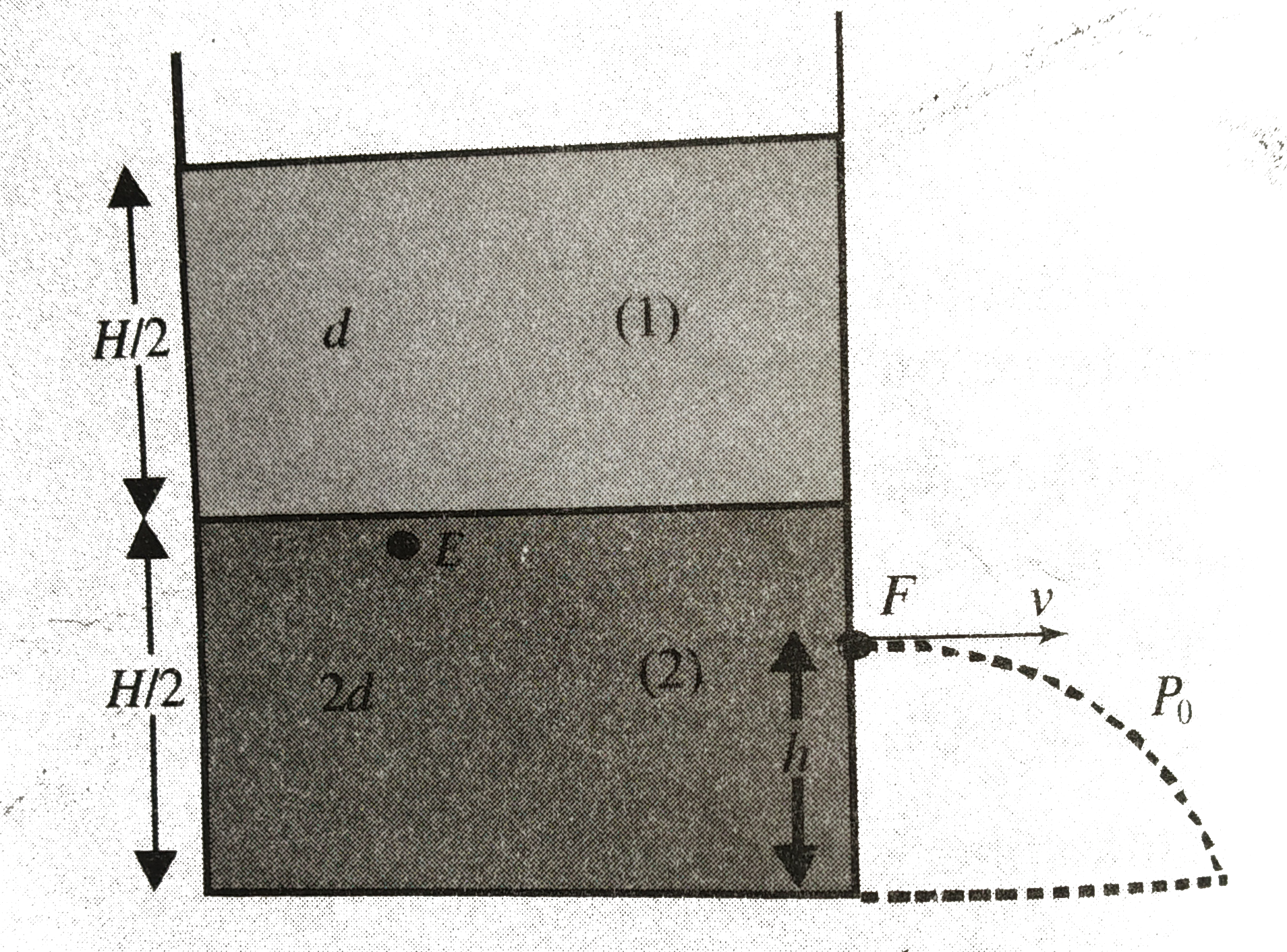
A container of large uniform cross sectonal area `A`, resting on horizontal surface, holds two immiscible non viscous and incompresible liquids of density `d` and `2d`, each of height `H/2` as shown in the figure. Thelower density liquid is open to the atmospher having presure `P_(0)`. A tiny hole of area `(s(sgt gtA)` is punched on the vertical side of the container at a height `h(hgtH/2)`. Determine

a.the initial speed of efflux of the liquid at the hole
b. the horizontal disance `x` travelled by the liquid initially
c. the height `h_m` at which at the hole should be punched so that the liquid travels the maximum distance `x_(m)` initially. also calculate `x_(m)` (neglect air resistance inte calculations).

Text Solution

Verified by Experts

a. Applying Beroulli's theorem at point `E` ( `a` point on the interface of the liquids and on the top surface of the liquid of density `2d`) and `F`, i.e, pressure energy `=` kinetic energy `+` potential energy `=` constant
`implies P_(0)+H/2dg+1/2(2d)xx0+H/2dg`
`=P_(0)+1/2(2d)v^(2)+2hdg`
`implies3/2Hdg=dv^(2)+2hdg`
`implies v^(2)=3/2Hg-2hg=((3H-4h)g)/2`
`:. v=sqrt({((3H-3h))/2g})`
Method :2 Let the equivalent depth of liquid `1` of denisty in terms of density `2d` which gives the dame pressure as liquid `1` at interface i.e.,
`H/2dg=H'(2d)g` which gives `H'=H/4`
Hence depth depth of the liquid above opening (in terms of depth of liquid of density `2d`).
`H'+(H/2-h)=H/4+(H/2-h)`
`H_("net")=((3H-4h)/4)`
and velocity of efflux is given by
`v=sqrt(2gh_("net"))`
`v=sqrt((3H-4h)/2)g`
time taken by the liquid to fall through a vertical height `h` is given by
`H=1/2"gt"^(2)implies t=sqrt((2h)/g)`
Therefore horizontal distance traversed by liquid is
`x=vt=sqrt(((3H-4h)g)/2)xxsqrt((2h)/g)`
c. For the minimum horizontal distance `x`
`(dx)/(dh)=0impliesd/(dh)(3Hh-4h^(2))^(1/2)=0`
or `1/293Hh-4h^(2)^(-1/2)xx(3H-8h)=0`
this gives `3H-8h-0impliesh=(3H)/8`
This is the length of the liquid for which the range is maximum i.e
`hrarr h_(m)=(3H)/8`
The maximum horizontal distance is given by
`x_(m)=sqrt((3H-3h_(m))h_(m))`
`sqrt({(3H-4(3H)/3)(3H)/8}9=3/4H`
Promotional Banner

Topper's Solved these Questions

  • FLUID MECHANICS

    CENGAGE PHYSICS|Exercise Exercise 4.1|11 Videos
  • FLUID MECHANICS

    CENGAGE PHYSICS|Exercise Exercise 4.2|11 Videos
  • FLUID MECHANICS

    CENGAGE PHYSICS|Exercise INTEGER_TYPE|1 Videos
  • DIMENSIONS & MEASUREMENT

    CENGAGE PHYSICS|Exercise Integer|2 Videos
  • GRAVITATION

    CENGAGE PHYSICS|Exercise INTEGER_TYPE|1 Videos
