Home
Class 11
PHYSICS
A uniform solid cylinder of density 0.8g...

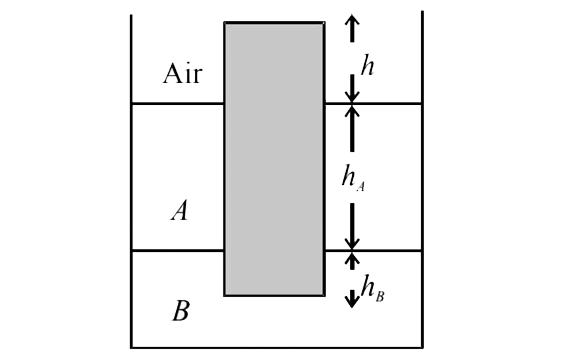
A uniform solid cylinder of density `0.8g//cm^3` floats in equilibrium in a combination of two non-mixing liquids A and B with its axis vertical.
The densities of the liquids A and B are `0.7g//cm^3` and `1.2g//cm^3`, respectively. The height of liquid A is `h_A=1.2cm.` The length of the part of the cylinder immersed in liquid B is `h_B=0.8cm`.

(a) Find the total force exerted by liquid A on the cylinder.
(b) Find h, the length of the part of the cylinder in air.
(c) The cylinder is depressed in such a way that its top surface is just below the upper surface of liquid A and is then released. Find the acceleration of the cylinder immediately after it is released.

Text Solution

Verified by Experts

a. Liquid A exerts horizotal force on all area elements for all directions. By symmetry, the resultant of these horizontal force is zero. So the total force exerted by liquid A onn the cylinder is zero.
b. Let A be the cross sectional area of the cylinder.
For floating equilibrium.
Weight of floating cylinder `=` Buoyant force `=` weight of liqid displaced.
`(h+h_A+h_B)xxAxx0.8g=(h_Arho_Ag+h_BArho_Bg)`
or `(h+h_A+h_B)xx0.8=h_Arho_A+h_Brho_B`
`implies (h+1.2+0.8)xx=1.2xx0.7+0.8xx1.2`
`implies 0.8h+1.6=1.8 or 0.8h=0.2`
`implies h=0.25cm`
b. Mass of cylilnder `=(h+h_A+h_B)Arho`
`=(0.2+1.2+0.8)Axx0.8=1.8A`
When the cylinder is depressed just completely, its height h goes in liquid B, so extra buoyant fore due to liquid B acts on it. Due to this force cylinder is accelerated upward.
Extra buoyant force `F=(h_A)rho_Bg`
`=0.25Axx1.2g=0.3Ag`
Acceleration is given by `a=F/m=(0.3Ag)/m=(0.3Ag)/(1.8A)=g/6`
`=10/6=5/3m//s^2`
Promotional Banner

Topper's Solved these Questions

  • FLUID MECHANICS

    CENGAGE PHYSICS|Exercise Exercise 4.1|11 Videos
  • FLUID MECHANICS

    CENGAGE PHYSICS|Exercise Exercise 4.2|11 Videos
  • FLUID MECHANICS

    CENGAGE PHYSICS|Exercise INTEGER_TYPE|1 Videos
  • DIMENSIONS & MEASUREMENT

    CENGAGE PHYSICS|Exercise Integer|2 Videos
  • GRAVITATION

    CENGAGE PHYSICS|Exercise INTEGER_TYPE|1 Videos

Similar Questions

Explore conceptually related problems

A column of water 40 cm height supports a 30 cm column of an unknown liquid . What is the density of the liquid ?

The density of a liquid at 100^(@)C is 8.0g//cm^(3) and at 0^(@)C is 8.4g//cm^(3) , the coefficient of cubical expansion of the liquid is

Two miscible liquids of densities 1.2gm//cm and 1.4gm//cm aer mixed with a proportion ratio of their volumes equal to 2.5: what is the density of redulting liquid?

Two identical tanks contain water and a liquid of density 0.8 g cm^(-3) . Pressure exerted by the liquid is equal to the pressure due to water column of 50 cm. Find the height of the liquid column in the tank ?

Two immiscible of densities 2.5g//cm^(3) and 0.8g//cm^(3) are taken in the ratio of their masses as 2:3 respectively find the average density of the liquid conbination.
