Home
Class 11
PHYSICS
Consider a container having an inclined ...

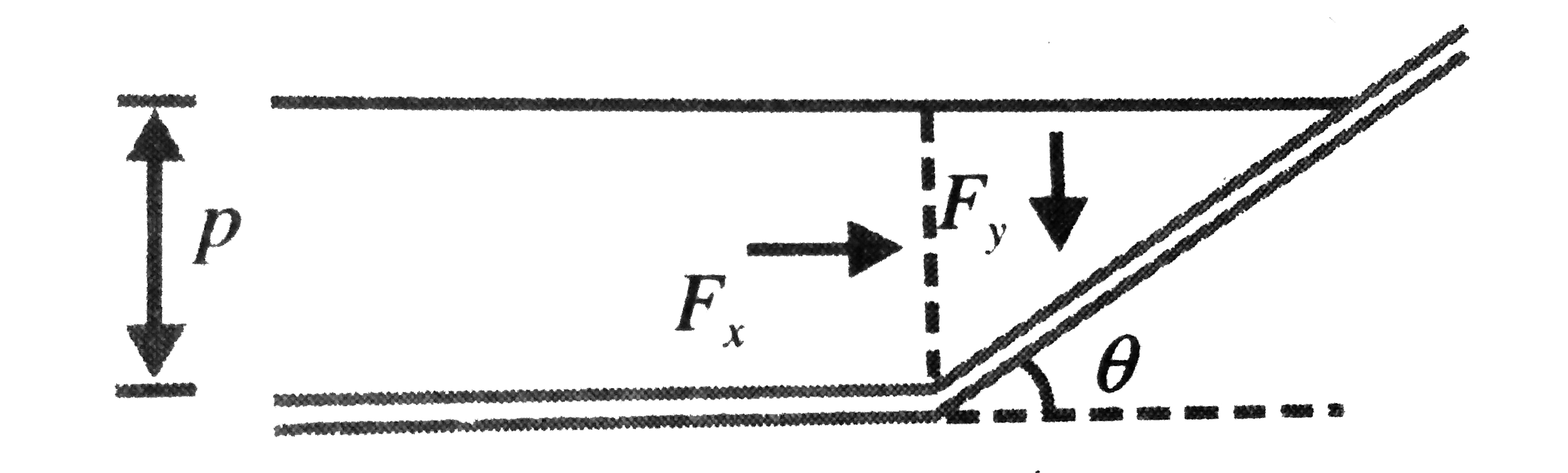
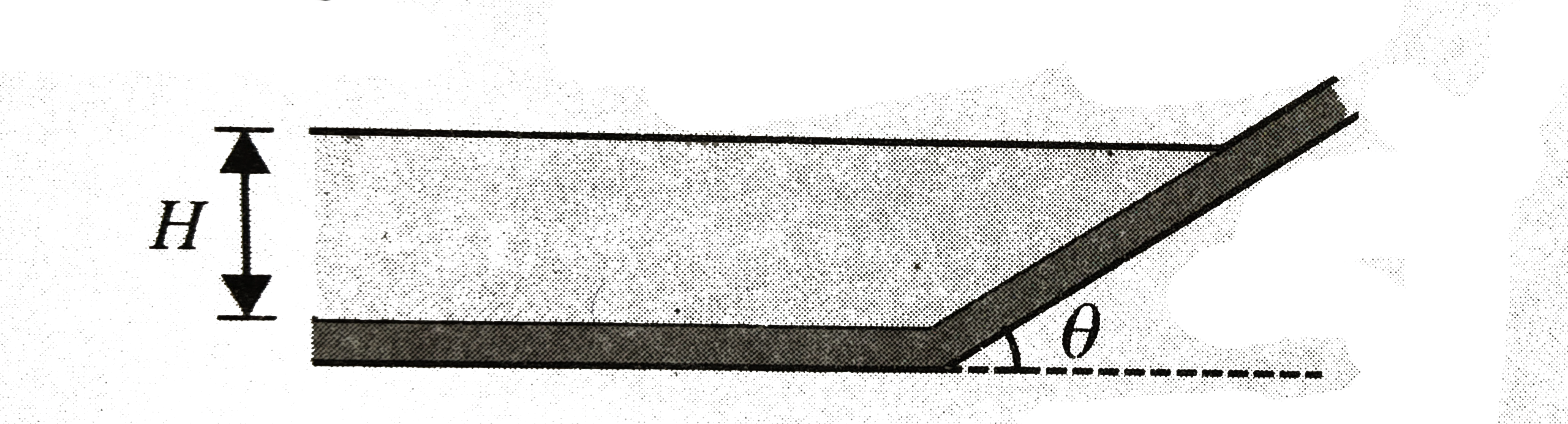
Consider a container having an inclined wall, inclined an angle `theta` with horizontal as shown in Fig. Calculate the force per unit width on the wall.

A

`F/b=1/2rhogH^(2)/(costheta)`

B

`F/b=1/2rhogH^(2)/(sintheta)`

C

`F/b=rhogH^(2)/(sintheta)`

D

none

Text Solution

Verified by Experts

The correct Answer is:
B

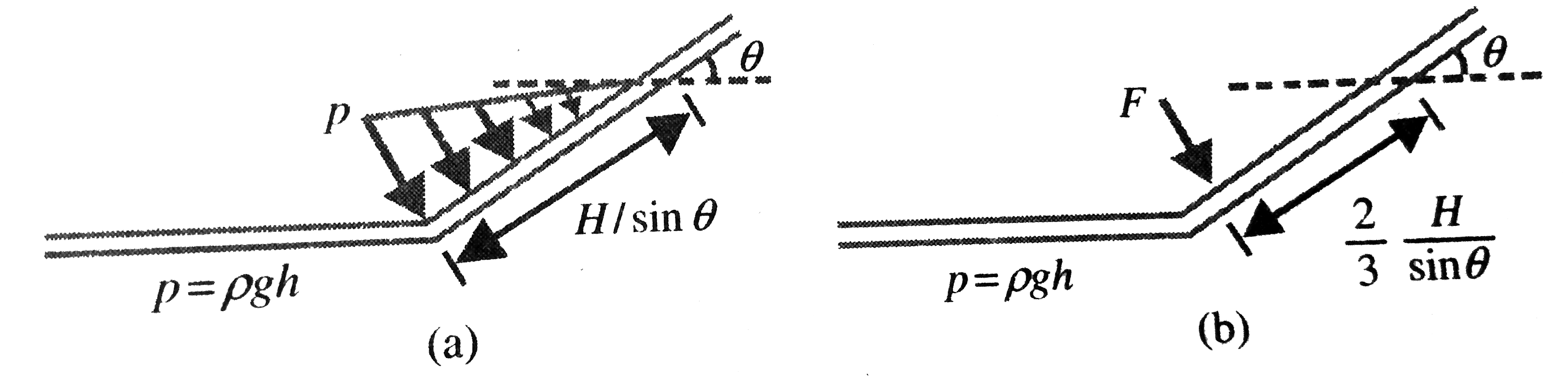
Since pressure always gets normal to the suface therefore the pressure diagram for an inclined wall is shown in Figure. The base of the triangular presure diagram is equal to `rhoghH` because pressure at a point depends on the height of liquid column above it.

The total of application of the total force is through the centroid of the pressure diagram as shown in figure.
Alternatively the force on the inclined wall may be obtained in two parts horizontal and vertical.
The horizontal force `F_(x)` acts on the vertical projection of the inclined wall.

`F_(x)=1/2rhoghbH^(2)`
The vertical force `F_(v)` acts due to the weight of the liquid supported by the wall
`F_(y)=1/2rhogb(H)(hcottheta)=1/2rhoghH^(2)cot^(2)theta`
The magnitude of the resultant force is
`F=sqrt(F_(x)^(2)-F_(y)^(2))=1/2rhogbH^(2)cosectheta`
`impliesF/b=1/2rhogH^(2)/(sintheta)`
Promotional Banner

Topper's Solved these Questions

  • FLUID MECHANICS

    CENGAGE PHYSICS|Exercise Exercise 4.2|11 Videos
  • FLUID MECHANICS

    CENGAGE PHYSICS|Exercise Exercise 4.3|10 Videos
  • FLUID MECHANICS

    CENGAGE PHYSICS|Exercise Solved Examples|7 Videos
  • DIMENSIONS & MEASUREMENT

    CENGAGE PHYSICS|Exercise Integer|2 Videos
  • GRAVITATION

    CENGAGE PHYSICS|Exercise INTEGER_TYPE|1 Videos

Similar Questions

Explore conceptually related problems

A particle is projected up an inclines plane. Plane is inclined at an angle theta with horizontal and particle is projected at an angle alpha with horizontal. If particle strikes the plane horizontally prove that tan alpha=2 tan theta

A solid sphere of mass M and radius R is covered with a thin shell of mass M. There is no friction between the inner wall of the shell and the sphere. The ball is released from rest, and then it rolls without slipping down an incline that is inclined at an angle theta to the horizontal. Find the acceleration of the ball.

A uniform cylinder of mass M and radius R is released from rest on a rough inclined surface of inclination theta with the horizontal as shown in figure. As the cylinder rolls down the inclined surface, the maximum elongation it the spring stiffness k is

A solid cylinder of mass m rolls without slipping down an inclined plane making an angle theta with the horizontal. The frictional force between the cylinder and the incline is

A very heavy box is kept on a frictionless incline plane inclined at an angle theta from the horizontal. Box is having an another frictionless incline plane, inclined plane as shown in the figure. A block of mass m is kept on this inclined plane inside the box. Acceleration of block w.r.t. box is

A trolley containing a liquid slides down a smooth inclined plane of angle alpha with the horizontal. Find the angle of inclination theta of the free surface with the horizontal.

A block is at rest on an inclined plane making an angle alpha with the horizontal. As the angle of the incline is increased the block start slipping when the angle of inclination becomes theta then coefficient of friction is equal to

A block of mass m is at rest on an incline having an angle of inclination theta with the horizontal. The incline is now being rotated with constant angular velocity omega about an axis passing through the perpendicular side. If the surface of the incline is rough having coefficient of friction as mu , then find the distance 'x' aong the incline so that block just remains stationary with restpect to incline and is on the verge of slipping. [ Take 'x' from the top of the incline as shown in the figure.]