Home
Class 11
PHYSICS
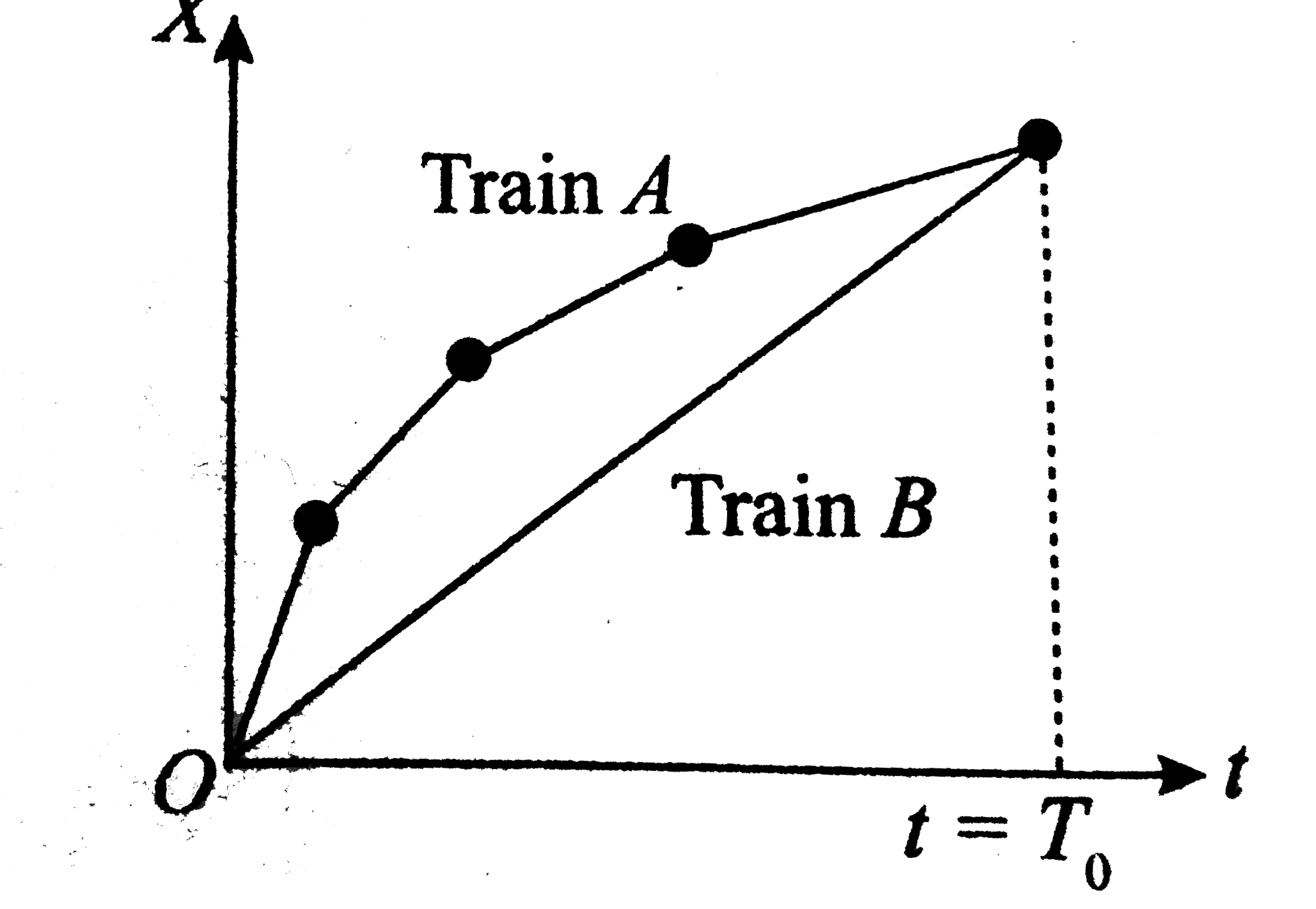
The plot shows the position (x) as a fun...

The plot shows the position (`x`) as a function of time (`t`) for two trains that run on a parallel track. Train `A` is next to train `B` at `t=0` and at `t=T_(0)`.

A

At `T_(0)` both the trains have the same velocity.

B

Both the trains speed up all the times.

C

Both trains have the same velocity at some time before `T_(0)`.

D

At `T_(0)` the trains have covered different distances

Text Solution

Verified by Experts

The correct Answer is:

C

Initially slope of `A` is more than `B` and initially finally slope of `A` is less. So speed of `A` is initially more than finally less than `B`. So somewhere in between their speeds become the same.
Promotional Banner

Topper's Solved these Questions

  • MISCELLANEOUS VOLUME 2

    CENGAGE PHYSICS|Exercise MCQ_TYPE|20 Videos
  • MISCELLANEOUS VOLUME 2

    CENGAGE PHYSICS|Exercise LC_TYPE|34 Videos
  • MISCELLANEOUS KINEMATICS

    CENGAGE PHYSICS|Exercise Interger type|3 Videos
  • NEWTON'S LAWS OF MOTION 1

    CENGAGE PHYSICS|Exercise Integer|5 Videos

Similar Questions

Explore conceptually related problems

The graph shows position as a function of time for two trains running on parallel tracks. Which statement is true ?

Problems based on trains running on parallel track

A train of length L move with a constant speed V_(t) . A person at the back of the train fires a bullet at time t = 0 towards a target which is at a distance of D ( at time t = 0 ) from the front of the train ( on the same direction of motion ). Another person at the front of the train fires another bullet at time t = T towards the same target. Both bullets reach the target at the same time. Assuming the speed of the bullets V_(b) are same, the length of the train is

45 Shows position time graph of a particle of mass 100g Find the impulse at t = 0 and at t = 4 s .

A particle's position as a function of time is described as y (t) = 2t^(2) + 3t + 4 . What is the average velocity of the particle from t = 0 to t = 3 sec ?

The instantaneous velocity of a particle moving in a straight line is given as a function of time by: v=v_0 (1-((t)/(t_0))^(n)) where t_0 is a constant and n is a positive integer . The average velocity of the particle between t=0 and t=t_0 is (3v_0)/(4 ) .Then , the value of n is

A train A crosses a station with a speed of 40 m/s and whitles a short pulse of natural frequency n_0=596Hz another train B is approaching towards the same station with the same speed along a parallel track, Two track are d=99m apart. When train A whistles. train B is 152 m away from the station as shown in Fig. If velocity of sound in air is v=300(m)/(s) . calculate frequency of the pulse heard by driver of train B.

State the law of radioactive decay. Plot a graph showing the number (N) of undecayed nuclei as a function of time (t) for a given radioactive sample having half life T_(1//2) Depict in the plot the number of undecayed nuclei at (i) t=3T_(1//2) and (ii) t=5T_(1//2) .

An experimenter is inside a uniformly accelerated train. Train is moving horizontally with constant acceleration a_(0) . He places a wooden plank AB in horizontal position with end A pointing towards the engine of the train. A block is released at end A of the plank and it reaches end B in time t_(1) . The same plank is placed at an inclination of 45^(@) to the horizontal. When the block is released at A it now climbs to B in time t_(2) . It was found that (t_(2))/(t_(1))= 2^((5)/(4)) . What is the coefficient of friction between the block and the plank?
