Home
Class 12
CHEMISTRY
Explain IUPAC nomenclature of Co-ordinat...

Explain IUPAC nomenclature of Co-ordination compounds with suitable examples.

Text Solution

Verified by Experts
IUPAC nomenclature : The formula of a compound is an abreviated description of the constitution of the compound. The following rules are prescribed by IUPAC for naming of Co-ordination compounds.
i) Positive ions are named first followed by negative ions. eg. : Potassium hexacyanoferrate (II), `K_(4)[Fe(CN)_(6)]`
i) Within the Co-ordination sphere ligands are named before the metal atom/ion. However, in formulae, metal ion is written first. eg. : Tetraammine copper (II) sulphate `[Cu(NH_(3))_(4)]SO_(4)`
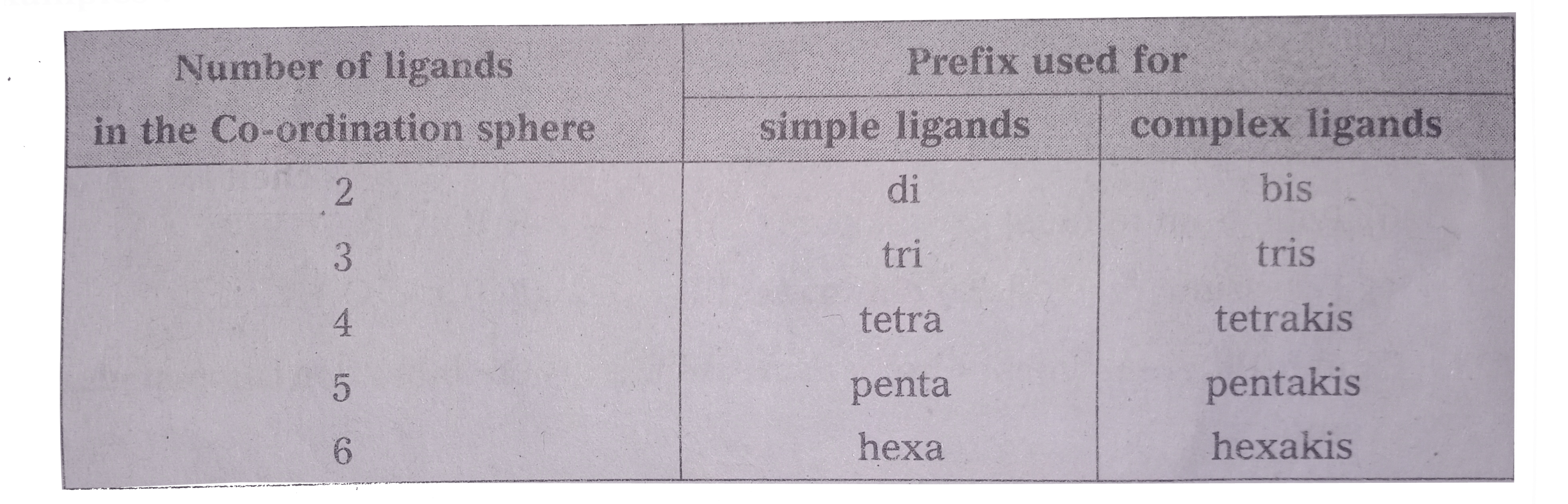
iii) Prefixes are used to denote the number of same ligands that the present in the Coordination sphere. Complex ions are denoted in paranthesis ( ) and prefixed by bis, tris etc.
Examples :

eg. : `[Co(NH_(2)CH_(2)CH_(2)NH_(2))Cl_(2)` Cl is named as dichloro bis (ethylendeiamine) cobalt (III) chloride
iv) Ligands are named in alphabetical order.
eg. : `[PtCl_(2)(NH_(3))_(2)` diammine dichloro platinum (II)
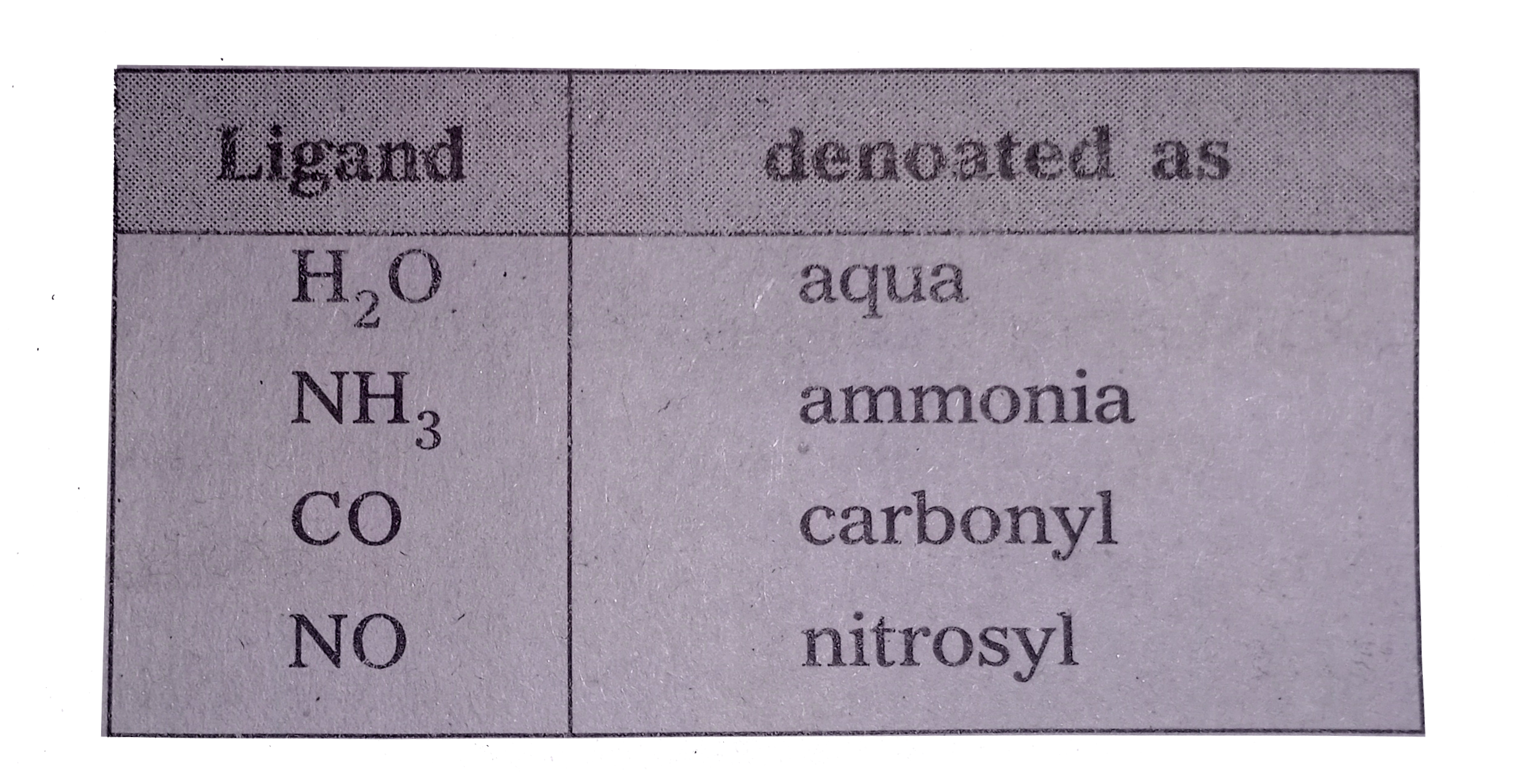
v) Anionic ligands are denoted by a suffix 'O' and netural ligands are denoted by their original names.
eg. : `Cl^(-)-" Chloro", CN^(-)-"Cyano"`
Exception for the above are indicated below.

vi) Oxidation state of the metal ion is indicated by Romen numerical in parenthesis.
eg. : `[Ag(NH_(3))_(2)][Ag(CN)_(2)]` is named as diammine silver (I) dicyanoargentate (I).
vii) If the charge of the Co-ordination entity is negative, the name of the metal ends with a suffix-ate.
eg. : `[Co(SCN)_(4)]^(2-)-tetrahiocyanato cobaltate (II)
Some metal ions are denoted by their names from which their symbols are derived
eg. : Fe-ferrate Pb-plumbate Sn-stannate
Ag- argentate Au-aurate
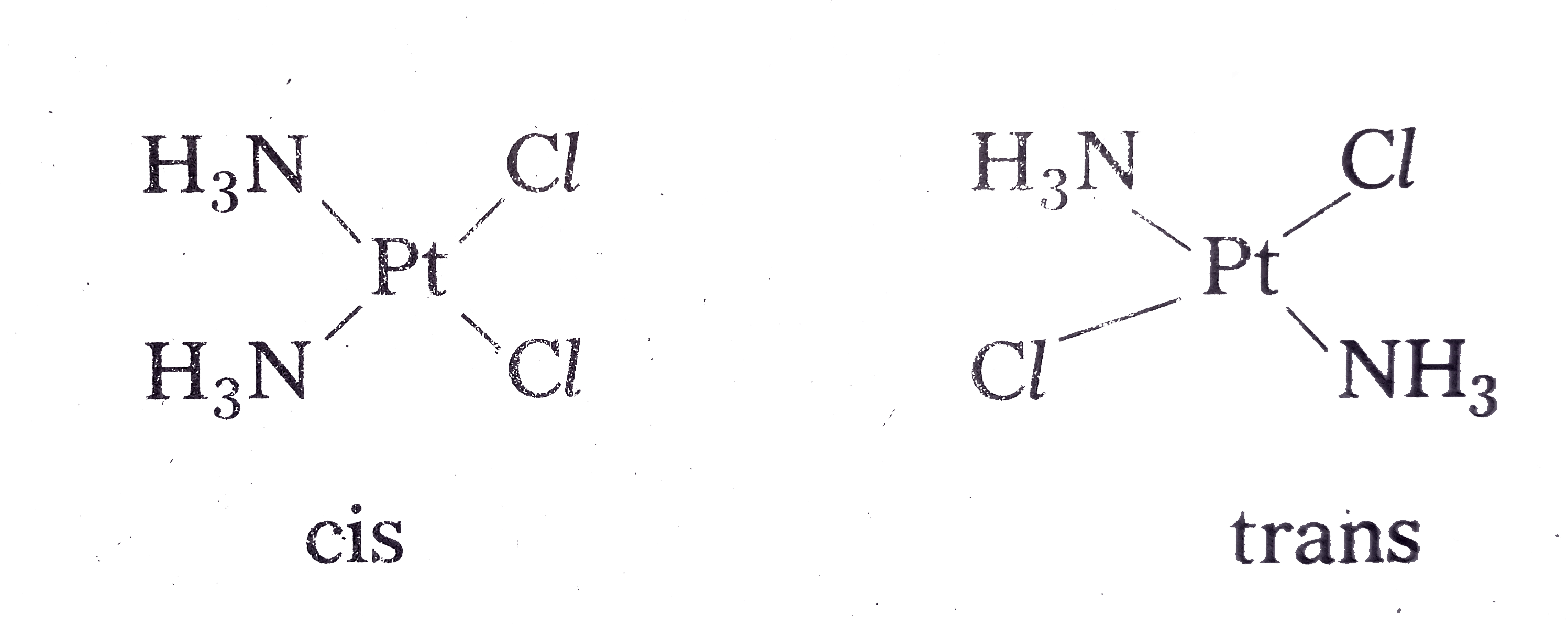
viii) Prefixes cis - and trans are used to designate adjacent and opposite geometric locations of the ligands, in a complex.
eg. :

ix) Bridging ligands between two metal ions in a Co-ordination entity are denoted by prefix `mu`(greek letter 'mu').
eg. : `[(NH_(3))_(4)Co(OH)(NH_(2))Co(NH_(3))_(4)]^(+)` is named as `mu`amido-`mu` hydroxo bis (tetraammine) cobalt (IV).
i) Tetrahydroxozincate (II) - `[Zn(OH)_(4)]^(-2)`
ii) Hexa ammine cobalt (Ill) sulphate - `[Co(NH_(3))_(6)]_(2)(SO_(4))_(3)`
iii) Potassium tetrachloropalladate - `K_(2)[PdCl_(4)]`
iv) Potassium tri(oxalato) chromate (III) - `K_(3)[Cr(C_(2)O_(4))_(3)]`
Promotional Banner

Topper's Solved these Questions

  • D AND F- BLOCK ELEMENTS AND CO-ORDINATION COMPOUNDS

    VIKRAM PUBLICATION ( ANDHRA PUBLICATION)|Exercise INTEXT QUESTIONS|33 Videos
  • D AND F- BLOCK ELEMENTS AND CO-ORDINATION COMPOUNDS

    VIKRAM PUBLICATION ( ANDHRA PUBLICATION)|Exercise SHORT ANSWER QUESTIONS|57 Videos
  • CHEMISTRY IN EVERYDAY LIFE

    VIKRAM PUBLICATION ( ANDHRA PUBLICATION)|Exercise Intex questions|5 Videos
  • ELECTROCHEMISTRY & CHEMICAL KINETICS

    VIKRAM PUBLICATION ( ANDHRA PUBLICATION)|Exercise DAM SURE|18 Videos

Similar Questions

Explore conceptually related problems

Explain ionic bond with suitable example.

Explain coagulation with suitable examples.

What are co-ordination compounds? Give two examples.

Explain geometrical isomerism in Co-ordination compounds giving suitable examples.

What is Stereoisomerism ? Explain the geometrical' isomerism in coordinationi compounds with suitable example.

Explain binomial nomenclature.

Explain the formation of Ionic Bond with a suitable example.

Discuss the colour of the transition metal compounds with suitable examples.

VIKRAM PUBLICATION ( ANDHRA PUBLICATION)-D AND F- BLOCK ELEMENTS AND CO-ORDINATION COMPOUNDS -LONG ANSWER QUESTIONS
  1. Give two reactions in which transition metals or their compounds acts ...

    Text Solution

    |

  2. Describe the preparation of potassium permanganate. How does the acidi...

    Text Solution

    |

  3. Compare the chemistry of the actinoids with that of lanthanoids with r...

    Text Solution

    |

  4. How would you account for the of the d(4) species, Cr^(2+) is strongly...

    Text Solution

    |

  5. How would you account for the Cobalt (II) is stable in aqueous solutio...

    Text Solution

    |

  6. How would you account for the The d(1) configuration is very unstable ...

    Text Solution

    |

  7. Give examples and suggest reasons for the following features of the t...

    Text Solution

    |

  8. Give examples and suggest reasons for the following features of the t...

    Text Solution

    |

  9. Give examples and suggest reasons for the following features of the t...

    Text Solution

    |

  10. Compare the chemistry of the actinoids with that of lanthanoids with r...

    Text Solution

    |

  11. Explain IUPAC nomenclature of Co-ordination compounds with suitable ex...

    Text Solution

    |

  12. Explain different types of isomerism exhibited by Co-ordination compou...

    Text Solution

    |

  13. Discuss the nature of bonding and magnetic behaviour in the [Fe(CN)(6)...

    Text Solution

    |

  14. Discuss the nature of bonding and magnetic behaviour in the [FeF(6)]^(...

    Text Solution

    |

  15. Discuss the nature of bonding and magnetic behaviour in the [Co(C(2)O(...

    Text Solution

    |

  16. Discuss the nature of bonding and magnetic behaviour in the [CoF(6)]^(...

    Text Solution

    |

  17. Sketch the splitting of d orbitals in an octahedral crystal field,

    Text Solution

    |

  18. What is spectrochemical series ? Explain the difference between a weak...

    Text Solution

    |

  19. Discuss the nature of bonding in metal carbonyls.

    Text Solution

    |

  20. Explain the applications of Co-ordination compounds in different field...

    Text Solution

    |