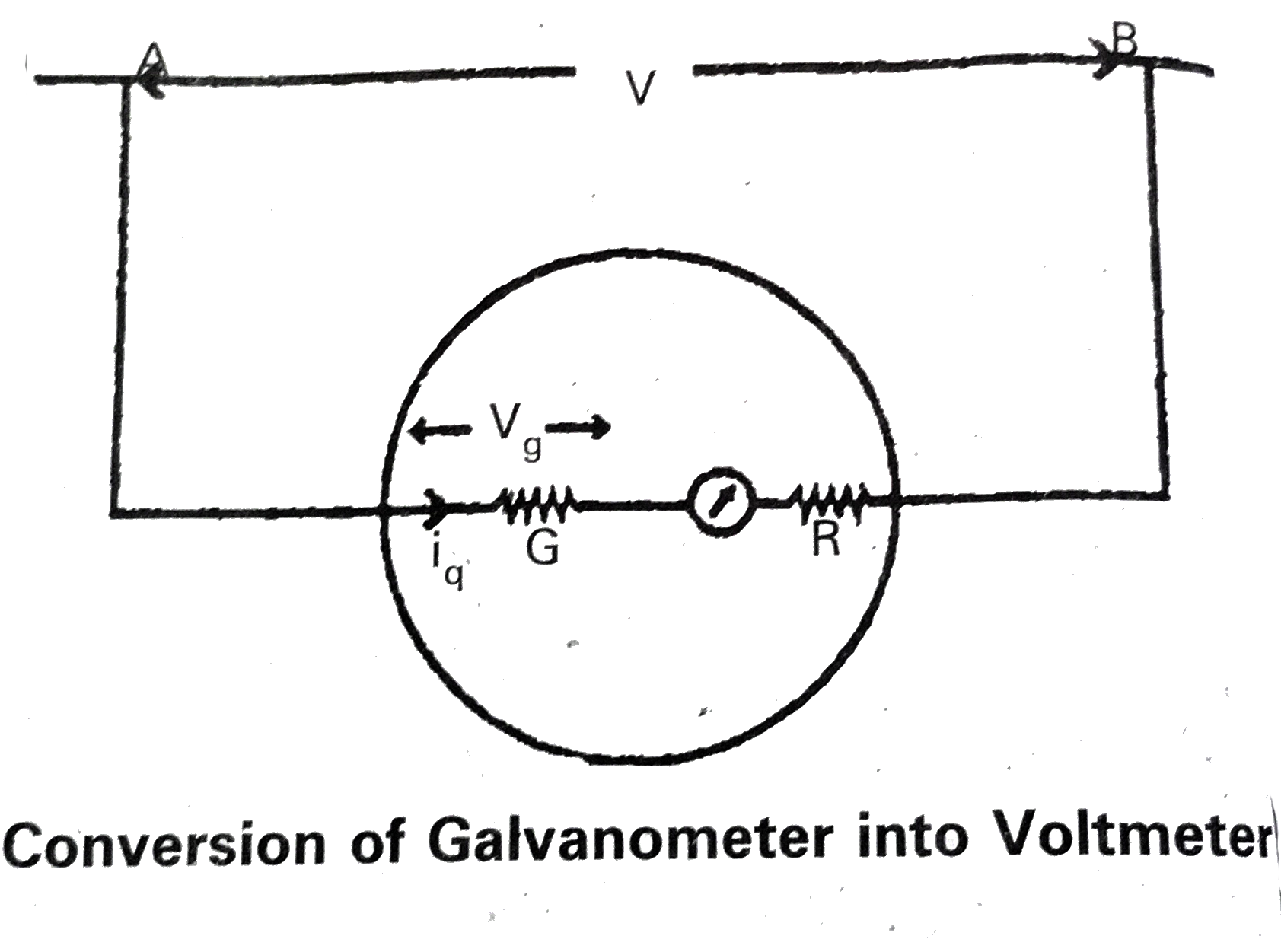
Conversion of Galvanometer into Voltmeter : A galvanometer is converted into voltmeter by connecting a high resistance (R ) in series with it. Voltmeter is used to measure the P.D. between any two points in circuit and it is connected in parallel to the component of the circuit.
Let 'V' be the potential difference to be measured between the points 'A' and 'B'.
`therefore V= (R+G) i_(g)" "[therefore V= iR]`
Where G = Galvanometer Resistance
`i_(g)`= Current passing through the galvanometer `(V)/(i_(g))=R+G`
`therefore R=(V)/(i_(g))-G" "-(1)`
The value of 'R' can be calculated using the above formula. If `V_(g)` is the maximum P.D. across the galvanometer then `V_(g)=i_(g)G`
`therefore i_(g)=(V_(g))/(G)" "-(2)`
Substitute `'i_(g)'` in Equ (1)
`R=(VG)/(V_(g))-G=G((V)/(V_(g)-1))`
If `(V)/(V_(g))=n rArr R= G(n-1)`
Note : `n=(V)/(V_(g))` is the ratio of maximum voltage to be measured to the maximum voltage across the galvanometer.
Series resistance is greater than galvanometer resistance because the current in external resistance and potential difference will be decreased and to increase the resistance of the galvanometer.
Solution for the problem :
Formula series resistance required, `R=(V)/(i_(G))R_(G)`
`(1.5)/(15xx10^(-3))-5=(1.5xx10^(3))/(15)-5`
`=(1500)/(15)-5=100-5=95 Omega therefore R=95 Omega`


