Home
Class 12
PHYSICS
In a horizontal unifrom electirc field, ...

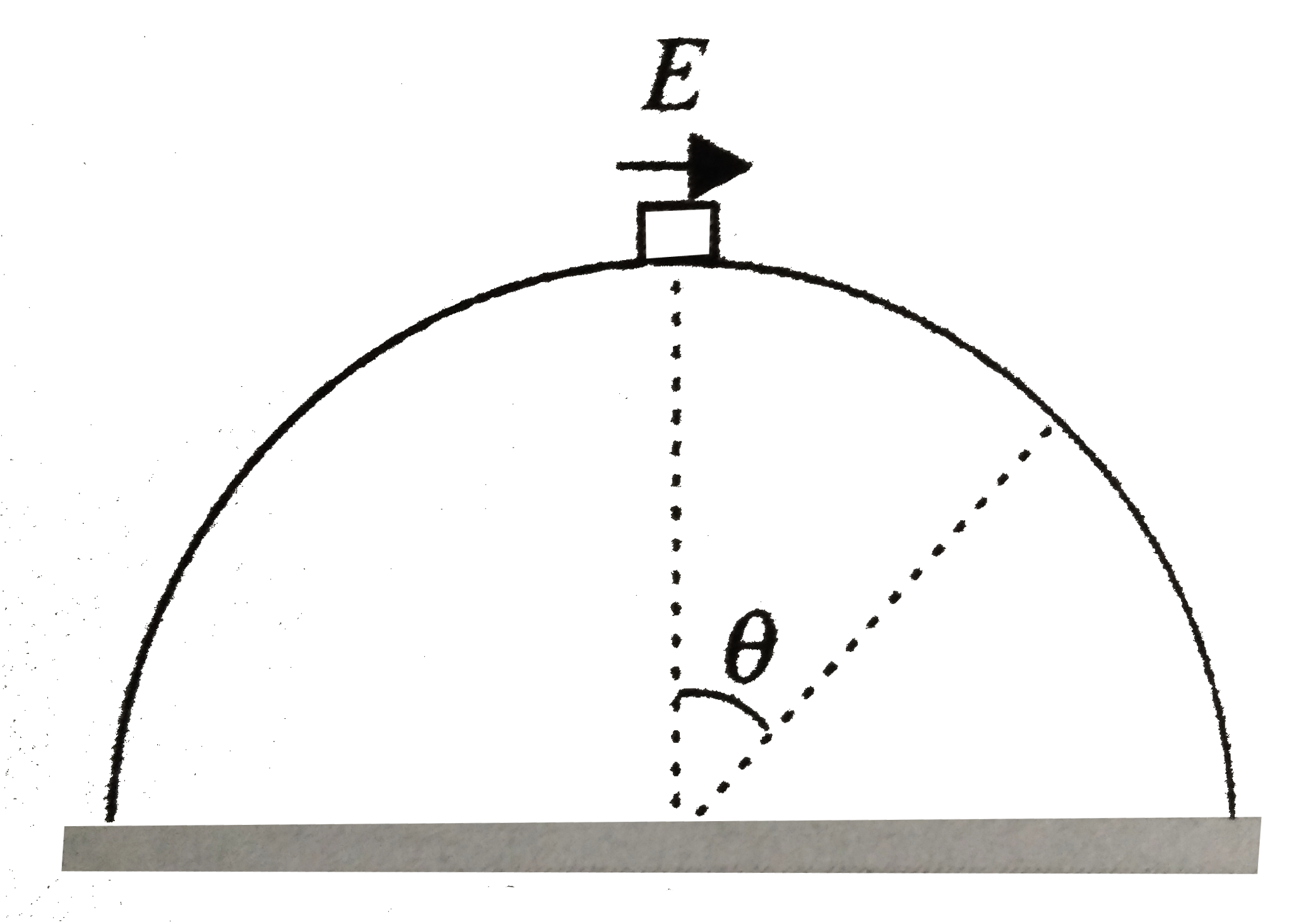
In a horizontal unifrom electirc field, a small charged disk is gently released on the top of a fixed sperical dome. The disk slides down the some without friction and breaks away from the surface of the dome at the angular position `theta = sin^(-1)(3//5)` from verical. Determine the ration of the force of gravity acting on the disk to force of its interaction with the field .

Text Solution

Verified by Experts
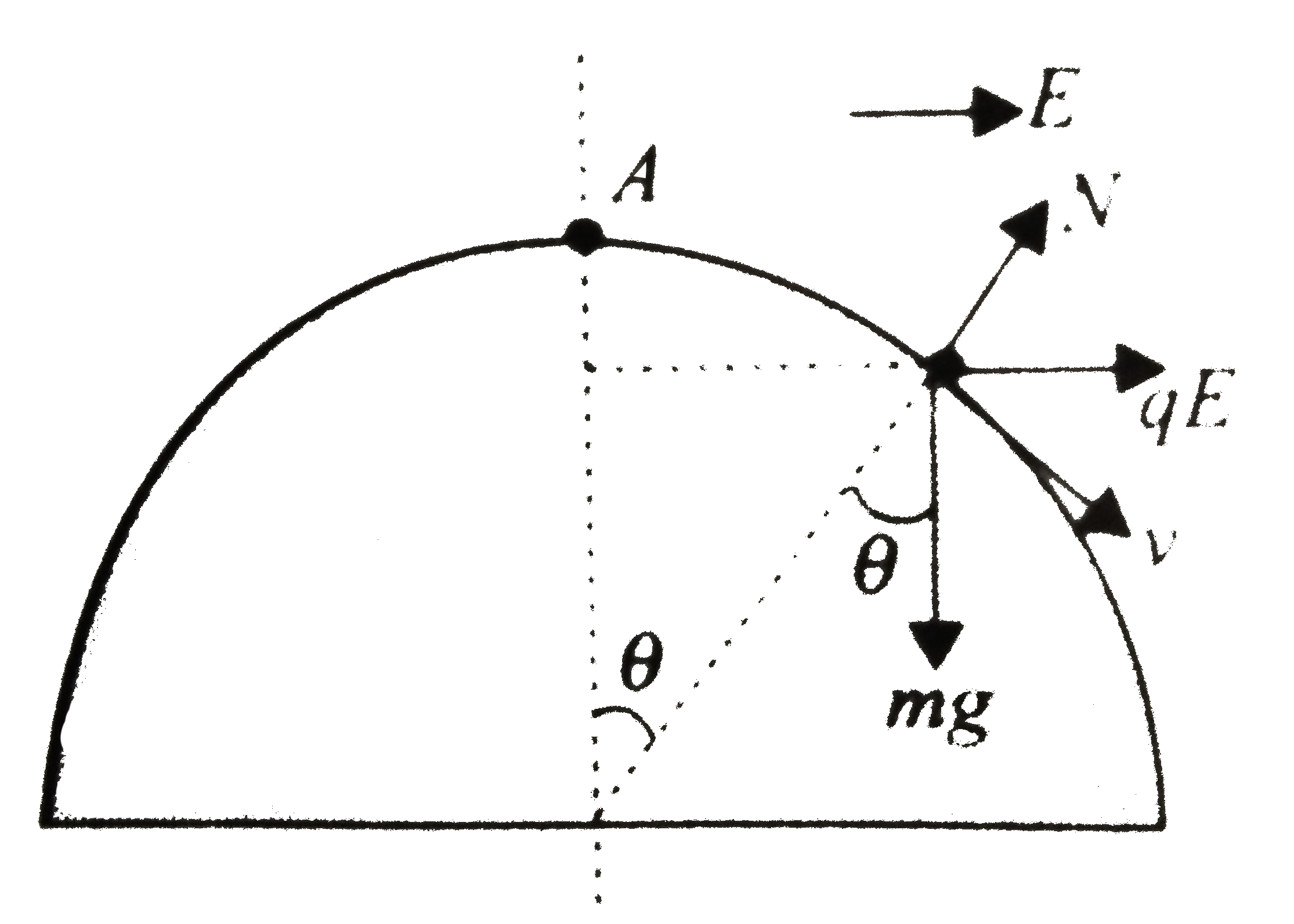
Motoin fron A to B
`mgR(1-cos theta)+qER sin theta =(mv^(2))/(2)`
Given `sin theta=(3)/(5)`
`:. cos theta=(4)/(5)`
`:. mgR((1)/(5))+qER((3)/(5))=(mv^(2))/(2)`
or `(mg+3qE) = (5)/(2) (mv^(2))/(R )` …(i)
Also the equation of circular motion is
`mg cos theta-N-qE sin theta=(mv^(2))/(R )`
When the paricle loses contact , `N=0, sin theta=(3)/(5)`, and `cos theta=(4)/(5)`.Therefore ,
`mg((4)/(5))-qE((3)/(5))=(mv^(2))/(R )`
or, `4mg-3qE=5(mv^(2))/(R)` ...(ii)
Form Eqs, (i) and (ii), `(mg+3qE)/(4mg-3qE)=(1)/(2)`
or, `2mg+6qE=4mg-3qE`
or , `2mg=9qE` or `(mg)/(qE)=(9)/(2)`.
Promotional Banner

Topper's Solved these Questions

  • COULOMB LAW AND ELECTRIC FIELD

    CENGAGE PHYSICS|Exercise Exercises|58 Videos
  • COULOMB LAW AND ELECTRIC FIELD

    CENGAGE PHYSICS|Exercise Subjective|32 Videos
  • COULOMB LAW AND ELECTRIC FIELD

    CENGAGE PHYSICS|Exercise Single Answer Correct Type|22 Videos
  • COMMUNICATION SYSTEM

    CENGAGE PHYSICS|Exercise QUESTION BANK|19 Videos
  • Current Electricity

    CENGAGE PHYSICS|Exercise QUESTION BANK|40 Videos

Similar Questions

Explore conceptually related problems

A samll object of mass 10.0 g is at rest 30.0 cm from a horizontal disk's centre. The disk starts to rotate from rest about its centre with a constant angular acceleration of 4.50 rad/ s^(2) . What is the magnitude of the net force acting on the object after a time of t=1/3 s if the object remains at rest with respect to the disk ?

A uniform thin cylindrical disk of mass M and radius R is attaached to two identical massless springs of spring constatn k which are fixed to the wall as shown in the figure. The springs are attached to the axle of the disk symmetrically on either side at a distance d from its centre. The axle is massless and both the springs and the axle are in horizontal plane. the unstretched length of each spring is L. The disk is initially at its equilibrium position with its centre of mass (CM) at a distance L from the wall. The disk rolls without slipping with velocity vecV_0 = vacV_0hati. The coefficinet of friction is mu. The net external force acting on the disk when its centre of mass is at displacement x with respect to its equilibrium position is.

Two thin rings of slightly different radii are joined together to make a wheel (see figure) of radius R. There is a very small smooth gap between the two ring. The wheel has a mass M and its centre of mass is at its geometrical centre. The wheel stands on a smooth surface and a small particle of mass m lies at the top (A) in the gap between the rings. The system is released and the particle begins to slide down along the gap. Assume that the ring does not lose contact with the surface. (a) As the particle slides down from top point A to the bottom point B, in which direction does the centre of the wheel move? (b) Find the speed of centre of the wheel when the particle just reaches the bottom point B. How much force the particle is exerting on the wheel at this instant? (c) Find the speed of the centre of the wheel at the moment the position vector of the particle with respect to the centre of the wheel makes an angle q with the vertical. Do this calculation assuming that the particle is in contact with the inner ring at desired value of theta

In the figure a charged small sphere of mass m and the charge q starts sliding from rest on a vertical fixed circular smooth track of radius R from the position A shown. There exist a uniform magnetic field of B . Find the maximum force exerted by track on the sphere during its motion.

A small circular coil with a mass of m consists of N turns of fine wire and carries a current of I. The coil is located in a uniform magnetic field of B with the coil axis orginally parallel to the field direction. a. What is the period of small angle oscilations of the coil axis around its equilibrium position, assuming no friction and no mechanical force? b. If the coil is rotated through an angle of theta from its equilibrium position and then released, what will be its angular speed when it passes through equilibrium position?

A point mass m = 1 kg is attached to a point P on the circumference of a uniform ring of mass M = 3kg and radius R = 2.0 m . The ring is placed on a horizontal surface and is released from rest with line OP in horizontal position (O is centre of the ring). Friction is large enough to prevent sliding. Calculate the following quantities immediately after the ring is released- (a) angular acceleration (alpha) of the ring, (b) normal reaction of the horizontal surface on the ring and (c) the friction force applied by the surface on the ring. [Take g = 10 m//s^(2) ]

(i) In the shown arrangement, both springs are relaxed. The coefficient of friction between m_(2) " and " m_(1) is mu . There is no friction between m_(1) and the horizontal surface. The blocks are displaced slightly and released. They move together without slipping on each other. (a) If the small displacement of blocks is x then find the magnitude of acceleration of m_(2) . What is time period of oscillations ? (b) Find the ratio (m_(1))/(m_(2)) so that the frictional force on m_(2) acts in the direction of its displacement from the mean position. (ii) Two small blocks of same mass m are connected to two identical springs as shown in fig. Both springs have stiffness K and they are in their natural length when the blocks are at point O. Both the blocks are pushed so that one of the springs get compressed by a distance a and the other by a//2 . Both the blocks are released from this position simultaneously. Find the time period of oscillations of the blocks if - (neglect the dimensions of the blocks) (a) Collisions between them are elastic. (b) Collisions between them are perfectly inelastic.

