Home
Class 12
PHYSICS
Two small identical balls lying on a hor...

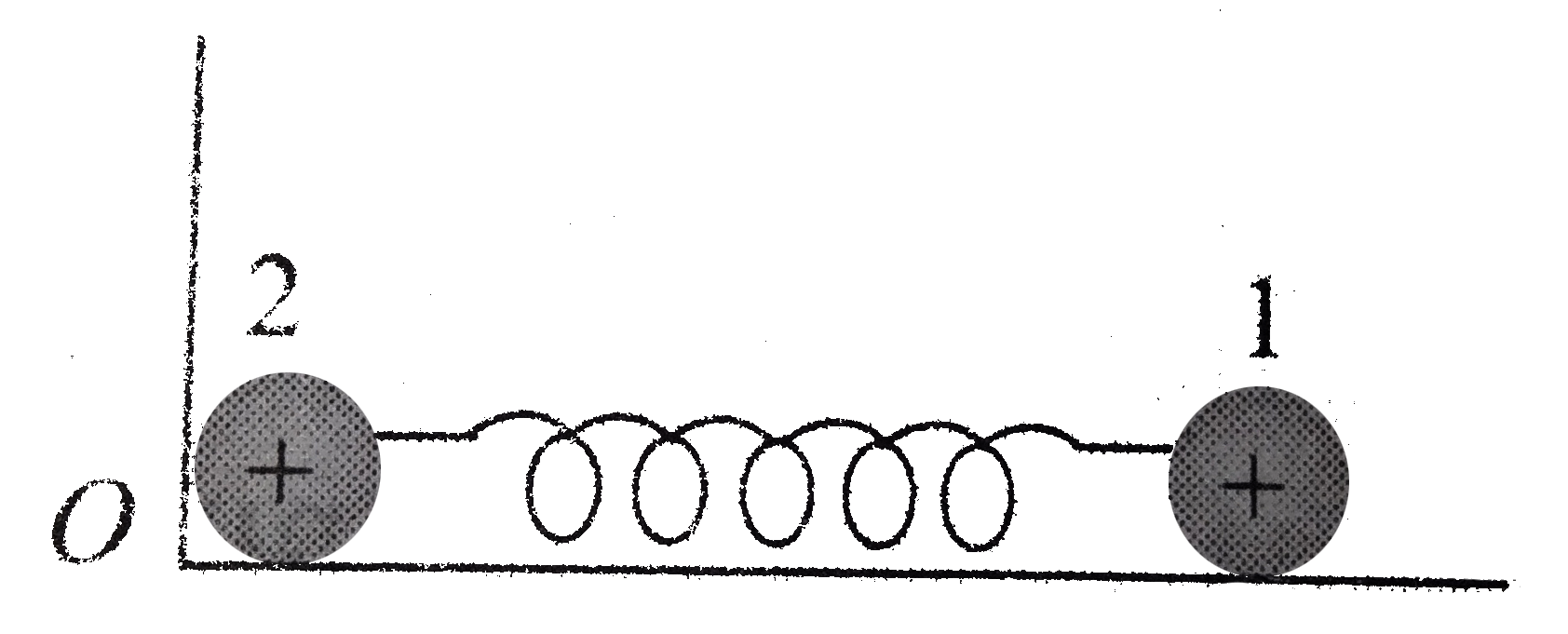
Two small identical balls lying on a horizontal plane are connected by a weightless spring. One ball (ball 2) is fixed at O, and the other (ball 1) is free. The balls are charged identically as a result of which the spring length increases `eta=2` times. Determine the change in frequency.

Text Solution

Verified by Experts

When the balls are unchangeed
`v_(0)=(1)/(2 pi)sqrt((k)/(m))`
where k is the force constant of the spring and ma is the mass of the oscillating ball (ball 1). When the balls are charged, ball 1 will oscillate about the new equilibrium position. At the equilibrium position of ball 1.
`(1)/(4 pi epsilon_(0))(q^(2))/((eta l)^(2))=k(etal-l)=k(eta-1)`
or `l^(3)=(q^(2))/(4 pi epsilon_(0)eta^(2)(eta-1)k)` ...(i)
When ball 1 is displaced by a small distance from the equilibrium position to the right. the unbalanced froce to the reight is given by
`F=(1)/(4 pi epsilon_(0))(q^(2))/((eta l+x)^(2))-k(eta l+x-1)`
From Newton law, we have
`m(d^(2)x)/(dt^(2))=(1)/(4 pi epsilon_(0))(q^(2))/(eta^(2)l^(2))[1+(x)/(eta l)]^(2)-kl(eta-1)-kx`
`=(1)/(4 pi epsilon_(0))(q^(2))/(eta^(2)l^(2))[1-(2x)/(eta l)]-kl(eta-1)-kx`
`=-[(1)/(4 pi epsilon_(0))(2q^(2))/(eta^(3)l^(3))+k]x`
From Eqs (i) and (ii), `m(d^(2)x)/(dt^(2))=-[(2(eta-1))/(eta)k+k]x=-(3 eta-2)/(eta)kx`
or `(d^(2)x)/(dt^(2))=-(3 eta-2)/(eta)(k)/(m)` or `a =-[(3eta-2 k)/(meta)]x`
Comparing with `a=-omega^(2)x`,
(i) `omega^(2)=(3 eta-2)/(eta)(k)/(m)` or `v=(1)/(2pi)sqrt(((3 eta-2)/(eta))(k)/(m))`
(ii) or `(v)/(v_(0))=sqrt((3 eta-2)/(eta))`
(iii) Thus the frequency is increased `sqrt((3 eta-2)//eta)` times . Hence `eta=2` and so frequency increases `sqrt(2)` times .
Promotional Banner

Topper's Solved these Questions

  • COULOMB LAW AND ELECTRIC FIELD

    CENGAGE PHYSICS|Exercise Exercises|58 Videos
  • COULOMB LAW AND ELECTRIC FIELD

    CENGAGE PHYSICS|Exercise Subjective|32 Videos
  • COULOMB LAW AND ELECTRIC FIELD

    CENGAGE PHYSICS|Exercise Single Answer Correct Type|22 Videos
  • COMMUNICATION SYSTEM

    CENGAGE PHYSICS|Exercise QUESTION BANK|19 Videos
  • Current Electricity

    CENGAGE PHYSICS|Exercise QUESTION BANK|40 Videos

Similar Questions

Explore conceptually related problems

A weightless horizontal rigid rod along which two balls of the same mass m can move without friction rotates at a constant angular velocity omega about a vertical axle. The balls are connected by a weightless spring of rigidity k, whose length in the undeformed state is l_(0) . The ball which is closer to the vertical axle is connected to it by he same spring. Determine the lengths of the springs. Under what conditions will be balls move in circles ?

Two small identical metal balls of radius rare at a distance a (a lt lt r) from each other and are charged, one with a potential V_(1) and the other with a potential V_(2) . The charges on the balls are:

Two identical ball of radii r are kept on a horizontal plane with their centres d distance apart. A third ball, identical to previous one, collide elastically with both the balls symmetrically as shown in the figure. If the third ball comes to rest after the collision, d should be

Two identical balls each of mass m interconnected by a small light inextensible string are kept on a smooth horizontal surface. One of the balls is pushed towards the other with a speed v_(0) find the loss of K.E. of the ball. What will be the final velocities of the balls ? (e=1).

Two billiard balls are moving on a table and the component velocities along the length and breadth are 5,5 ms^(-1) for one ball 2sqrt(3) 2ms^(-1) for the other ball the angle between the motion of balls is

Two identical balls are interconnected with a massless and inextensible thread. The system is in gravity free space with the thread just taut. Each ball is imparted a velocity v , one towards the other ball and the other perpendicular to the first, at t=0 . Then,

Two stiff non conducting rods have length L each and have small balls connected to their ends. The rods are placed parallel to each other and the balls are connected by two identical springs as shown. When each ball is given a charge q, the system stays in equilibrium when it is in the shape of a square. If natural relaxed length of each spring is L/2 find the force constant (k) for them.

Three identical balls 1, 2 and 3 are placed together at rest on a smooth horizontal surface. A fourth identical ball moving with velocity u in line of first three balls collides head on elastically as shown in figure, then

Two identical balls are dropped from the same height onto a hard surface, the second ball being released exactly when the first ball bollides with the surface. If the first ball has made two more collisions by the time the second one collides. Then the coefficient of restitution between the ball and the surface satisfies :
