Home
Class 12
PHYSICS
Two small beads having positive charges ...

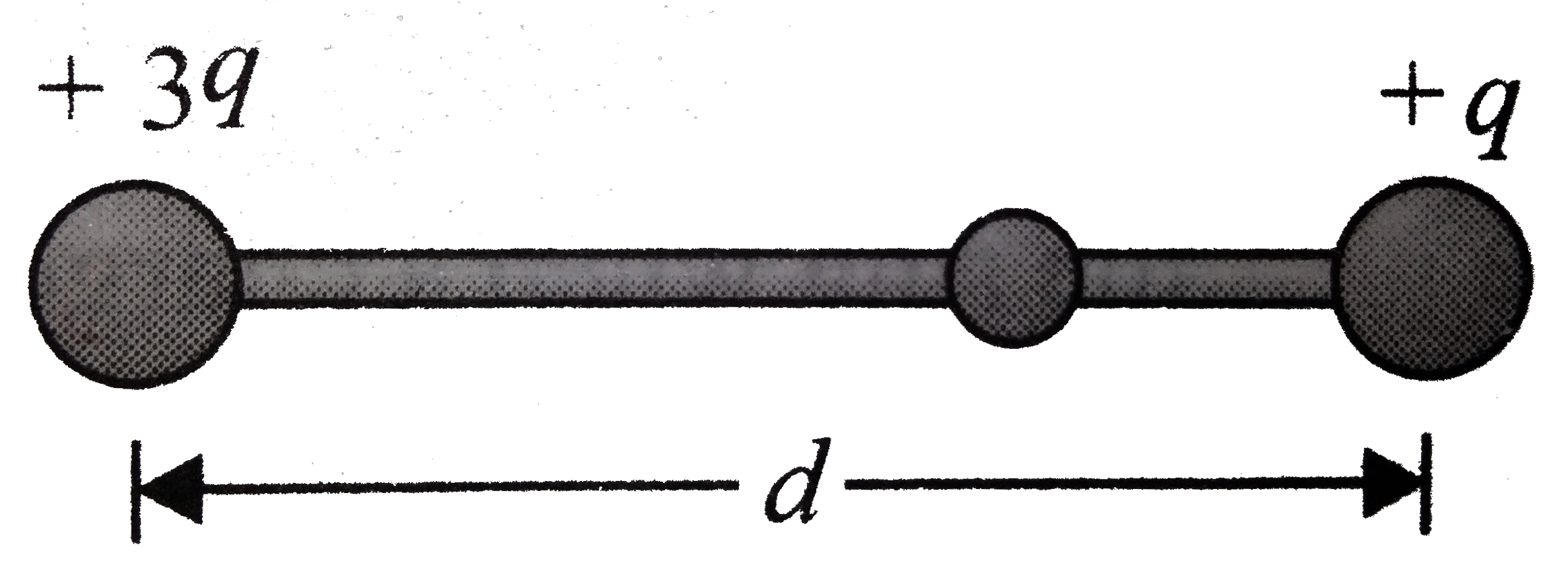
Two small beads having positive charges 3q and q are fixed at the opposite ends of a horizontal, insulating rod, extending from the origein to the point x=d as shown in fig. A third small charged bead is free to slide on the rod. At what position is the third bead in equilibrium? Can it be in stable eqyilibrium ?

Text Solution

Verified by Experts

The correct Answer is:
`(sqrt(3)d)/(sqrt(3)+1)`


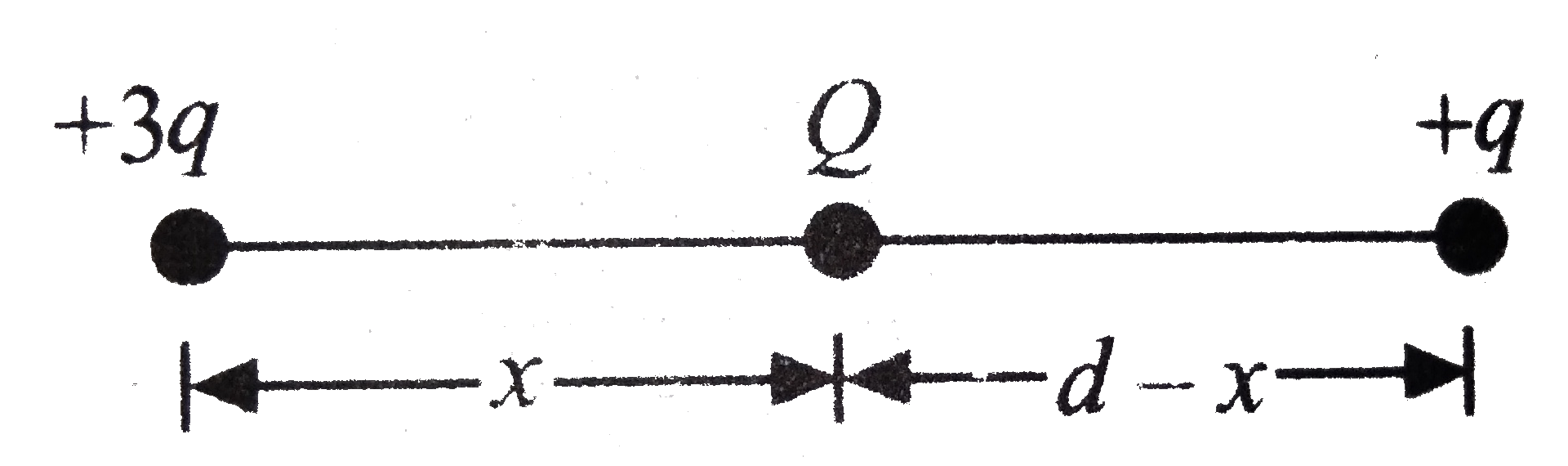
For Q to be in equilibrium
`(k3qQ)/(x^(2)) =(kQq)/((d-x)^(2))`
or , `x=(sqrt(3)d)/(sqrt(3)+1)`
The bead can be in stable equilibrium, if it has positive charges.
Promotional Banner

Topper's Solved these Questions

  • COULOMB LAW AND ELECTRIC FIELD

    CENGAGE PHYSICS|Exercise Single Correct|47 Videos
  • COULOMB LAW AND ELECTRIC FIELD

    CENGAGE PHYSICS|Exercise Multiple Correct|8 Videos
  • COULOMB LAW AND ELECTRIC FIELD

    CENGAGE PHYSICS|Exercise Exercises|58 Videos
  • COMMUNICATION SYSTEM

    CENGAGE PHYSICS|Exercise QUESTION BANK|19 Videos
  • Current Electricity

    CENGAGE PHYSICS|Exercise QUESTION BANK|40 Videos

Similar Questions

Explore conceptually related problems

In the shown figure two beads slide along a smooth horizontal rod as shown in figure. The relation between v and v_(0) in the shown position will be

Two equal negative charges are fixed at points and on y-axis. A positive charge Q is released from rest at the point on the x-axis. The charge Q will:

A two point charges 4q and -q are fixed on the x - axis x=-d/2 and x = d/2 , respectively. If a third point charge 'q' is taken from the origin to x = d along the semicircle as shown in the figure, the energy of the charge will

Two positive point charges , each Q , are fixed at separation d . A third charge q is placed in the middle. Describe the equilibrium of the third charge.

A bead of mass m can slide without friction on a fixed circular horizontal ring of radius 3R having a centre at the point C. The bead is attached to one of the ends of spring of spring constant k. Natural length of spring is R and the other end of the spring is R and the other end of the spring is fixed at point O as shown in the figure. If the bead is released from position A, then the kinetic energy of the bead when it reaches point B is

Two equal positive charges Q are fixed at points (a, 0) and (-a,0) on the x-axis. An opposite charge -q at rest is relased from point (0, a) on the y-axis. The charge -q will

Four small particles charged with equal positive charges Q each are arranged at the four corners of a horizontal square of side a. A unit positive charge mass m is placed at a point P, at a height h above the centre of the square. What should be the magnitude of charge Q in order that the unit charge remain in equilibrium

Two point charges (+Q) and (-2Q) are fixed on the X -axis at position a and 2a from origin respectively. At what position on the axis, the resultant electric field is zero

Two point charges (+Q) and (-2Q) are fixed on the X-axis at positions a and 2a from origin respectively. At what positions on the axis, the resultant electric field is zero

A thin insulating wire is stretched·along the diameter of an. insulated circular hoop of radius R. A small bead of mass m and charge-q is threaded onto the wire. Two small identical charges are tied to the hoop at points opposite to each other, so that the diameter passing through them is perpendicular to the thread as shown in figure. The bead is released at a point which.is located at a distance x_(0) from the centre of the hoop. Assume that x_(0) lt lt R . (a) What is the resultant force acting on the charged bead? (b) Describe the motion of the bead after it is released X (c) Use the assumption that (x)/(R) lt lt 1 to obtain an approximate equation of motion, and find the displacement and velocity of the bead as functions of time (d) When will the velocity of the bead will bcome zero for the first time?

CENGAGE PHYSICS-COULOMB LAW AND ELECTRIC FIELD-Subjective
  1. Two similarly and equally charged identical metal spheres A and B repe...

    Text Solution

    |

  2. Three point charges of +2muC, -3muC , and -3muC are kept at the vertic...

    Text Solution

    |

  3. Two small beads having positive charges 3q and q are fixed at the oppo...

    Text Solution

    |

  4. A copper atom consists of copper nucles surrounded by 29 electrons. Th...

    Text Solution

    |

  5. A flat square sheet of charge (side 50 cm) carries a uniform surface c...

    Text Solution

    |

  6. A particle of mass 9xx10^(-31) kg having a negative charge of 1.6xx10^...

    Text Solution

    |

  7. Point chages q and -q are located at the verticles of a squre with dia...

    Text Solution

    |

  8. Two mutually perpendicular long straight conductors carrying uniformly...

    Text Solution

    |

  9. A ring of radius 0.1m is made out of thin metallic wire of area of cro...

    Text Solution

    |

  10. A charged cork ball of mass m is suspended on a light sting in the pre...

    Text Solution

    |

  11. A ring of radius R has charge -Q distributed uniformly over it. Calcul...

    Text Solution

    |

  12. Two identical small equally charged conducting balls are suspended fro...

    Text Solution

    |

  13. Two point charge Q(a) and Q(b) are positional at point A and B. The fi...

    Text Solution

    |

  14. Two semicircle wires ABC, and ADC, each of radius R are lying on xy an...

    Text Solution

    |

  15. An infinte wire having linear charge density lambda is arranged as sho...

    Text Solution

    |

  16. Two similar balls, each of mass m and charge q, are hung from a common...

    Text Solution

    |

  17. Three equal negative charges, -q(1) each form the vertices of and equi...

    Text Solution

    |

  18. A ball of radius R carries a positive charges whose volume density at ...

    Text Solution

    |

  19. A uniform nonconducting rod of mass ma and length l, with charge densi...

    Text Solution

    |

  20. Electrically charged drops of nercury fall from an altitude h into a s...

    Text Solution

    |

