Home
Class 12
PHYSICS
Two point charge Q(a) and Q(b) are posit...

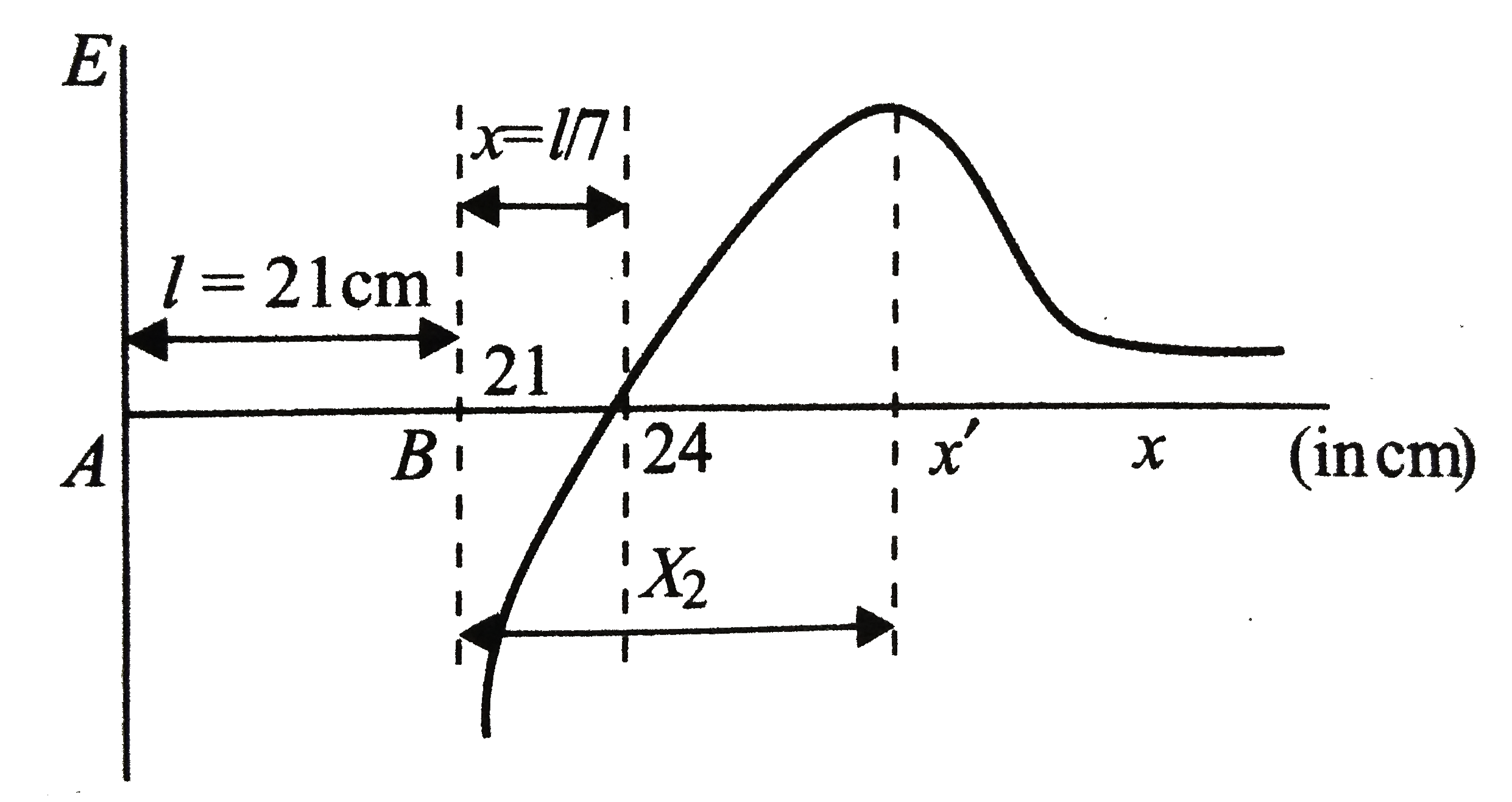
Two point charge `Q_(a)` and `Q_(b)` are positional at point A and B. The field strenght to the right of charge `Q_(b)` on the line that passes therough the two charges varies according to a law represented schematically in fig. (without employing a definite scale). The field strength is assumed to be positive if its direction coincedes with the positive direction of the x-axis. The distance between the charges is `l=21 cm`.

(a) Find the sign of the charges.
(b) Find the ration between the absolute value of charge `Q_(a)` and `Q_(b)`.
(c ) Find the coordinate x of the point where the field strenght is maximum.

Text Solution

Verified by Experts

The correct Answer is:

(i) x=7 cm (ii) x'=21 cm (iii) x=28 cm

(a) Electric field near B and the right of B is along the positive x-axis so the sign of `Q_(b)` should be negative. There is a neutral point at x=24 cm, so the sign of `Q_(a)` should be opposite of `Q_(b)`. Hence `Q_(a)` should be positive.
(b) At netural point (at x=24 cm),
`k(Q_(a))/(24^(2))=k(Q_(b))/(3^(2))` or `|(Q_(a))/(Q_(b))|=((24)/(3))^(2)=64`
(c ) Electric field to the right of charges (at x=x).
`E=k(Q_(a))/(x^(2))-k(Q_(b))/((x-21)^(2))`
For field to be maximum
`(dE)/(dx)=0`
or `(kQ_(a)(-2))/(x^(3))-(kQ_(b)(-2))/((x-21)^(3)) =0` or `x=28 cm`.
Promotional Banner

Topper's Solved these Questions

  • COULOMB LAW AND ELECTRIC FIELD

    CENGAGE PHYSICS|Exercise Single Correct|47 Videos
  • COULOMB LAW AND ELECTRIC FIELD

    CENGAGE PHYSICS|Exercise Multiple Correct|8 Videos
  • COULOMB LAW AND ELECTRIC FIELD

    CENGAGE PHYSICS|Exercise Exercises|58 Videos
  • COMMUNICATION SYSTEM

    CENGAGE PHYSICS|Exercise QUESTION BANK|19 Videos
  • Current Electricity

    CENGAGE PHYSICS|Exercise QUESTION BANK|40 Videos

Similar Questions

Explore conceptually related problems

Two point charges Q_(1) and Q_(2) are positioned at points I and 2. The field intensity to the right of the charge Q_(2) on the line that passes through the two charges varies according to a law that is represented in the figure. The field intensity is assumed to be positive if its direction coincides with the positive direction on the x-axis. The distance between the charges is l. (a) Find the sign of each charge (b) Find the ratio of the absolute values of the charges |(Q_(1))/(Q_(2))| (c) Find the value of b where the field intensity is maximum [(a) Q_(2) is negative and Q_(1) is positive (b) ((l +a)/(a))^(2) , (c) (l)/(((l+a)/(a))^(2//3)-1)]

Two point charges Q and - Q //4 are separated by a distance X . Then .

Two point-like charges a and b whose strengths are equal in absolute value are positioned at a certain distance from each other. Assuming the field strength is positive in the direction coinciding with the positive direction of the r axis, determine the signs of the charges for each distribution of the field strength between the charges shown in Figures (a), (b), (c), and (d).

The positions of two point charges q_(1) and q_(2) are vecr_(1) and vecr_(2) , respectively. Find the position of the point where the net field is zero due to thses charges.

Two fixed charges 4Q (positive) and Q (negative) are located at A and B the distance AB being 3m

The product of positive charge and distance between the two charges is

Two equal negative charges are fixed at points and on y-axis. A positive charge Q is released from rest at the point on the x-axis. The charge Q will:

Two point charges+ q and-q are placed at distanced apart. What are the points at which the resultant field is parallel to the line joining the two charges ?

Two charge +q and -q are kept apart.then at any point on the right beisector of line joining the two charges

CENGAGE PHYSICS-COULOMB LAW AND ELECTRIC FIELD-Subjective
  1. Point chages q and -q are located at the verticles of a squre with dia...

    Text Solution

    |

  2. Two mutually perpendicular long straight conductors carrying uniformly...

    Text Solution

    |

  3. A ring of radius 0.1m is made out of thin metallic wire of area of cro...

    Text Solution

    |

  4. A charged cork ball of mass m is suspended on a light sting in the pre...

    Text Solution

    |

  5. A ring of radius R has charge -Q distributed uniformly over it. Calcul...

    Text Solution

    |

  6. Two identical small equally charged conducting balls are suspended fro...

    Text Solution

    |

  7. Two point charge Q(a) and Q(b) are positional at point A and B. The fi...

    Text Solution

    |

  8. Two semicircle wires ABC, and ADC, each of radius R are lying on xy an...

    Text Solution

    |

  9. An infinte wire having linear charge density lambda is arranged as sho...

    Text Solution

    |

  10. Two similar balls, each of mass m and charge q, are hung from a common...

    Text Solution

    |

  11. Three equal negative charges, -q(1) each form the vertices of and equi...

    Text Solution

    |

  12. A ball of radius R carries a positive charges whose volume density at ...

    Text Solution

    |

  13. A uniform nonconducting rod of mass ma and length l, with charge densi...

    Text Solution

    |

  14. Electrically charged drops of nercury fall from an altitude h into a s...

    Text Solution

    |

  15. A thin rigid insulated rod of mass m and length l carrying a charge Q ...

    Text Solution

    |

  16. Two particles of chargaes and masses (+q(1),m(1)) and (+q(2),m(2)) are...

    Text Solution

    |

  17. A small beads of mass ma having charge -q is constrained to move along...

    Text Solution

    |

  18. A charged particle q of mass m is in wquilibrium at a height h from a ...

    Text Solution

    |

  19. A point charge Q(1)=-125mu C is fixed at the center of an insulated di...

    Text Solution

    |

  20. Two small balls having the same mass and charge and located on the sam...

    Text Solution

    |
