Home
Class 12
PHYSICS
Two point charge Q(a) and Q(b) are posit...

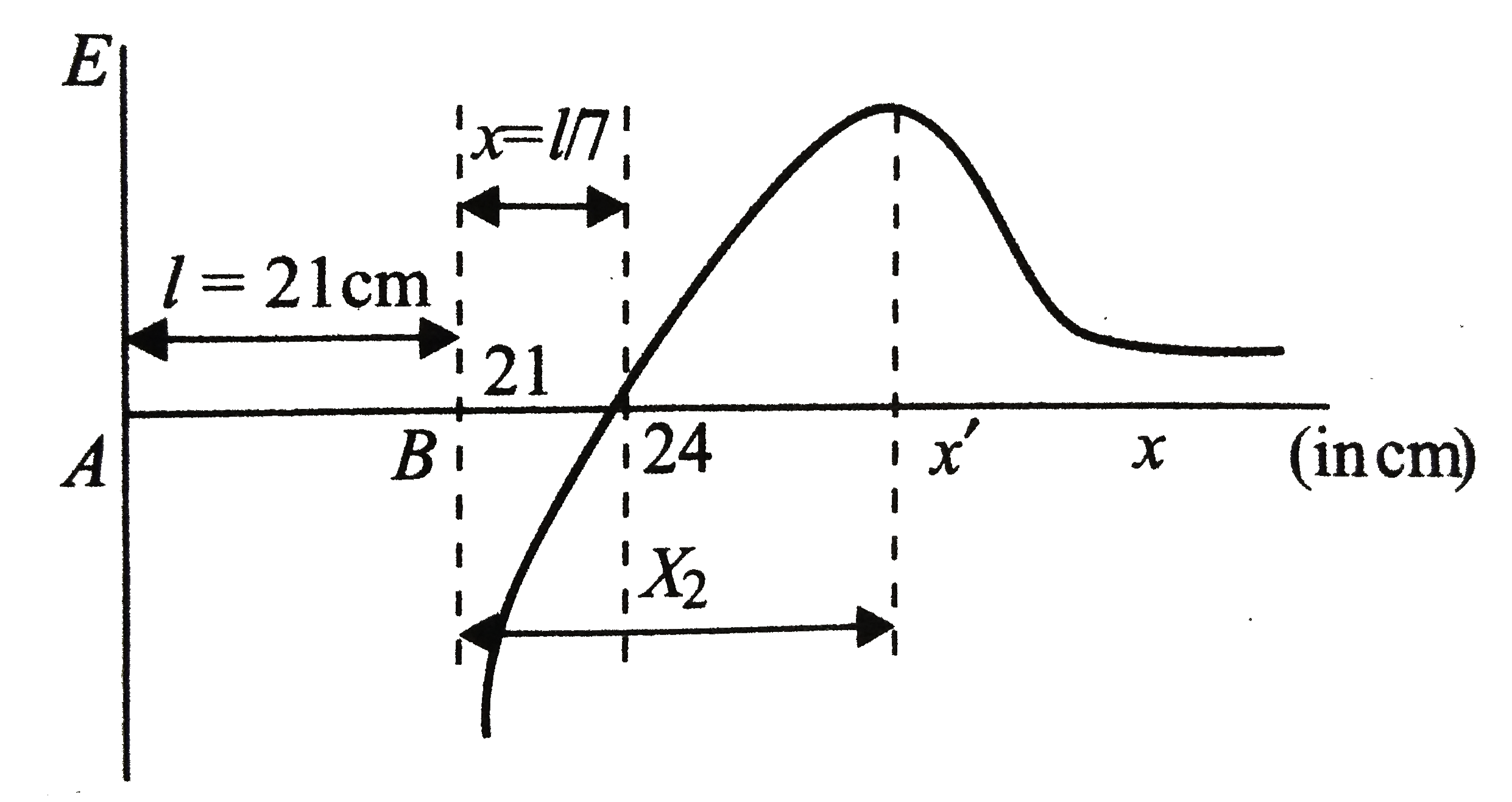
Two point charge `Q_(a)` and `Q_(b)` are positional at point A and B. The field strength to the right of charge `Q_(b)` on the line that passes through the two charges varies according to a law represented schematically in fig. (without employing a definite scale). The field strength is assumed to be positive if its direction coincides with the positive direction of the x-axis. The distance between the charges is `l=21 cm`.

(a) Find the sign of the charges.
(b) Find the ration between the absolute value of charge `Q_(a)` and `Q_(b)`.
(c ) Find the coordinate x of the point where the field strength is maximum.

A

`(l)/((Q_(1)//Q_(2))^(1//3)+1)`

B

`(l)/((Q_(1)//Q_(2))^(1//3)-1)`

C

`(l)/((Q_(2)//Q_(1))^(1//3)+1)`

D

`(l)/((Q_(2)//Q_(1))^(1//3)-1)`

Text Solution

Verified by Experts

The correct Answer is:
B

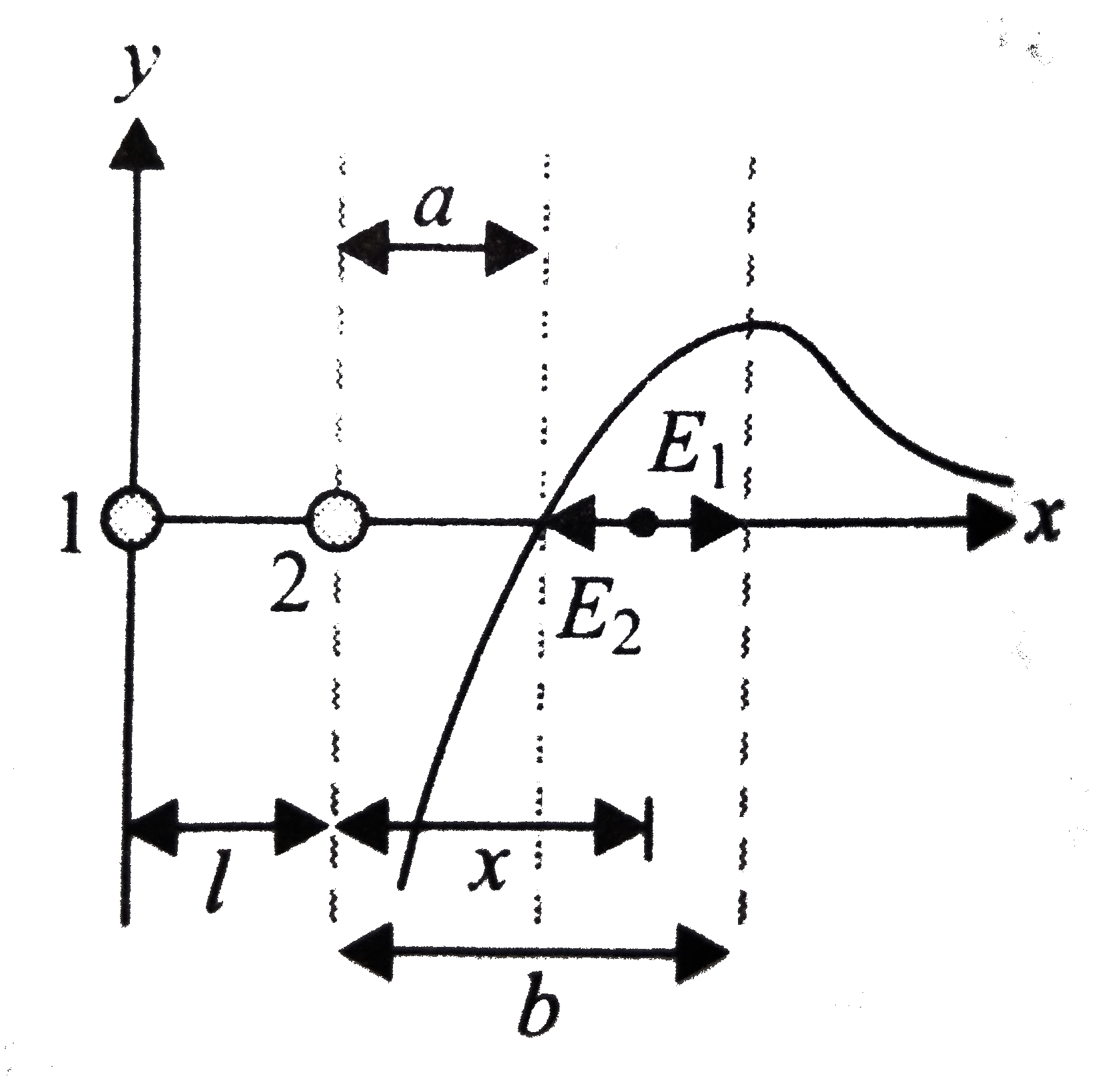
Electric field at (2) tends to ` -oo`, hence the charge at (2) should be negative. There is a neutral point to the right of charges. This is possible onlu when the charge at (1) should be positive. Hence `Q_(1)` is positive and `Q_(2)` is negative. At netural point, `vecE_(1)=vecE_(2)`.
`(1)/(4 pi epsilon_(0)) (Q_(1))/((a+l)^(2))=(1)/(4 pi epsilon_(0))(Q_2)/(a^(2))` or `(Q_(1))/(Q_(2))=((a+l)/(a))^(2)`
Electric field at any position to the right of charges is
`E=E_(1)-E_(2)=(1)/(4 pi epsilon_(0))(Q_(1))/((l+x)^(2))-(1)/(4 pi epsilon_(0))(Q_(2))/(x^(2))`
For the maximum value of E,
`(dE)/(dx)=0 or d/(dx) [(1)/(4 pi epsilon_(0))(Q)/((l+x)^(2))-(1)/(4 pi epsilon_(0))(Q_(2))/(x^(2))]=0`
`Q_(1) (-2)/((l+x)^(3))-Q_(2)(-2)/(x^(3))=0`
or `(Q_(1))/((l+x)^(3))=(Q_(2))/(x^(3))` or `((l+x)/(x))^(3)=(Q_(1))/(Q_(2))`
or, `(l+x)/(x)=((Q_(1))/(Q_(2)))^(1//3)` or `(l)/(x) = ((Q_(1))/(Q_(2)))^(1//3)-1`
or `x=(l)/(((Q_(1))/(Q_(2)))^(1//3)-1)`.
Promotional Banner

Topper's Solved these Questions

  • COULOMB LAW AND ELECTRIC FIELD

    CENGAGE PHYSICS|Exercise Integer|8 Videos
  • COULOMB LAW AND ELECTRIC FIELD

    CENGAGE PHYSICS|Exercise Single Correct Ansewr Type|20 Videos
  • COULOMB LAW AND ELECTRIC FIELD

    CENGAGE PHYSICS|Exercise Multiple Correct|8 Videos
  • COMMUNICATION SYSTEM

    CENGAGE PHYSICS|Exercise QUESTION BANK|19 Videos
  • Current Electricity

    CENGAGE PHYSICS|Exercise QUESTION BANK|40 Videos

Similar Questions

Explore conceptually related problems

Two point charge Q_(a) and Q_(b) are positional at point A and B. The field strenght to the right of charge Q_(b) on the line that passes therough the two charges varies according to a law represented schematically in fig. (without employing a definite scale). The field strength is assumed to be positive if its direction coincedes with the positive direction of the x-axis. The distance between the charges is l=21 cm . (a) Find the sign of the charges. (b) Find the ration between the absolute value of charge Q_(a) and Q_(b) . (c ) Find the coordinate x of the point where the field strenght is maximum.

Two point charges Q_(1) and Q_(2) are positioned at points I and 2. The field intensity to the right of the charge Q_(2) on the line that passes through the two charges varies according to a law that is represented in the figure. The field intensity is assumed to be positive if its direction coincides with the positive direction on the x-axis. The distance between the charges is l. (a) Find the sign of each charge (b) Find the ratio of the absolute values of the charges |(Q_(1))/(Q_(2))| (c) Find the value of b where the field intensity is maximum [(a) Q_(2) is negative and Q_(1) is positive (b) ((l +a)/(a))^(2) , (c) (l)/(((l+a)/(a))^(2//3)-1)]

Two point-like charges a and b whose strengths are equal in absolute value are positioned at a certain distance from each other. Assuming the field strength is positive in the direction coinciding with the positive direction of the r axis, determine the signs of the charges for each distribution of the field strength between the charges shown in Figures (a), (b), (c), and (d).

The positions of two point charges q_(1) and q_(2) are vecr_(1) and vecr_(2) , respectively. Find the position of the point where the net field is zero due to thses charges.

Two fixed charges 4Q (positive) and Q (negative) are located at A and B the distance AB being 3m

Two equal negative charges are fixed at points and on y-axis. A positive charge Q is released from rest at the point on the x-axis. The charge Q will:

Two equal like charges are positioned at a certain distance from each other. How do the electric field strength and the potential vary along the axis that passes through the midpoint of the distance between the charges at right angles to the line connecting the charges?

Two point charges+ q and-q are placed at distanced apart. What are the points at which the resultant field is parallel to the line joining the two charges ?

Two charge +q and -q are kept apart.then at any point on the right beisector of line joining the two charges

CENGAGE PHYSICS-COULOMB LAW AND ELECTRIC FIELD-Comprehension
  1. Three charges are placed as shown in fig. the magnitude of q(1) is 2.0...

    Text Solution

    |

  2. Three charges are placed as shown in fig. the magnitude of q(1) is 2.0...

    Text Solution

    |

  3. Two point charge Q(a) and Q(b) are positional at point A and B. The fi...

    Text Solution

    |

  4. Two point charge Q(a) and Q(b) are positional at point A and B. The fi...

    Text Solution

    |

  5. Two point charge Q(a) and Q(b) are positional at point A and B. The fi...

    Text Solution

    |

  6. Four equal positive charges, each of value Q, are arranged at the four...

    Text Solution

    |

  7. Four equal positive charges, each of value Q, are arranged at the four...

    Text Solution

    |

  8. An electron is projected with an initial speed v(0)=1.60xx10^(6)ms^(-1...

    Text Solution

    |

  9. An electron is projected with an initial speed v(0)=1.60xx10^(6)ms^(-1...

    Text Solution

    |

  10. An electron is projected with an initial speed v(0)=1.60xx10^(6)ms^(-1...

    Text Solution

    |

  11. An electron is projected with an initial speed v(0)=1.60xx10^(6)ms^(-1...

    Text Solution

    |

  12. An electron is projected as shown in fig. with kinetic energy K, at an...

    Text Solution

    |

  13. An electron is projected as shown in fig. with kinetic energy K, at an...

    Text Solution

    |

  14. In 1909, Robert Millikan war the firest to find the charge of an elect...

    Text Solution

    |

  15. In 1909, Robert Millikan was the first to find the charge of an electr...

    Text Solution

    |

  16. A simple pendulum of mass m charged negatively to q coulomb oscillates...

    Text Solution

    |

  17. A simple pendulum of mass m charged negatively to q coulomb oscillates...

    Text Solution

    |

  18. There is an insulator rod of length L and of negligible mass with two ...

    Text Solution

    |

  19. There is an insulator rod of length L and of negligible mass with two ...

    Text Solution

    |

  20. There is an insulator rod of length L and of negligible mass with two ...

    Text Solution

    |

