Home
Class 12
PHYSICS
An electron is projected as shown in fig...

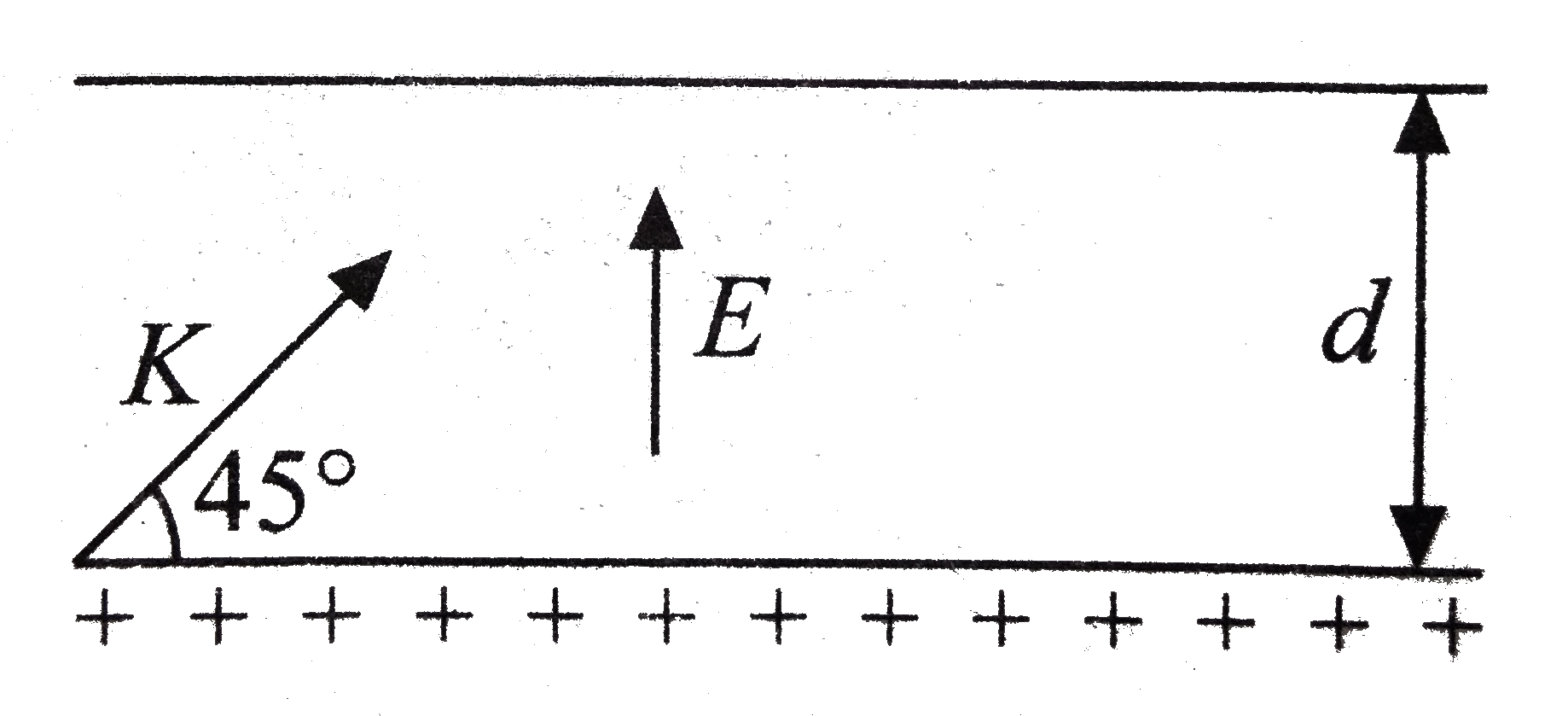
An electron is projected as shown in fig. with kinetic energy K, at an angle `theta=45^(@)` between two charged plates. Ignore the gravity.

At what distance from the starting point will the electron strike the lower plate?

A

d

B

2d

C

3d

D

4d

Text Solution

Verified by Experts

The correct Answer is:
D

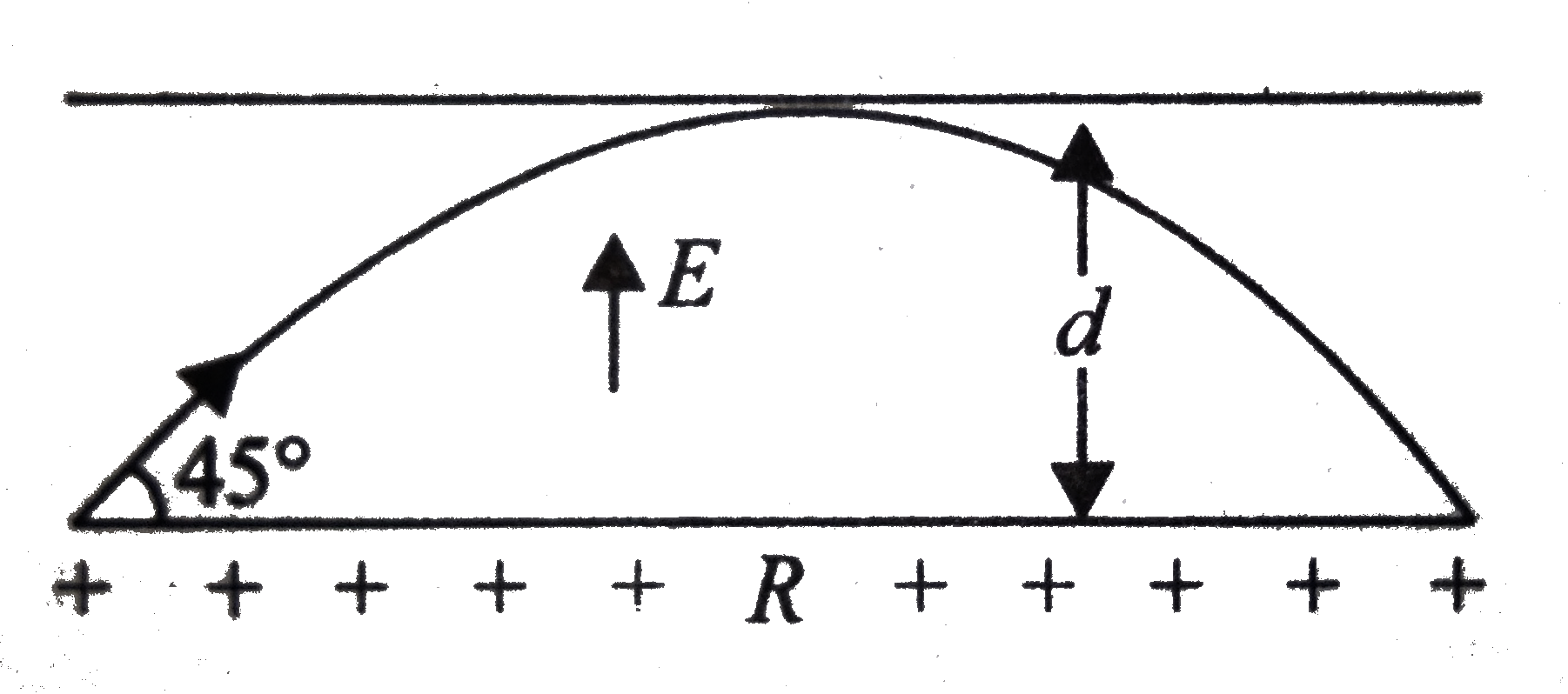
`d=(u^(2)sin^(2)theta)/(2a) [a=(qE)/(m)]`
`=(m u^(2)sin^(2)45^(@))/(2qE)`
`d=(K)/(2qE) or, E=(K)/(2dq)`
`R=(u^2)/(a) = (2d)/(sin^(2)theta)=4d`
Promotional Banner

Topper's Solved these Questions

  • COULOMB LAW AND ELECTRIC FIELD

    CENGAGE PHYSICS|Exercise Integer|8 Videos
  • COULOMB LAW AND ELECTRIC FIELD

    CENGAGE PHYSICS|Exercise Single Correct Ansewr Type|20 Videos
  • COULOMB LAW AND ELECTRIC FIELD

    CENGAGE PHYSICS|Exercise Multiple Correct|8 Videos
  • COMMUNICATION SYSTEM

    CENGAGE PHYSICS|Exercise QUESTION BANK|19 Videos
  • Current Electricity

    CENGAGE PHYSICS|Exercise QUESTION BANK|40 Videos

Similar Questions

Explore conceptually related problems

An electron is projected as in figure with kinetic energy K, at an angle theta=45^(@) between two charged plates. The magnitude of the electric field so that the electron just fails to strike the upper plate, should be greater than:

An electron is projected as shown with speed u . If electron just fails to strike the upper plate, find range. (distance from starting point at which electron strike the lower plate again). Consider only electric force.

The plate of a capacitor are 2.00cm apert . An electron -prodon pair is released somewhere in the gap between the plates and it is found that the prolon reeaches the negative plate . At what distance from the negative plate was the pair released?

A uniform magnetic field (B) is applied between the plates of a capacitor in the outward direction as shown in the figure. Surface charge density on the capacitor plates is sigma . An electron is fired in between the plates, parallel to them, as shown in the figure. The electron is found to move straight in-between the plates of capacitor. Neglect the gravity. If L is the length of the plates then caleulate the time taken by the electron to cross the plates.

A paricle is projected at an anged theta from the horizontal with kinetic energy (T). What is the kinetic energy of the particle at the highest point ?

An electron enters the region between the plates of a parallel plate capacitor at an angle theta to the plates. The plate width is l , the plate separation is d . The electron follows the path shown just missing the upper plate. Neglect gravity. Then,

An electron passes between two parallel plate of a capacitor as shown in the diagram. The electron enters the plate at t=0 and it comes out of the plates at time t=T. The electron hits the screen at A, as shown. Now a time varying potential difference V is applied between the plates, as shown in the graph. (Neglect the gravity). The point where the electron now will strike (as compared to point A) will be

An electron is projected from a distance d and with initial velocity u parallel to a uniformly charged flat conducting palte as shown. It strikes the plate after travelling a distance l along the direction of projection. The surface charge density of the conducting plate is equal to

An electron (charge = e, mass = m) is projected horizontally into a uniform electric field produced between two oppositely charged parallel plates, as shown in figure. The charge density on both plates is +- sigma C//m^2 and separation between them is d. You have to assume that only electric force acts on the electron and there is no field outside the plates. Initial velocity of the electron is u, parallel to the plates along the line bisecting the gap between the plates. Length of plates is 2L and there is a screen perpendicular to them at a distance L. (i) Find s if the electron hits the screen at a point that is at same height as the upper plate. (ii) Final the angle q that the velocity of the electron makes with the screen while it strikes it.

CENGAGE PHYSICS-COULOMB LAW AND ELECTRIC FIELD-Comprehension
  1. Three charges are placed as shown in fig. the magnitude of q(1) is 2.0...

    Text Solution

    |

  2. Three charges are placed as shown in fig. the magnitude of q(1) is 2.0...

    Text Solution

    |

  3. Two point charge Q(a) and Q(b) are positional at point A and B. The fi...

    Text Solution

    |

  4. Two point charge Q(a) and Q(b) are positional at point A and B. The fi...

    Text Solution

    |

  5. Two point charge Q(a) and Q(b) are positional at point A and B. The fi...

    Text Solution

    |

  6. Four equal positive charges, each of value Q, are arranged at the four...

    Text Solution

    |

  7. Four equal positive charges, each of value Q, are arranged at the four...

    Text Solution

    |

  8. An electron is projected with an initial speed v(0)=1.60xx10^(6)ms^(-1...

    Text Solution

    |

  9. An electron is projected with an initial speed v(0)=1.60xx10^(6)ms^(-1...

    Text Solution

    |

  10. An electron is projected with an initial speed v(0)=1.60xx10^(6)ms^(-1...

    Text Solution

    |

  11. An electron is projected with an initial speed v(0)=1.60xx10^(6)ms^(-1...

    Text Solution

    |

  12. An electron is projected as shown in fig. with kinetic energy K, at an...

    Text Solution

    |

  13. An electron is projected as shown in fig. with kinetic energy K, at an...

    Text Solution

    |

  14. In 1909, Robert Millikan war the firest to find the charge of an elect...

    Text Solution

    |

  15. In 1909, Robert Millikan was the first to find the charge of an electr...

    Text Solution

    |

  16. A simple pendulum of mass m charged negatively to q coulomb oscillates...

    Text Solution

    |

  17. A simple pendulum of mass m charged negatively to q coulomb oscillates...

    Text Solution

    |

  18. There is an insulator rod of length L and of negligible mass with two ...

    Text Solution

    |

  19. There is an insulator rod of length L and of negligible mass with two ...

    Text Solution

    |

  20. There is an insulator rod of length L and of negligible mass with two ...

    Text Solution

    |

