Home
Class 12
PHYSICS
A hollow uncharged spherical conductor h...

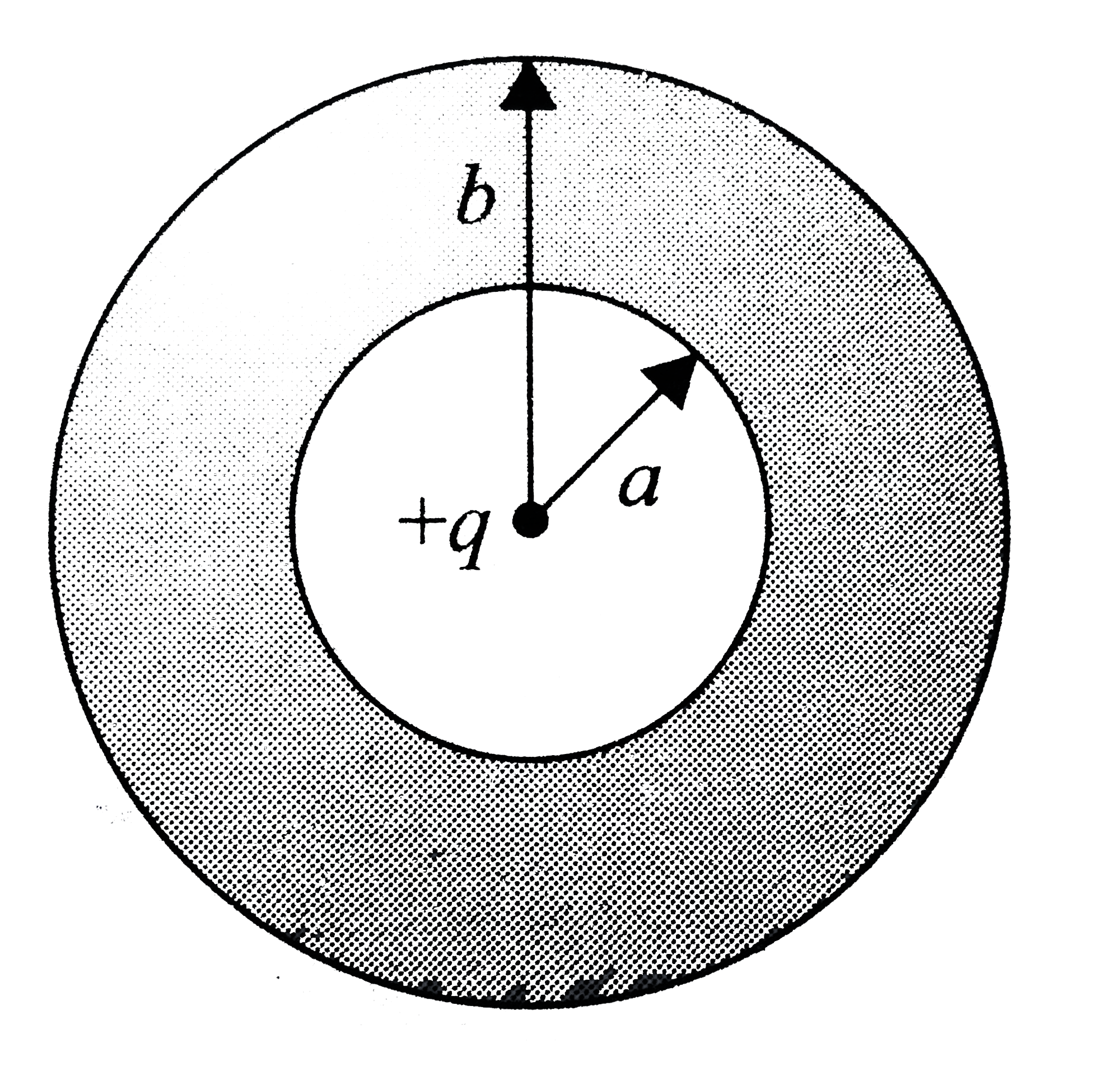
A hollow uncharged spherical conductor has inner radius A and outer radius b. A positive point charge +q is in the cavity at the center of the sphere (Fig. 3.48). Find the potential V( r) everywhere, assuming that `V = 0` at `r rarr oo`.
.

Text Solution

Verified by Experts

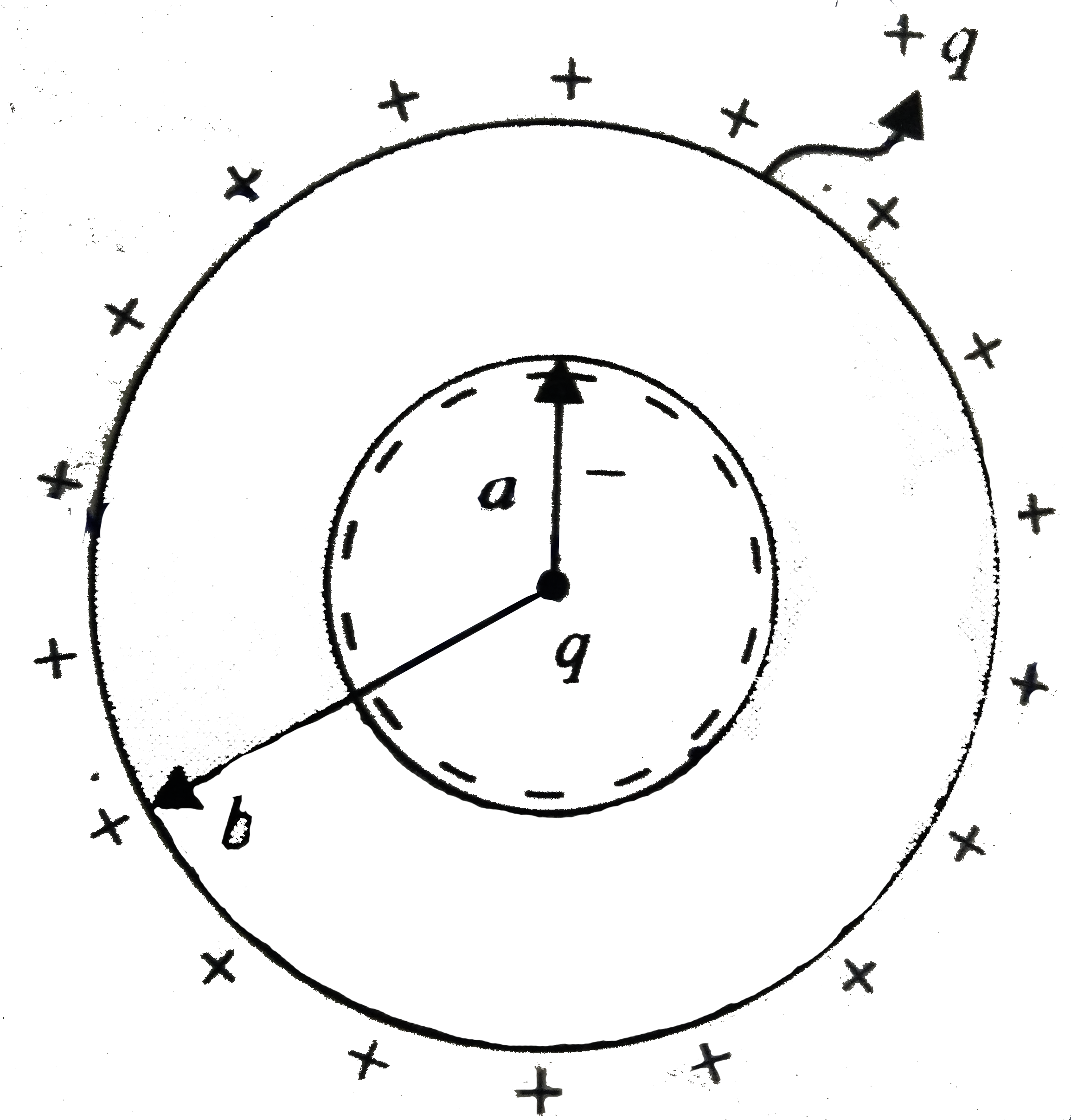
The conductor is an equipotential volume, so V is constant for `a le r le b`. The field lines inside the cavity must end on the inner surface of the cavity, so this surface has an induced charge `-q`. Since the shell is uncharged a positive charge `+q` is on the outer surface (Fig . 3.49).
.
The three charges q at the center, `-q` on the inner surface, and +q on the outer surface produce a field
`E_r = (1)/(4 pi epsilon_0) q/(r^2)`
for `r gt b`, so the potential for `r gt b` is
`V = (1)/(4 pi epsilon_0)q/( r)`
Outside the shell, `V(r)` is the same as that due to a point charge q at the origin. Choosing `V = 0` at `r = oo`, we have
`V (r )= (1)/(4pi epsilon_0) q/r, r ge b`
At r = b, the potential is `q// 4 pi epsilon_0 b, V`remains at this constant value throughtout the spherical shell from `r = b` to `r = a`, so
`V ( r) = (1)/(4 pi epsilon_0) q /b , a le r le b`
For any point inside the cavity `(r lt a)`
V ( r) = Electric potential due to q at center + Electric potential due charge distributed on spherical surface of radius a + Electric potential due to charge distributed on spherical surface of radius B. So
`V (r) =V_q + V_(a, "inside") + V _(b, "outside")`
=`(1)/(4 pi epsilon _0) q/(r) +(1)/(4 pi epsilon_0) ((-q))/a + (1)/(4 pi epsilon_0) q/b`
=`(1)/(4 pi epsilon_0) q/r + (1)/(4 pi epsilon_0) q/b - (1)/(4pi epsilon _0) q/a, r le a`
(Figure 3.50) shows the electric potential as a function of distance from the center of the cavity.
,
Promotional Banner

Topper's Solved these Questions

  • ELECTRIC POTENTIAL

    CENGAGE PHYSICS|Exercise Examples|9 Videos
  • ELECTRIC POTENTIAL

    CENGAGE PHYSICS|Exercise Exercise 3.1|23 Videos
  • ELECTRIC FLUX AND GAUSS LAW

    CENGAGE PHYSICS|Exercise MCQ s|38 Videos
  • ELECTRICAL MEASURING INSTRUMENTS

    CENGAGE PHYSICS|Exercise M.C.Q|2 Videos

Similar Questions

Explore conceptually related problems

A point charge q is placed inside a conducting spherical shell of inner radius 2 R and outer radius 3 R at a distance of R from the center of the shell. Find the electric potential at the center of the shell.

Inside a conducting hollow sphere of inner radius R_(1) and outer radius R_(2) , a point charge q is placed at a distance x from the center as shown in (Fig. 3.70.) Find. . (i) electric potential at C (ii) electric field and potential at a distance r from the center outside the shell.

A metallic spherical shell has an inner radius R_(1) and outer radius R_(2) . A charge is placed at the centre of the spherical cavity. The surface charge density on the inner surface is

A metal spherical shell has an inner radius R_(1) and outer radius R_(2) . A charge Q is placed at the center of the spherical cavity. What will be surface charge density on (i) the inner surface, and (ii) the outer surface ?

A point charge +q is placed at the centre of a conducting spherical shell of inner radius a and outer radius b. Find the charge appearing on the inner and outer surface of the shell.